Back
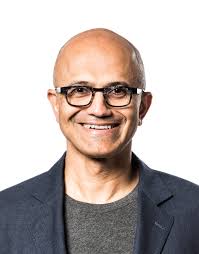
Satya Nadella
Chairman & Chief Executive Officer, Microsoft

In Partnership With Satya Nadella, Microsoft CEO | American Express

🎥 Jun 22, 2026 📺 American Express ⏱ 17m 👁 174 views
The conversation is part of American Express' “In Partnership With” series, where Chief Partner Officer, Glenda McNeal, discusses modern leadership topics with executives from the company’s expansive roster of strategic partners. » Subscribe to the Amex YouTube Channel: http://bit.ly/SubscribeAMEX About: American Express is a global service company, providing customers with exceptional access to charge and credit cards, insights and experiences that enrich lives and build business success. Get up close to the passionate lives of rising artists, a new wave of entrepreneurs, and everyday peop...
Watch on YouTube

About Satya Nadella

Satya Nadella, chairman and CEO of Microsoft, has been active in a series of public appearances over the past two months, including the company's Build 2026 developer conference, earnings calls, and interviews. At Build 2026, Nadella announced the Majorana 2 quantum computer, which he said provides a qubit mean lifetime of up to a minute and operations of one microsecond, and introduced the Surface RTX Spark Dev Box, a developer machine with one petaflop of AI compute. He also discussed a partnership with NVIDIA, including the RTX Spark system-on-chip and the Windows DGX Station, which he described as a "desktop data center." In conversations with NVIDIA CEO Jensen Huang and Qualcomm CEO Cristiano Amon, Nadella emphasized a shift toward an "agentic" computing ecosystem. In earnings calls and interviews, Nadella discussed the transition of Microsoft's business models from per-user to per-user and usage-based pricing, and said that IT budgets will be reshaped by business outcomes and reallocation from other line items. He stated that the company expects capital expenditures to increase to over $40 billion in the next quarter. In a conversation with The New York Times' Hard Fork podcast, Nadella said that "everyone is a stakeholder" in AI and that the industry must address public anxiety about the technology. He also said that the economy must be at the frontier of AI, not just a single firm or model. In an interview with American Express, Nadella discussed the importance of partnerships and said that a platform company is defined by the value created above the platform.

Source: AI-verified profile updated from Satya Nadella's recent appearances. Browse all interviews →

Transcript (25 segments)
G
Glenda McNeal0:13
Welcome, everyone. I'm Glenda McNeal, President of Enterprise Strategic Partnerships at American Express. I'm thrilled to continue the In Partnership with Series with Satya Nadella, Chairman and CEO of Microsoft. Satya, thanks so much for talking with me today.
S
Satya Nadella0:31
Thank you so much, Glenda, for the opportunity. It's a real pleasure to be with you.
G
Glenda McNeal0:35
Excellent. I want to start out with a couple of rapid-fire questions that Bing Chat suggested I ask you. Can you share a recent book that has influenced your thinking?
S
Satya Nadella0:45
I recently reread, Glenda, a book called Bootstrapping written by Thierry Bardini, I think if I get the author's name right. It was written in the early 2000s. I reread it recently because it's a book about computing and in particular about the work of Douglas Engelbart, who is very well known for being the person who first came up with the mouse, the keyboard, the graphical user interface. So, a big contributor to personal computing. And he's the one who really conceptualized this human-computer symbiosis, if you will, to augment human capability. And I felt like, in the age of co-pilots, it is good to go back to that first computer age and say, 'Well, essentially now this new generation of AI is really helping us take that vision to the next step.' And so, that's the book that has influenced a lot of my thinking in recent times.
G
Glenda McNeal1:45
Would you recommend that for a layman?
S
Satya Nadella1:48
Absolutely. It's actually a beautiful book. It has nothing to do with any technology. It's a human story of a person. In fact, one of the most inspiring parts is why did he choose his life's work, right? So, he went on this quest of saying, 'I want to make a choice.' He was an electrical engineer by training. He had many different options, and he chose this particular field of human-computer interaction because he felt that humanity needed new tools to deal with critical issues with urgency. And so, he chose this. And so, I think it's as much of a human story as a technical story.
G
Glenda McNeal2:25
That's great. Well, it sounds interesting. A lot of Microsoft products out there. Do you have a favorite one?
S
Satya Nadella2:30
That's always the hard one. I must say this Copilot. Even now we have something called Microsoft Copilot. It's kind of like my AI agent. And I use it, as I always say, for my travel and for my meeting prep. It's the one tool for anything. Copilot has become my go-to for lots and lots of tasks every day.
G
Glenda McNeal2:53
Well, it sounds as though it's getting a lot of attention. I know we talk about it here at American Express. So, we appreciate all the work and all the products. As you know, we are a big Microsoft customer. So, thank you very much for all the hard work that you and your team do together. So, let's talk a little bit about leadership. You started at Microsoft in 1992 as a software engineer, and you became CEO in 2014. When you took on the role, you focused on company culture. You said the team needed to rediscover the soul of Microsoft, your reason for being. What did you see at that time as the big opportunities, and what did you do to make people believe they could achieve the level of success that you have today?
S
Satya Nadella3:36
I think a lot about what keeps organizations like American Express or Microsoft or anyone relevant into the future because in some sense what happened in the past is in the past, and the question really is how do you renew yourself and stay relevant for our customers. And that I think comes from two sources, at least in my mind. One is a sense of purpose and mission, which helps with the company's ability and the people's ability to pick on things that add value. So, for example, in our case, we talk about our mission to empower every person and every organization on the planet to achieve more. And I feel that that has a lot to do with how we chose this design concept of Copilot. I don't think Copilot as a product would have gotten created if we didn't have the mission we have. So, therefore, one is going back constantly to your mission, reinterpreting that mission for today and tomorrow, not for the past. Obviously, technologies come and go. So, to be able to keep your mission constant, but technology and its expression in products and services fresh, I think is one side of it. The other side of it is culture, to your point, which is in order for us to do that, you have to have a learning culture. It's very hard to manage change and change in technology, change in business models, change in everything, pretty much, if you don't have a learning culture. And so, we emphasized internally this cultural meme, which has been very helpful to us, of growth mindset. In other words, going from being the know-it-alls to learn-it-alls. And quite frankly, right now, again, back in this age of AI, what happened in the cloud over a 15-year period, it seems to be happening now in a 5-year period. So, we now need to be the best learn-it-alls we can ever be. These would be the two things, Glenda, I would say: sense of purpose and mission, and reimagining that for what is possible today with new technology and new products and services, and then using our culture to give us that ability to pursue the mission.
G
Glenda McNeal5:47
One of the things I loved in going through your book, Hit Refresh, at the beginning you talk about empathy and how empathy played a key role in how you brought the team on board. And I think everything that you said kind of shrouded in this notion of being empathetic and understanding the reason for your being has been quite powerful. And you guys have achieved incredible success financially. You're on the cutting edge of tech advancements. And so clearly the path you set and the way you're leading today has made a huge difference. And so that's exciting to know and to understand. So thank you for that.
S
Satya Nadella6:29
No, absolutely. And I think sometimes people think of empathy as some sort of a soft skill that's nice to have, but it's not a critical skill. The way I think about it is it's a very important design skill that every business leader needs to have. Because at the end of the day we all have inherently as humans empathy for different things. Collectively we need to harness it to be able to have better insight, for example, into the unmet unarticulated needs of customers. That's at the end of the day American Express or Microsoft will be successful if we have that insight. Some people may call it design insight and skills. And I would submit that it comes from a deep sense of empathy for customer issues and customer opportunities. And so therefore I think it's not just a soft skill, but it's probably the hardest skill to learn and exercise in order to be able to be successful in business.
G
Glenda McNeal7:21
I completely agree. I think it's a critical leadership skill. So we agree on that. You changed Microsoft's mission, as you just said, to empower every person and every organization on the planet to achieve more. One of the ways you do that is through partnerships. And I can easily say that you and I have a shared belief that partnerships power success and American Express and Microsoft have a very long history of leveraging each other's products and partnering to innovate. When you think about Microsoft's mission to achieve more, what attributes differentiate your most successful partners? What do you look for?
S
Satya Nadella7:59
First of all, I'm so glad you brought up this entire thing about partnerships because I think at its core to our sense of purpose and mission of empowering every person and every organization, right there is the definition of partnerships because we will only be successful if our technology output can be parlayed by our partners into more higher value for their customers. When we work with American Express, it's that touchless expense or touch-free expense management system you build with some input from us, but you're building your own platforms, your own technology. Same thing, in fact, we're already fascinated to see how Bing Chat is being used in your customer service to be able to do better customer service responses and what have you. So, to me, that ability to take some output of ours to help our customers realize value in terms of them creating more value on top of our platform. One of the things I always think about: a platform company is a platform company only if the value above the platform is more than in the platform. That's as simple as that. Otherwise, the platform is unstable. And so, that's the approach we take when it comes to partnerships. And so, being able to have not just the technology, but the business model and a culture that reinforce it, I think, is one of the things that we seek to understand. Somebody said this to me: you can't say one thing and do something else. It has to be all congruous in how value gets created. And so, that's the approach we've taken.
G
Glenda McNeal9:38
Well, that's fantastic. And I think, you know, I lead the strategic partnership relationships at American Express and I think the amount of alignment around values, the ability to create trust between organizations and see the possibilities that you can work together to create incremental value in the marketplace can only be done through partnerships. And so, we value very much the relationship that we have with Microsoft and the alignment that we have on the value of partnerships is real. So, thank you for that.
S
Satya Nadella10:10
Yeah, it's very interesting. As I've been studying a little bit about even different companies, different companies are successful. Sometimes companies are successful by saying we only think about customers. If I think about Microsoft, we're a little more, I think we think of our customers as our partners. That's how I think we're a much more partner-focused. How do you construct more win-win? Don't think of everything as zero-sum. Otherwise, sometimes what happens is you have customers and suppliers. I think of everybody as a customer and a supplier, so therefore they're a partner. And when you think that way, then it becomes a very different approach.
G
Glenda McNeal10:47
I definitely agree. So, let's talk a little bit about technology, which I know is a real passion of yours. Microsoft is leading the way for what is shaping up to be one of the most significant waves of change in the history of the tech industry with the rise of generative AI. I don't know if when you first started to think about that, did you really believe that there would be all of this that's happening today? Would love to understand the role you think generative AI will play in shaping the future of business and how you see it shaping humanity, because I think it has an impact on humanity and people aren't always talking about that.
S
Satya Nadella11:28
No, you're absolutely right, Glenda. There's obviously a lot going on in terms of generative AI. I would say the first time I was able to get a real sense of what the shift is was with GitHub Copilot, right? When we started seeing our software engineers start using GPT-3.5 and inside of their coding workflow see the productivity gains, see even their ability to stay in the flow of their work. That's when I felt there was something new and big. And I would say there are two really new things that are happening. One is a much more natural user interface, which starts with language but goes beyond that. It can take images, it can take speech input, and also output images and speech. So there's going to be a much more natural user interface that will change pretty much every software category out there. And then the second thing is a new reasoning engine. Just like databases back in the day helped us with digital information, this new AI neural engine will help us make sense, like summarizations or continuation. So these are the two technological foundations. And they're being deployed even on American Express in customer service, in expense management, and broadly every software category is going to be changed. And I think one way to go about this perhaps for every organization is to get it broadly deployed. It reminds me a little bit like in the late '80s when the PCs first showed up. They changed workflow. We all remember before a word processor and after a word processor, before a spreadsheet and after a spreadsheet for those of us who were there at that time working. And so I think that's the same thing that's going to happen now, which is fundamental knowledge work workflow will change across every function and every business process, whether it's in marketing, sales, support, finance. And so that's an exciting time.
G
Glenda McNeal13:21
Well, what we've seen is that when technology advances and it's used appropriately, the world just changes. And I think to the point around how people and how this affects humanity, it's all around how this actually gets embraced and rolled out. And it sounds as though there's an opportunity to really have some fascinating opportunities going forward. So, looking forward to learning more.
S
Satya Nadella13:49
That's right. And then I think your point about the humanity part. That's why I love to describe even this age as the age of co-pilots. It's about humans having more agency and more capability with computers. It's not about autopilot. It's really about ultimately human judgment, human agency matters, and giving more tools.
G
Glenda McNeal14:11
You know, I was listening to a podcast recently, and there was a conversation around how quickly generative AI is accelerating. And it was fascinating to hear there are two sides to it. It's being accelerated because companies are investing in it because they see the possibilities, and humans are embracing it because they're excited about the change this can have. And so, I think there's more for us to learn and more for us to see, and the important thing is to be responsible around it. So, looking forward to seeing what happens next. We talked about empathy as kind of an under-served leadership skill. The other one is curiosity, in my opinion. And so, you have had all your life a passion for information and curiosity, specifically when it comes to technology and the impact it has on the world. It's been a through-line throughout your life. We both know curiosity is powerful. For me, it's all about wonder and questioning. So, as an agent for change, what do you consider as you continue to challenge what's possible? Because you've done that so much, and it's fascinating to watch. So, tell me a little bit about that.
S
Satya Nadella15:32
It's a great way to phrase it. Curiosity. Our CTO, Kevin Scott, recently said something which has stuck with me. He talks about whenever there are these new possibilities or new paradigm shifts, in our case with some new technology, it's when something hard is possible now. That's very exciting. That's fantastic. But when what was something that we considered impossible is possible, that's magical. That's what you should be curious about. What was something that was impossible that now can be made possible because of some new input or new human ingenuity. One of the areas I'm thinking a lot about with all this generative AI capability is take something like chemistry. When I think about energy and energy transition, fundamentally, what we are talking about is taking 250 years of chemistry and trying to compress it perhaps into 25 years, because we've got to synthesize some new compounds, new molecules, new materials, what have you. And so, if you take that as the challenge, then how do you apply both human ingenuity, curiosity, and this new tool and technology to go after that sort of impossibility and turning it into something that is possible.
G
Glenda McNeal16:57
You know, one of my favorite quotes is a quote by Nelson Mandela, and he said, 'It is impossible until it is done.' And so, I think you and the work that you and your team are doing is a perfect example of that. There's a lot of really great things to kind of stand on the sideline or be involved in as generative AI and technology continues to change the world. Thank you so much for a great conversation. I can't wait to see where Microsoft goes and where our partnerships go from here. It's been a real pleasure having this conversation with you, Satya.
S
Satya Nadella17:37
Thank you so much, Glenda, for the opportunity. It was a real pleasure and thank you so much for the partnership as well.
G
Glenda McNeal17:42
Absolutely. Have a great day.