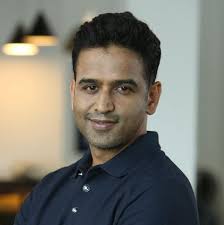
About Nithin Kamath
Nithin Kamath appeared in several videos in mid-2026 discussing business risk, personal routine, and Zerodha's referral program. In a July 2026 interview, Kamath said his primary job as a founder is to think about risk, stating, "If you want to win you have to bet and if you lose all your chips you can't bet." He described a personal tipping point in 2016-17 when he moved enough money out of the business to sustain his lifestyle into a bank fixed deposit, which he said changed how he thinks about risk. Kamath also mentioned that for the last three to four years, he spends the first two hours of his day on workouts, stretching, and yoga, and that he does not have much of a social life outside of work and home.
In a June 2026 video, Kamath discussed the history of Zerodha's referral program, noting that referrals were a growth lever from the company's early days and that an estimated 50-60% of customers may have come through referrals. He said the program was paused in 2024 due to SEBI regulations but was being restarted, partly because the business is "plateauing." In a May 2026 episode of a new series called "The Back Office," Kamath mentioned that Zerodha lost 50 crore rupees in one day due to a drop in gold and silver prices, and that half of the margin trading facility book is in non-FNO stocks, which he said he thinks about "quite a bit."
Source: AI-verified profile updated from Nithin Kamath's recent appearances.
Browse all interviews →
Transcript (22 segments)
N
Nithin Kamath0:00
What a founder needs to do all the time is to figure what is the differentiator. If you want to ask me what is my primary job, it's to think about the risk. If you want to win, you have to bet. If you lose all your chips, you can't bet. The tipping point in this journey was 2016-17.
N
Nithin Kamath0:19
When I took out some money that I think is enough to sustain my lifestyle out of business and put it as a bank fixed deposit.
I
Interviewer0:37
Nathan, thanks for doing this. Obviously you've been doing this with a few founders. So I'll ask you two simple questions basically to get people to think about some of these directions as they are building companies early on. The first question is around differentiation. We keep asking some of the startups we meet what differentiates them. Obviously there's no one-size-fits-all, but what do you think somebody who's younger starting up today should think about differentiating themselves as a business?
N
Nithin Kamath1:03
I don't want this to be sounding like advice, but what I can tell you is what worked for Zerodha.
Yeah. Back when we started, the first thing we didn't have tech, we didn't have money.
N
Nithin Kamath1:14
So we were going out there and saying come trade with us for a low cost. And because we didn't have money to advertise, we had to pay referral fees. You know, we created a referral model. So the first 3 to 5 years was spent with that as a differentiation. And luckily for us, back when we started, people didn't really think the pricing model would really work.
N
Nithin Kamath1:40
Right. Because brokers were really stuck in an offline way of working. Yeah. But they were online. So we kind of broke the mold and we said we'll be both online in the way we operate and the way we work also.
Yeah. Around 2015, once we got the tech, then it became about better products.
N
Nithin Kamath2:08
Right. And then around 2018-19 onwards, it became more about credibility and trust.
Correct. Because there are so many customers who are trading with us, and throughout the journey there had to be some kind of a differentiating factor for us to be able to sell it. I'm not saying that this is the only way to build it, because I think Groww has done it brilliantly. They went and advertised to customers saying we are much better, etc. So that's their way of differentiating, and our way of differentiating also works for us as a business because we didn't advertise, there was no cost of acquisition. So we didn't really have to push any customers to trade or anything of that sort. So I think what a founder needs to do all the time is to figure what is the differentiator.
I
Interviewer3:15
So what's interesting is you said there are different times where different things became differentiation. So for a founder or an entrepreneur, this is constantly evolving, I guess. On day one when you start, whatever is your mo can change in year three, year four. I mean it has to change, otherwise you know I was listening to 'The Innovator's Dilemma' the book. Otherwise there's no status quo in today's world, everyone's going to get disrupted. So the mo itself has to keep evolving over time. Correct. So the extension to that question is also risks, just like you mentioned. Everybody's prone to disruption, a lot of people wanting to take business away from people who are building smaller businesses. So today as Zerodha after 16 years, how much time do you spend thinking about risks to the business? Obviously we've spoken about this multiple times, but for younger founders, I think it's sometimes not obvious because when you're raising money, you've got enough money in the bank today for the next two years, you feel like everything is great, and at some point in time an event can happen that can ruin the business, right? So somebody, I think entrepreneurs have to constantly think about it and nobody tells them this very obviously. So how do you think about this on a daily basis? Is it a daily activity to think about this?
N
Nithin Kamath4:40
I think if you were to ask me what is my primary job, it's to think about the risk. Right from the day we started, because our business involves risk. Our customers are trading with more money than what they have with them. So I always demarcated 10% like a watch, saying that this much money is bound to go back. So that 10% has been that watch from day one of starting the business. For example, recently when gold suddenly dropped, we lost 50 crores on that day. Or crude oil when it went to negative, we lost like 30-40 crores on that day. So these incidents are going to happen to the business. So essentially, risk for us is priority. The most important priority for me is risk. But the whole point is if you have to work in a risky environment, you have to be willing to take the risk. There are people who are unwilling to take the risk, and it can't really work out that way. So you need to be adept at taking risk, but essentially ensure that the risk can't bring you down. There's a code that says if you want to win, you have to bet, and if you lose all your chips, you can't bet. So that's really the way I think about risk.
I
Interviewer6:25
Does it come naturally to you, this making peace with the worst case outcome?
N
Nithin Kamath6:30
No, I think for me, the tipping point in this journey was 2016-17. When I took out some money that I think is enough to sustain my lifestyle out of business and put it as a bank fixed deposit. And from that time onwards, the way I think about risk is very different than the way I was thinking before that. So as a business, 50% of capital is blocked for working capital, and 50% is divided across private, public, gold, etc. And out of that, for me the riskiest thing is the private one that we were investing in. So in my head, I've thought about 10% of the money of all our capital is in private. And the way I can make peace with it is by knowing that this private is something that can disappear anytime. And I think that's the right way to approach it. You basically ensure that your risk is divided, it's a portfolio, a basket of risk, so hopefully something works, something doesn't, and not everything goes bad at the same time. Absolutely.
I
Interviewer7:47
So last question. In terms of people who are building businesses today, I think it's a quite stressful environment. I think all of the founders we meet, you can sense the sense of pressure. So I'm sure all of them are probably not taking time out to just take care of themselves apart from fitness, which we all know you spend a lot of time on. What do you do to really keep yourself going? Because work is one part of your day. Before you come to work, after you go back, none of us really know what you do on a daily basis. So are there things that you do that you really enjoy which is outside of work that you can't go your day without? I mean for me, for the last 3-4 years, it's essentially the first two hours of the day. I get up at 5, and from 5:30 to 7:30 I spend on workouts and stretching and yoga and things like that.
N
Nithin Kamath8:42
That's really my time. If I don't get that time, I feel the rest of the day goes for a toss. So it's like that. And unfortunately or fortunately, I don't really have a social life. So I'm either here or in my house. There's nothing in between.
I
Interviewer9:06
Thank you so much. We'll do more of this. But these were the three questions.
Thanks. Oh, and by the way, if you're a startup founder, what is that one question keeping you up at night? Is it about your sales funnel or cracking distribution or something else entirely? Just fill out the form in the description and get your question answered on the startup blueprint. We'll see you soon.