Back
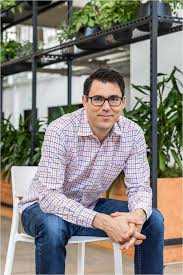
Robert Scaringe
Founder, CEO & Chairman of the Board, Rivian Automotive

Rivian founder & CEO RJ Scaringe on AI, robotics and the next big bet

🎥 Jul 14, 2026 📺 Behind the Business with Michelle Toh ⏱ 57m
Joining me this week is RJ Scaringe, founder & CEO of Rivian, the electric automaker backed by Amazon and Volkswagen.
Watch on YouTube

About Robert Scaringe

RJ Scaringe, founder and CEO of Rivian, has been promoting the company’s upcoming R2 electric SUV, which he described as a lower-priced vehicle starting at $45,000 that “captures and embodies what is Rivian.” At the 2026 Aspen Ideas Festival, he highlighted features such as a rear drop glass and said he hopes the R2 will “inspire more choices from other manufacturers” to help electrification reach 100% of new vehicle sales. Scaringe also discussed a $1.25 billion deal with Uber to deploy R2-based robo-taxis starting in 2028 in Miami and San Francisco, and a $5.8 billion software licensing agreement with Volkswagen Group. He stated that he began a robotics company called Mind Robotics last year, focused on human-like manufacturing robots, which has raised over $1 billion and plans to deploy its first robots at Rivian in early 2027. On earnings calls in 2025 and 2026, Scaringe noted that Rivian was increasing production capacity for its Georgia plant to 300,000 units annually, and described the company’s autonomy platform as a key focus. He also remarked that he believes “the biggest shift to transportation… is the shift to vehicles being able to drive themselves.”

Source: AI-verified profile updated from Robert Scaringe's recent appearances. Browse all interviews →

Transcript (93 segments)
I
Interviewer0:00
Every car company in the world has three choices. Today's guest is R.J. Scaringe, founder and CEO of Rivian, the automaker on a mission to make driving more adventurous, AI powered, and of course, all electric, rethinking the way we get around. Since being founded in 2009, Rivian has grown from a small startup into a major EV player, delivering tens of thousands of vehicles, winning backing from companies like Amazon and Ford, and raising billions of dollars, including in one of the largest IPOs in US history. Now, it's pushing into robo taxis, more affordable EVs, and even AI chips, teaming up with players like Uber and Volkswagen, and positioning itself as the company that can lead us into an AI defined future. How much of this is about reducing your own reliance on companies like Nvidia versus a bid to compete more broadly in the AI compute space? In this conversation, we'll get into the early days of building the brand.
R
Robert Scaringe0:56
I refinanced a house that I had and then my dad refinanced his house.
I
Interviewer1:00
Pivotal moments of growth and challenges.
R
Robert Scaringe1:02
The Rivian's business model doesn't work without our two. The goal is to make money. We have to make money so they can self-fund our significant growth.
I
Interviewer1:10
And what's next? The biggest shift to transportation, as big as electrification may seem, is not actually electrification. It's the shift to vehicles being able to drive themselves. R.J., thanks so much for joining us.
R
Robert Scaringe1:25
Thanks for having me.
I
Interviewer1:26
So, just to start off, you have described yourself as a lifelong car enthusiast. Take us back to your early years. Where did you grow up and what sparked your ambitions early on?
R
Robert Scaringe1:36
Yeah, I've been in the car since my earliest memory. It's hard to even say why. I think probably the freedom and the ability to explore and go places further than you might be able to walk at least in a reasonable time frame was what attracted me to it. But just enamored with it. The story behind every car is the amalgamation of thousands of people working together to make something, and it comes together in a vehicle. So there's the history, the stories. I grew up around cars, and as I got older, I worked on specifically Porsches, old air-cooled Porsches. Sometime along that journey when I was a kid, I decided I wanted to start a car company. Looking back, I'm a parent now. I have three kids. My oldest is 10, and I was about the age 10 when I told my dad I wanted to start a car company. It's really amazing how my dad responded to that because he was so supportive of both my enthusiasm for cars and this idea that I would eventually want to go start a company making cars. So, growing up, you always knew you wanted to be a founder. As a kid, you don't think of it as I'm going to be a founder. It was more like I want to build a car company. I doubt I even knew what an entrepreneur was. But it was from my earliest memories, it's always been in my head to go build a company.
I
Interviewer3:06
And this was in Florida. You grew up? Yeah. And I think I read that your dad, you were very close to him. He was a fellow engineer who built his own firm. Is that right?
R
Robert Scaringe3:14
Yep. Yep.
I
Interviewer3:16
How much did his example kind of play a role in especially in guiding you on the path that you set out on?
R
Robert Scaringe3:20
My dad's an engineer's engineer. He likes to build things. He understands how things work. He asked why. I learned a lot about parenting through seeing how he raised me, exposing me to learning new things, learning new skills, understanding how to put things together or take things apart. That was embedded in the way we lived. If the AC broke, we would fix it. If we needed to build something, we'd make it. So I had a really hands-on dad from an engineering point of view and a creation point of view. He wasn't as into cars as I was, so I don't know where that came from. I just always been so drawn to them. But also, being around him, seeing him build his business from an early age, I saw the process of him putting a company together.
I
Interviewer4:14
And did you always know EVs in particular or did that kind of come later?
R
Robert Scaringe4:18
It's a pretty complex journey. When I was a kid, it was like I wanted to start a car company as an enthusiast. As I got older, I realized cars were at the root of so many of society's biggest challenges. As that became more clear, I realized I wanted to work on finding a way to make cars better for the world. I didn't know what that meant. This was well before, in the '90s. I wanted to make them more efficient, but I didn't really know electrification versus other sources of propulsion.
I
Interviewer4:53
So how did that kind of specific interest really come about? Because it really propelled you forward, right? This passion, this singular passion later on to really get into the EV space.
R
Robert Scaringe5:05
Well, growing up, I really enjoyed the history of industry. Cars was one embodiment, but I loved reading about how it's pretty wild when you think about it. Our parents' parents' parents lived in a world without refrigerators. In just a couple of generations, we went from a world where we could not travel long distances, you could travel as far as a horse could walk in a day. You could not have goods and services from all over the world at your fingertips. It was very hard to get certain things if you didn't live close to them. And you certainly weren't making phone calls or doing all the things that are so natural to us. That was how humanity lived for thousands of years. Then in the last few generations, having strawberries in cold climates in the winter, hopping on a plane and 12 hours later being on the other side of the planet, sitting in a room like this with the lights on and air conditioned. These are all very recent things in human history. I was intrigued by that. I learned about it and studied it, and that drew me into transportation, the story of how these car companies were built and created. They inspired me so much as a kid that my hope was that I could make something that would inspire other people. I wanted to contribute to this thing that I saw as so powerful and remarkable in just a few generations.
I
Interviewer6:39
It's so true actually. Such a good point. There's so much that we take for granted today. When you really step back and think about it, it sounds like you had this conviction early on. You had the passion. But obviously going out and doing it is quite another thing. I read that Rivian truly started from a clean sheet, which means literally creating a new vehicle from scratch without relying on existing platforms, parts, or manufacturing from previous models. You have said, R.J., that there was no money, no team, no technology, no suppliers, no brand, and no production infrastructure. Why and how did you decide to go and do that? Maybe the hardest part is the no money part because you need to raise capital, you need technology, a product that's desirable, a brand that connects. In order to do all those things, you need capital, but when you have none, how can you show those things? It's a chicken and egg infinite loop. How do you start the business?
R
Robert Scaringe7:42
And so, for me, it was brute force. You start with nothing. You make a teeny little bit of progress enough to raise a very small amount of money, then you make a little more progress and raise a little more money. Slowly you start to build some momentum. Unlike where we are today, where capital markets are much more open to investing in hardware companies, when I started Rivian in 2009, the idea of going to a venture capitalist and saying I want to start a car company was foreign to them.
I
Interviewer8:13
Right, right, like after the recession or still feeling the recession.
R
Robert Scaringe8:17
GM had just gone through bankruptcy. Chrysler was going through bankruptcy. So the very idea of going and starting something, the meetings were comically bad. The questions would start: 'You're starting a car company. Tell us about the product.' 'Well, we haven't really defined the product yet.' 'What's the tech?' 'We have to go build that.' 'Who are your suppliers?' 'We don't have any of those yet.' By the end, you're like, yeah, the likelihood is very low. In starting any business, it's always hard to start a business where you're starting with zero momentum and you have to create momentum and engagement with investors, future employees, partners. But a hardware company, specifically a car company, is uniquely hard in that way.
I
Interviewer9:08
Absolutely. So how did you navigate that? Your story reminds me of another guest we had on, Jet Zero, the aviation company. The founder and CEO, Tom Liry, came on and said they literally started with post-its on a wall. That was it. Post-its on a wall, and you knock them down one at a time. I wonder if it was similar for you, or how did you tackle things from the beginning?
R
Robert Scaringe9:33
Yeah, I find the best entrepreneurs are the ones that have simultaneously a tremendous amount of optimism but balance it with reality and the ability to focus on removing risk. Taking a set of activities to reduce the risk of success. The work that goes into being optimistic but also finding steps you can take every day was for me, I was doing that and not fully appreciating the likelihood of getting to this point. It's like throwing a toothpick across the street into a straw on a windy day, very unlikely. Enough of the right things had to happen: the combination of fortune, good luck, the right person, the right thing, the right idea mixed with hard work. But I wasn't thinking 'one in a million chance.' It was more like 'what can I do today to make it more likely to be successful?' The laws of compounding, all those things you do day over day, start to add up over time.
I
Interviewer10:51
Do you remember like even one or two really early wins that just got you over that hump mentally and allowed you to keep going?
R
Robert Scaringe10:57
There weren't like early wins. It was such a gradual process. The first capital, just to make the point, I refinanced a house that I had and then my dad refinanced his house. That generated a grand total of a couple hundred thousand, which is comical to think that's the seed financing for a car company. But it was enough to make a little progress. Then we secured a really small amount of money, well under a million dollars of investment, and a little bit more. So it's just really hard. Imagine the early investors investing in a 26-year-old with no experience running a car company, no team, no tech. It's a very high-risk investment. A lot of those investments were built on some level of confidence in me as a person, saying, 'We don't know how this is going to go, but we think you have at least some slim chance of making something successful.'
I
Interviewer12:02
You know what? It's even more striking because I feel like sitting here today, I would have said you are so good at raising money, R.J. You have so many amazing partnerships, you won backing from Amazon. But I feel like it would be hard to imagine that it was ever difficult for you. Obviously people don't know the backstory and the blood, sweat, and tears. I'm curious, for those listening, is there anything you learned from those pitch meetings or anything you did to get yourself mentally in the zone that might help others today?
R
Robert Scaringe12:43
I mean, I'm sure everyone has a classic answer to this question: you have to be comfortable being told no a lot. It's a cliche answer, but it is particularly if the business is hard. If it's a hard business and not the popular topic to finance from venture capital, venture capital tends to move in categories. Car companies were not in the category of things venture capital was investing in. The number of meetings that ended with 'this is a really bad idea,' including well-respected people saying, 'RJ, you seem like a smart guy. Why waste your intelligence on this silly thing like starting a car company?' So you have people tell you that, and you'd be like, 'Okay, all right.'
I
Interviewer13:38
So demoralizing.
R
Robert Scaringe13:39
Yeah. So, but you just have to realize that the conviction you have and the confidence you have in what you're building needs to be independent of what other people say. But the hard part is you need to learn from all those. You need to find a way to learn to get a different response. Ultimately we raised a lot of money, and the story, the strategy, what we were selling in terms of our vision for the business had to evolve to be something that was investable. Some of that was slow brute force progress, but some of it was also learning how to tell the story. If you're an entrepreneur building a business, you quickly learn you have to be able to tell a story because you're describing a future state that doesn't yet exist. Unless you have capital from another source, you have to get other people's capital to go create that vision. Communicating the vision is really important to investors and equally important to employees.
You have to recruit people, so you have to say, 'Here's someone that has skill and talent, quit your job and come to this thing that's probably higher risk.' You have to be able to weave the story, the vision together. One of the things with storytelling and describing the mission or vision for a business, similar to teaching, if you can't describe why you're doing something, it probably means you don't really understand it. So forcing yourself to really understand why we deserve to exist as a company and being able to articulate that clearly to yourself is important. As a result, in building Rivian, there are lots of pivots and evolutions of the idea to arrive at a robust answer to that question. In the early days, it wasn't that robust. The answer can't be 'well, I wanted to do it since I was a kid.' That can't be my why. That may be the deeper motivation, but the reason the company deserves to exist has to be much bigger.
I
Interviewer15:45
So constant refinement of your message, that's really important.
R
Robert Scaringe15:49
And message is the manifestation of strategy, so it's the refinement of the strategy as well.
I
Interviewer15:54
So around 2018, Rivian secured major investments from companies like Ford and Amazon. I remember my colleagues talking about this at work. Amazon went on to place an order for 100,000 electric delivery vans, and it was reported that Jeff Bezos even flew to Michigan to come meet you and see the vehicles. For a lot of founders, these are dream encounters. How did these really come about and what do you remember about those conversations back then?
R
Robert Scaringe16:20
You know, something like Amazon investing and becoming a major partner, that was our dream. We wanted to have Amazon as an investor. We saw them as a really great partner. The company's extremely mission-oriented. When we look at the opportunity to have electrification have impact, we said, 'Boy, the commercial space is really interesting.' But preceding all that, there were lots of discussions and analysis internally to say, 'Can we deliver something that could be really compelling?' Now Amazon has the largest centrally managed electric fleet in the world, which are vehicles we built. You see them everywhere. It was a great discussion with Jeff. He's a big supporter and advocate for what we're doing.
I
Interviewer17:11
Yeah. A long time advocate now it seems.
R
Robert Scaringe17:13
Yeah. It's been a while. And in November 2018, Rivian debuted the first two vehicles, the R1T, an all-electric pickup, and the R1S, an all-electric SUV. How did you pick these two models to enter the market with? If you're launching a new company that's consumer-focused, one of the most important questions is what's the launch product, your handshake with the world. We spent a lot of time iterating on that. From the very beginning through 2018, we were debating and iterating. The initial product plan in 2009, 2010 was actually to start with a sports car, which sounds funny because it's not at all what Rivian's brand became. Brands are fabricated; you create them. Rivian didn't know what Rivian was at a point in time. Even in 2015, we were still figuring out our values, our aesthetic, the segments to focus on, what we want to enable in terms of consumer experience. We started to narrow in around 2014, 2015. I started to get much sharper around this idea of both enabling people to go do the kinds of things they want to take photographs of, the experiences you want to remember for years. But more important than the enabling was inspiring people to go do the kinds of things you want to have memories of for years to come.
When you pull that apart, if it's a vehicle that's going to inspire and enable you to go do things you want to take photographs of, it's going to fit the things you care about: your friends, family, pets, gear. When you look at vehicles that are platforms for life or adventure, the segments that naturally map to that are the SUV and the truck. They're designed to fit your life into them. They're the most ripe for a rethink. They're highly inefficient, narrow-focused in capability. They can fit a lot of stuff and maybe go off-road, but they're not refined. The question we started pulling at was: can we make the most efficient truck or SUV that's incredibly fun to drive on-road, the best vehicle off-road, something you can drive every day, fits all your gear, family-friendly, looks great and capable but not intimidating? Our launch vehicle had over 800 horsepower. How do you make an 800 horsepower look capable but not scary? That was the idea: launch with a flagship, our highest end product, then follow with mass market products. The strategy was flagship first, which was the sibling set R1T and R1S. Fortunately, they really connected with the market. The R1 is now the best-selling premium electric car in the United States by a significant degree, by far the market share leader.
I
Interviewer19:57
That looks good.
R
Robert Scaringe19:58
That looks
I
Interviewer20:00
Great and capable, but not intimidating.
R
Robert Scaringe20:01
So like our launch vehicle, the launch vehicle had over 800 horsepower. How do you make an 800 horsepower look capable but not scary? And um and so that was the idea. Launch with a flagship. So launch with our highest end product and then following that launch with our mass market products. And so the strategy was flagship first which was this sibling set the R1T the truck and the R1S the SUV which fortunately really connected with market. So the R1 is now the bestselling premium electric car sold in the United States by a pretty significant degree. So it's by far the market share leader.
I
Interviewer20:35
I saw a lot actually.
R
Robert Scaringe20:36
Yeah. which is really cool, but the size of the market for 90ish thousand vehicles is fairly small. And so that's where our mass market product comes in, which we're about to launch, which we call R2 quite creatively. And then there's a sibling product to R2, which we call R3. And so R2 and R3 are the like the much higher volume, much more mass market products but they still have all the essence of the brand embedded in them in terms of both enabling and inspiring adventure. Um and they still feel and drive like Rivians and they're just like amazing. The R2 which you know is about to start deliveries is just incredible. It's the best thing that Rivian has ever developed. It's very good. And so like we're just starting, we just had a like first batch of reviewers. Seeing all the positive feedback was really encouraging because it's been many years of time in the making and many learnings like R1 was something we learned a lot from to be able to apply all those learnings into a completely new architecture with R2 is really I mean it's just so much fun.
I
Interviewer21:43
Yeah, you probably were so excited to get that out there to the world finally, right? Well, I wasn't going to ask till later, but since we're on it, let's talk about the R2 because it's a big year for Rivian on a number of different fronts. Obviously with the R2 launching this spring, I heard you spent a lot of time in Normal, Illinois working on this. The R2 and the R3 are really seen as potential game changers for Rivian and the EV industry as a whole. What can you share so far about how plans for the wider rollout are going, and can you talk a little bit about how this is significant not just in terms of sales you anticipate but in advancing your longer term mission?
R
Robert Scaringe22:24
Yeah, well, it's helpful to ground this in context for the auto industry. In the United States, and this is actually true in most of the West, in Europe as well, the most popular segment is a five-passenger SUV. In the US, that represents about half of the demand for vehicles. Five-passenger two-row SUV or crossover. The average price of a new car in the US is just over $50,000. The US market is about 15 to 16 million cars sold per year, so it's a very large market. Europe's of similar size. In developing R2, we wanted to hit right into that market and deploy products and our brand in a way that was exciting and new. R2 is a five-passenger SUV, remarkable in its capability off-road, capable on-road, everyday usability. So call it like $45,000 to our top spec just over $57,000. It has very broad mass market appeal.
And the reason we think that's important for Rivian is it's going to grow our volume dramatically. It's an order of magnitude increase in our revenue and volume. But it also introduces to the market, I think for the first time, another choice of a highly compelling product in this price range. Today you really have one highly compelling choice, the Tesla Model Y, which is a great vehicle. But in order to see electrification scale beyond today's seven or eight percent market share, we need to have a lot of choices. Today the market is highly concentrated, with around 60% market share with Tesla Model 3 and Model Y. The market needs choice. In the internal combustion world, you have hundreds of choices. There are so few great choices at affordable prices at these $50,000 price points. I'm excited about what R2 represents to help expand electrification. For folks who maybe haven't had a form factor that fits their needs or a design that connects with what they're looking for, there's now a choice that's different. Ultimately, if we want electrification to happen, it requires choice. R2 is a choice, R3 is another choice, and you can imagine R4. Rivian is going to do everything we can to continue to create more choice, and we hope it inspires other companies to create choice as well.
I
Interviewer25:03
Yeah. So that's your contribution. And obviously you're so excited to get out there and put it out there. The R2 could essentially turn Rivian into a volume manufacturer to your point earlier as you ramp up production to turn these out at scale. What challenges have you been encountering or do you anticipate ahead? Are there specific manufacturing or supply chain hurdles unique to this process that you're spending a lot of time on?
R
Robert Scaringe25:26
Car is complex. Again, to ground this, when you see a vehicle, you see the finished surface. Even for me, when I was growing up, you'd think it's a small team of people putting this together. But to develop a car, there are tens of millions of engineering and design decisions necessary to execute a product. To do it in a reasonable time frame, a couple of years from scratch to complete car, you have many thousands of people working in parallel. That's the only way. The way we solve these really complex engineering problems, you have maybe five or six thousand people working in parallel. The reason that's important is that because there are so many people involved, a huge part of the effort is coordinating how decisions are made. You want the front of the car and the front trunk to feel like it was engineered by the same brain as the rear seat mechanism. Of course, they're not the same people. You want the team doing the drive unit to be connected to the team doing the software. So you create frameworks for how you make decisions. The success of any highly complex product like a car is ultimately a measure of how coordinated the teams are so that the decisioning feels consistent, so that it feels like a very small group of people did it.
Um, so that it feels like a very small group of people did it. That's what you want to present: it looks like 10 people designed this whole thing when in fact maybe 5,000 people worked on it. When you think about the number of decisions and engineering trade-offs and analyses necessary to complete the product, there are all types of development things that can go wrong. That's why we go through multiple iterations of prototypes and testing, to build hundreds of cars on the journey to the first saleable unit. That's largely controllable by us, meaning we have visibility to the health and status across thousands of different metrics on developing the product.
But then there are all the suppliers that make components. We make a lot of components ourselves. But take a headlight. We design the headlight, the lighting, the control systems. But a third party supplier makes it. That supplier has suppliers, tier two, tier three, etc. So when you look at the number of companies ultimately involved in making an R2, it's tens of thousands of companies. We have maybe 450 direct companies that we work with as our tier one suppliers. They all have anywhere from a handful to maybe 10 plus suppliers that feed them.
Have a handful to 10 plus. So just like really quickly becomes a huge number of companies involved and in stable supply chain environments, that's all right. So we don't have to spend time getting to know the mine that your raw material is coming out of. But in environments where the supply chain has lots of disruptions, suddenly you have to think about who's my tier four and who the tier four feeds a tier three that feeds a tier three that feeds tier one that feeds us. We experienced that first time when we launched R1. There are so many disruptions to the supply chain with CO that we had to get very skilled at understanding risk across all of our different tiers of supply. It's quite complex. And so the biggest risk with any program of this type is that you can't predict and you can't actually measure everything happening at every one of your suppliers. And this falls into big geopolitical challenges. So take a battery. Our batteries have nickel in them. 93% of the world's nickel comes from one country. It comes from Indonesia. Trade policy with Indonesia could have a dramatic impact on our ability to get nickel. And that's just one material in a battery. So extrapolate that out. There's a very large team that tracks these things and we had to learn all those skills. Those are skills you don't when you're starting a company you think I'm going to design an engineer. I don't think I'm going to build a team where we have mining expertise and we have shipping logistics expertise and we have people that are tracking shipping patterns in the ocean and seeing what's being disrupted by conflicts. I mean, the amount of complexity to manage all that is quite high and now we have all those capabilities. We built them, but I'd say that's the biggest risk is just supply chain disruption.
I
Interviewer30:20
Yeah, I can imagine that this is where you spend a lot of time and it almost sounds like a big command center, you know, like lots of different experts looking out and keeping tabs on whatever it is they're responsible for because the complexity is enormous.
R
Robert Scaringe30:31
Yeah. I think, you know, globally we often talk, I think it's easier to think about if you think about supply chains like this coffee cup, they're quite simple. Like there's probably one company that does everything on this coffee cup, right? Maybe two or three if you look at the raw materials. But developing complex products, the supply chains are not just dealing with coffee cups. So it's really complex supply chains and they're just very multifaceted and they do require you to be awake at all hours kind of thing.
I
Interviewer31:00
Obviously with EVs it's an interesting time to be in the space, let's say, right, because we saw the rollback of the federal EV tax credits and to your point, there's a lot going on with trade tensions and whatnot. How do you think about that? And has it changed the landscape for the industry fundamentally, do you think? Or do you think that Rivian is really just riding this out right now? It's short term. Who knows what could happen?
R
Robert Scaringe31:24
That's a good question. I don't think of it long term. In the fullness of time, all the policy changes aren't going to change the end state, which is the world's electrifying. Nearly every new car produced in the not too distant future, we could debate whether it's 5 years, 10 years, 20 years away, but certainly in my lifetime, every car produced on the planet, new car will be electric. And so then the question is what's the journey to get there? And if we believe that's what the end state will look like, what's the rate at which it gets there? And I think changes in policy, the biggest impact I've seen is just how much it's affecting other companies. And so the number of large existing manufacturers that have pulled back pretty rapidly from electrification in many ways underscores the importance of Rivian and a small number of other companies that remain focused on electrification creating choice. So from a competitive landscape point of view, there's going to be a lot less competition. If you look at from a health of the auto industry or from my kids' perspective in terms of the health of our planet or the health of the western auto industry, I think it's actually dangerous and we need more companies like Rivian, more companies like Tesla that are building electric vehicles, highly compelling, highly desirable. We hope that the example we set with R2 and we hope that its success will stir up more competition to have more people coming into the space.
I
Interviewer33:06
And interesting you point out, I understand you often say the reason you started the company is for our kids' kids. It's the age-old question, but how did becoming a public company change the way that you lead, R.J.? Especially when it comes to balancing Wall Street's short-term expectations with delivering on that long-term vision. I mean, this is something I feel like people constantly battle.
R
Robert Scaringe33:29
I think many founders when they start a business, I'm in this category, where your time scale that you're thinking about extends way beyond a quarter and even way beyond the fiscal year. And so you have a different mental model for making trade-offs. That's certainly true for me. A friend of mine once gave me the advice of be comfortable being misunderstood for a while. And what he was speaking to is we're investing heavily into technology. We're very vertically integrated. We design all of our electronics in house. We build all of our software in house. We build all of our power electronics and high voltage systems in house. And to do that we need a very large engineering team and therefore have a very large opex or R&D budget for it. And the reason we're doing that is because we're planning to become a very large company. Meaning, we expect to build many millions of units a year, but we're not yet. But in order to become a company that's building many millions of units a year, you need to have those technologies and to be world class in those areas. And so, as a result, our revenue doesn't keep up with our opex. And it will soon. It's not like this is an accident. This is highly planned. We very intentionally said we're going to raise a lot of money. We're going to deploy a lot of capital building all the infrastructure to have this highly vertically integrated business from a technology point of view and from a customer point of view. Meaning we own sales, service, distribution, all these go-to-market functions, which in the beginning are structural cost disadvantages because you have really high fixed cost and you don't have a lot of volume to cover it. But as soon as we get to a certain level of volume, it all starts to really make sense. And so that for us is all embodied in R2. As a company, managing the public markets, there are times where there's a lot of growth investment. And there are times where there's much more focus on short-term profitability. Rivian went public at a time when we're coming off the back of a lot of focus on growth. We then entered into a period of time where everything's been focused on much more short-term profitability. We didn't let that change our strategy. We didn't say, 'Okay, cancel all of our technology programs.' We are focused on still building a very large company. And so I have to explain that to public shareholders that sometimes don't fully appreciate the breadth of what we're building or the scale of what we're attempting to build. But that's okay. If you go into building a car company and being a public car company knowing you're going to be a little misunderstood for a while, you're going to have deep convictions on things and not everybody's going to share those convictions. I think that's a skill a lot of entrepreneurs pick up. It's certainly something I've learned and I'm very comfortable with lots of people disagreeing with me. If you're someone that is uncomfortable with people telling your ideas are wrong, being an entrepreneur is really hard. But if you're okay with people saying I don't agree with you and saying, 'Well, that's okay. You don't have to agree with me.' That's what you need when you're building large complex businesses.
I
Interviewer36:37
Yeah, you're able to shrug it off and it sounds like that's changing by the way with the profitability because obviously I did see your most recent earnings report. You guys had a great day with the stock there. I'm sure it was a good day.
R
Robert Scaringe36:48
Of course we have to be a profitable business. I say this with a smile, the goal is to make money. We have to make money so we can self-fund our significant growth. But the reality is to get to that point where we're designing for scale, there's a certain level of investment that we've had to make in the business.
I
Interviewer37:09
Is there a timetable just briefly, because I want to get to some of the other investments you've talked about. Is there a timetable you have in mind when it comes to steady profitability going forward? Because obviously you are still heavy in a lot of investments right now.
R
Robert Scaringe37:25
I think the balance is always balancing growth with profitability. Today we're obviously focused on growth on a journey to get to profitability given the scale of the business. With the mass market nature of R2 and R3, that trade-off becomes much less challenging. Meaning we start to generate enough revenue that even with a growth mindset investing in technology, the revenue offsets all that opex and generates positive free cash flow. That's getting to the escape velocity I think every hardware business thinks about and plans for. So we're hyperfocused on it.
I
Interviewer38:05
And obviously the R2 is meant to unlock that further. I mean, that's a huge part of the...
R
Robert Scaringe38:09
Rivian's business model doesn't work without R2. If there was no R2, we couldn't look the way we look. We couldn't have such a large engineering team. We couldn't have such a heavy engineering budget.
I
Interviewer38:19
I want to get your take on AI because in December, Rivian announced it had developed its very own AI chip, something extremely rare for an automaker. I know you were very excited to unveil this. Why take this on given the complexity required? It sounds like you had your hands full already. But obviously I'm mindful of the fact that in recent years a chip shortage exposed how fragile the supply chain can be. To your point earlier, is this a hedge against that? And how much of this is about reducing your own reliance on companies like Nvidia versus a bid to compete more broadly in the AI compute space?
R
Robert Scaringe38:52
Well, you're developing an in-house inference platform. It's not like something you wake up on a Sunday and say, 'Let's go do this and it's done in a week.' It's a big commitment. It's many hundreds of millions of dollars of time over years because you have to build a team, there's lots of iteration, you have to build a development environment around it. So it's a highly contemplated decision. The decision for us to bring our inference platform in house, we announced this is a very high performance chip. It's an 800 tops chip. We put two of them into a vehicle for 6900 sparse tops. So double that if you're talking about desktops, trillions of operations per second. The chip itself can process five billion pixels per second. So it's extremely high performance and it's optimized around vision based robotics. And the decision to do that was because we felt the most expensive part of a self-driving system, which is surprising and doesn't get enough attention, is not actually the perception. We often talk about cameras and radar and lidar and the different perception. All those elements have become fairly cost-effective. It's actually in the brain. And so we wanted to have a very cost-effective way to integrate very high levels of self-driving because we have very high levels of compute built into the vehicle. And it's built around a deeper thesis that the biggest shift to transportation, as big as electrification may seem, is not actually electrification. It's the shift to vehicles being able to drive themselves. We're at the very beginning of this. In terms of consumer vehicles today, there's what's called level two system. So it's where the vehicle, like in a Tesla FSD, can drive itself, but you still are paying attention to the road. A Waymo is level four. It can drive itself empty. It doesn't need a person in the driver's seat. But our view is that over the next few years, we're going to see every type of vehicle, whether it's owned or robo taxi, become something that should have level four capability, meaning it can drive itself empty. Now whether that's in two years or three years or four years you can debate, but certainly in the very near future. And so as we look at the remainder of this decade, we think consumer confidence in self-driving is going to grow a lot as they start to get exposure to early examples like Waymo. But by the time we get to 2030, 2031, there's two ways to look at this. Not having very high levels of capability in terms of self-driving will dramatically reduce market share. And the inverse is true. If you are among the small number of companies that have that capability, you can greatly expand market share, or you could sell the technology. You could do one of those two things. It is something that can be monetized through a few different paths. And so we made the decision that that's so important. If we believe we're convicted to being in the transportation space, we must have deep conviction here. It's a necessary element of how this space evolves. And so we invested heavily in it. To do self-driving you have to have a lot of ingredients. When we launched in 2021, we had a fairly off-the-shelf system. We used a Mobileye camera. We launched in 2024 an in-house system. We still use an Nvidia processor, but it was part of a broader effort to bring all of this in house. And so we have perception in house. Our camera platform is in house. The compute with our in-house processor comes in house with R2. And then the model, which is trained very different than how they've historically been built, but now it's built much more on a neural net type architecture. It's trained end to end. It's inspired from the transformer based encoding that we've seen be deployed in LLMs. So it's a very different style of building the model, the software side of this, and we're wildly bullish on what will happen with this over the next few years.
I
Interviewer42:57
Is the goal here to license or sell that out to other automakers or transportation providers long term and continue to grow beyond the traditional OEM?
R
Robert Scaringe43:05
I would say it's one of the major pathways to monetize, to have this make money. But I think we have to recognize there's a deeply held belief we have which is in time, if you're a vehicle manufacturer and you want to maintain market share, we think it's a must-have that you have these two things. The first is the vehicle needs a completely different software and electronic architecture than what has historically been in cars. So it's going from a world where, and this is true for every company with the exception of Tesla and Rivian, cars have many, many ECUs. Depending on the vehicle, call it anywhere from 75 to 150 electronic control units, little mini computers that run little islands of software that are supplied by suppliers. And all these ECUs are plugged together as part of a network architecture to essentially in aggregate deliver features in the vehicle. We could spend a lot of time on this, but for historical reasons, it grew out of the first ECU associated with fuel injection. And over time, like a field of weeds, all these ECUs started popping up as features within the vehicle started to become software defined. It's almost the precise opposite of what you would design if you're architecting a system. And if you're architecting a system, you design what you see in Rivian, which is a very small number of computers that do all the thinking in the vehicle. So more of this centralized computer zonal architecture. The reason that's so important is you don't want to have your software distributed across a hundred different companies on a hundred different little islands of code. You want to have one software codebase that you can do updates to and add features to. And so today what you see in all the legacy vehicles is this system of many ECUs and they're very hard to make software updates. You can do it but it's brute force. That's the reason you don't see a lot of over-the-air updates outside of a Rivian or Tesla. And so our view is that architecture is hard today. It's impossible in a world where you're imagining an AI enabled vehicle. And so I think every car, if it wants to maintain market share, will have to shift to this software defined architecture. So that's piece number one. But that's not necessarily binary. You can brute force your way for a bit, but then eventually it just becomes so archaic that it's hard to hire people to work in these development environments. That's number one. Second thing is it's inconceivable to us that you'll be able to maintain market share without high levels of autonomy when we get into that post late 2020s, early 2030s time frame. And that will become increasingly true. And so the reason I say all that is if we believe those two things to be true, every car company in the world has three choices. The first choice is they could decide to ignore that and shrink. So they could lose market share, which is a choice they may not explicitly make, but they may implicitly make by their actions. But it's important to note that that is a choice. They could decide to develop those technologies in house. That's very hard because for most car companies these are not skill sets that are embedded within the businesses. The way many car companies grew up, they grew up differently. They grew up as tech companies or software companies. So they don't have a lot of internal expertise around designing electronics, designing software, designing AI systems. Or third, they could go buy it from a third party. Our view is most companies are going to fall into the latter two categories. They'll try to do it themselves or they'll realize they don't have those capabilities and it would take too long to develop them and they'll decide to buy it. And so we think there's a pretty interesting business on both the software architecture, the software defined element of the vehicle, and then self-driving ultimately is going to be something we think most car companies are going to need to buy. And so that's a path to monetize those technologies. The other path of course is just market share, selling more vehicles. And so we're going to pursue both. And we did a deal with Volkswagen last year on the software defined aspect. We did a $5.8 billion software licensing deal to provide the ECUs and the software architecture and software platform for Volkswagen Group products. So it's like Audi, VW, there's a bunch of brands under.
I
Interviewer47:36
I think that's a very good example of an automaker that could use your expertise, by the way, and no shade to them. I'm just saying I think it's a perfect tie up.
R
Robert Scaringe47:43
Excuse me. Second largest car company in the world. Outstanding set of brands, but it's a really interesting partnership for us where we're able to deploy at scale our technology across different form factors, different price points, different markets.
I
Interviewer47:57
Another venture I recently learned about is Mind Robotics, a new company that you started last year. First off, genuinely, how the heck did you find time to do this? And second, tell us how this kind of came together and your strategic vision here.
R
Robert Scaringe48:11
We just talked a lot about AI. Vehicle autonomy is one form of AI in the physical world. We for a while have been convicted on AI manifesting in the physical world in many ways, but industrial robotics is another big enormous opportunity. And I live this every day with Rivian. We have a plant that employs lots of people to build our vehicles. And as we're thinking about scaling, there are real constraints on how many people are available to work in these plants. And I think a real opportunity to take a lot of these tasks, a lot of these jobs that are highly repetitive and can be quite challenging, and develop highly dexterous robotics that have reasoning capabilities. So to make a very long story short, we've been looking at this for a while. And last year, as you said, I started another company. And it took a little bit of time for myself along with Rivian's board to figure out how to structure that, because I'm the CEO and chairman of Rivian and I intend to stay the CEO and chairman of Rivian, and I wanted to start and run this other company. Where it stands today is it's enormously exciting. It's really at the point where we're about to see robotics in many different parts of the world and many different applications, but we think one of the biggest applications is industrial robots that are specifically designed to do manufacturing and to do humanlike skills in manufacturing.
I
Interviewer49:44
Well, so I previously covered business and tech out of Asia Pacific and we've seen a lot more of that as well over there, I think, especially with some of the factory applications and whatnot. I'm curious if you're taking any learnings from other regions as you continue to build out this new venture.
R
Robert Scaringe50:00
When we think about robotics and manufacturing, you could Google it and immediately see every car company in the world, every scale manufacturer, Rivian included, is using a lot of robotics as it is today. But these are very simple PLC controlled six-axis robots that are doing fixed motion plans with very specific end effectors. So they're not generalized robots. They're not doing humanlike skills. They can do things very fast and very repetitively. But when you introduce variation or when you introduce human decisioning, that type of robot really doesn't work well. And so the concept of doing robots that have humanlike capabilities or even humanlike form factors is something that's been around for a while. But it hasn't been until recently that the ability to create a brain for these, a model for these to operate with, has really facilitated the realistic deployment of these at scale. And so it's something we've been watching very closely. The way we're now creating these VLA models and these world models to describe how to behave in a plant with the benefit of lots of data feeding them is enormously exciting, but it's very new. This is not something that was around more than a couple of years ago. And I think precisely because of that, it gives me so much confidence that this is very realistic to deploy at scale. Rivian is a great first customer. By virtue of Rivian being a shareholder and Mind as a customer, it allows Mind to focus on scale deployment as opposed to demos. A lot of the robotics world for a while has been in this loop of lots of demos and lots of proof of concepts, but not like how do we deploy a hundred robots, how do we deploy a thousand robots.
I
Interviewer51:52
Lots of trade shows and whatnot.
R
Robert Scaringe51:53
So we're very focused on execution.
I
Interviewer51:55
Yeah. That you're building robots that will perform real tasks, real plans at real scale. What's like one example of that? What's something you really just want them to be able to get up and do?
R
Robert Scaringe52:04
So hard tasks are things like routing a wiring harness and plugging it in. Easy tasks, of which there are millions and millions across manufacturing globally, is something called pick and place. Taking a part, let's say in a box that's unsorted, like a box of parts, and placing it into a sorted shelf or into a fixture. And so it doesn't require enormous dexterity or manipulation. It's a relatively straightforward task, but it's one for which there's enough variation in the process that classical automation doesn't work for it. It's where we see lots of humans doing this type of work. Highly repetitive. In some cases, it can be quite tiresome or cumbersome. And so this is one of the very immediate things we can address with Mind. But when I think of the capability of Mind, it's not going to end at pick and place. It's going to include every type of manufacturing. So dealing with objects that can be manipulated. These are like soft goods, carpet, headliners, wiring harnesses, dealing with connectors that have force feedback when you plug them together. These are a lot of the skills we're both training against and then ultimately building the dexterity and the mechatronics to deliver on those tasks.
I
Interviewer53:24
And zooming out, R.J., what is your endgame here? Because you have your hands in so many different things. I'm just curious if we were to sit back down again in let's say 15, 20 years, where would you really want to be?
R
Robert Scaringe53:36
You think of the set of companies. So Rivian is obviously working very hard to help advance smart, connected, increasingly autonomous vehicles. And very soon, our view is that a modern vehicle should just be capable of driving itself. So it should be capable of going to the grocery store, picking up your stuff, dropping you at the airport. And we think that'll be, of course, in robo taxis, but importantly in just the car you own. Your car you own can be running tasks for you. And we're developing the technology to be operating at scale, producing many millions of units a year for that. To help on that journey, Mind was created to build the robotics to allow us to get the cost structure of these dramatically. And so if you look at the labor content that exists in a vehicle, not just in the vehicle assembly plant, but across its supply chain, it's quite high. And so allowing us to build really compelling products at a much lower price point is something that Mind is working towards. And Mind of course is designed to support all types of manufacturing. So building cars, microwaves, soft goods, clothing, everything we see is the surface area that we're working to address with Mind in manufacturing. And then there's a micromobility company that was a spin out from Rivian. And my goal there, the name of the company is Also, and the name sort of captures what its purpose is. It's built around this idea that Rivian is working very hard to electrify and create incredible products in the vehicle space, but we also need to rethink and electrify everything else, hence the name Also. So that's all these different form factors that are smaller than a car. In many parts of the world, our primary modes of transportation, in the US we're so used to it, but our primary mode of accessing personal transportation is a car. So there's over 700 cars per thousand people. That's two or three orders of magnitude more car ownership per person than what you have in most countries. And most countries are using two wheelers or three wheelers to get around. In some cases, quadricycles or four wheelers. Also is working to rethink that segment in a really meaningful way with both technology, connectivity, obviously electrification, and autonomy in these much smaller form factors.
I
Interviewer56:02
So stay tuned. That's an exciting one. I'm eager to see what you do with that. Thank you so much, R.J. Now, we're going to wrap with a quick rapid fire. All right. Okay. Don't overthink it. Just say whatever comes to mind. Ready? Go-to playlist in the car.
R
Robert Scaringe56:14
Go-to playlist? Uh, probably like electronic music.
I
Interviewer56:19
Peaceful. I would have like pictured like a country music star for you. Okay.
R
Robert Scaringe56:22
Country music.
I
Interviewer56:24
Tesla or Toyota? Who keeps you up at night as a competitor?
R
Robert Scaringe56:27
I wouldn't say we, I, you know, the classic line of focus on what you're executing, not looking to your left or your right.
I
Interviewer56:35
Favorite way to unwind after a long day?
R
Robert Scaringe56:37
Usually reading something, reading articles or...
I
Interviewer56:40
What do you like to ask when you're hiring?
R
Robert Scaringe56:41
Usually tie it to whatever the role is to a specific example challenge or problem to see how one would construct putting that together or solving it.
I
Interviewer56:53
One piece of advice you come back to often?
R
Robert Scaringe56:55
I'd say zoom out, take a step back and look at the full system.
I
Interviewer57:00
I love the simplicity of that, R.J. Thank you. I've enjoyed this.
R
Robert Scaringe57:03
Thank you.
I
Interviewer57:05
Thanks for joining us on Behind the Business. For more stories on business and leadership, follow us on Apple Podcasts, Spotify, YouTube, or wherever you get your podcasts. See you next week.