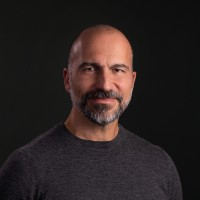
About Dara Khosrowshahi
In July 2026, Khosrowshahi announced Uber's $14.8 billion acquisition of Delivery Hero, describing the deal as "compelling value" that would expand Uber's delivery operations into nearly 50 new markets and bring its total delivery footprint to 99 markets. He stated that the company expects over $1 billion in synergies and that the effective price paid for the assets is eight times EBITDA. Khosrowshahi said that Uber's capital allocation strategy would prioritize organic growth, investment in autonomous technology, and stock buybacks, and that the company would remain "opportunistic" regarding future acquisitions.
Khosrowshahi has frequently discussed the future of autonomous transportation, stating that robotaxis are "coming" and that within five to ten years human and robot drivers will share the roads. He described the rise of physical AI, autonomous vehicles, and drones as "another trillion dollar marketplace" that will change how society operates. Khosrowshahi also noted that Uber's AI budget was exhausted within a quarter, forcing the company to meter headcount increases as engineers become more efficient. He emphasized that Uber's priority is organic investment and innovation over buybacks, and that the company aims to drive efficiency to lower prices for riders and increase earnings for drivers.
Source: AI-verified profile updated from Dara Khosrowshahi's recent appearances.
Browse all interviews →
Transcript (11 segments)
D
Dara Khosrowshahi0:31
Well, Delivery Hero is one of the largest delivery platforms in the world. We've known the company for some period of time. I've known Nicholas, the CEO, for some period of time, and we've always admired the assets that they put together. And the combination for us represents compelling value. It extends us in the delivery space into almost 50 new markets. That will be in 99 markets total with delivery. And what's really important are these are leading brands, Talabat and Hunger Station in the Middle East, leading brands, for example, in Korea is the leading player as well. And it increases by almost 50% the number of markets in which we operate both mobility and delivery together. That is our secret sauce, the power of the platform. It allows us to move mobility users to delivery and back and forth, and users who use the platform spend three times more than consumers who just use a single product. That's a unique advantage that we've got competitively, and Delivery Hero allows us to extend the number of markets in which we operate together.
I
Interviewer1:43
Is your expectation then to continue to operate these sort of sub-brands or to one day have them all be one? And how therefore does it work within the app? If the whole idea is to be on one platform.
D
Dara Khosrowshahi1:55
I think that the brands themselves are very strong, but we can essentially extend our technology platform globally so that underneath these sub-brands, you will have our technology platform that we invest billions of dollars on. And so that will allow us to bring in substantial synergies. We think over $1 billion in synergies, the effective price that we're paying for the assets with synergies after close is only eight times EBITDA. So we think we can create great economics. The brands themselves have very big growth prospects and cross-promoting Uber with these brands, we think is going to create compelling value.
I
Interviewer2:37
When you think about a deal like this, I'm sure you've thought to yourself, what would it take to really make massive inroads organically in these markets on your own? What would that cost? What would that cost to attract the restaurants and everybody who's going to have the product, what's it going to cost to create the marketplace for delivery workers and the like? Speak through that, the sort of delta there in your mind.
D
Dara Khosrowshahi3:04
Well, I think that the positions that Delivery Hero has built in these markets are almost priceless. At this point, it will be impossible for a player to start fresh and to build that kind of asset, which is why the asset was quite compelling for us. But for us, Andrew, it's not either or. We always have to be innovating to drive organic growth. We grew gross bookings 22% constant currency last quarter as well. So we're going to continue to build organically and acquisitions will be a part of our capital allocation strategy. We're going to keep buying back stock. We're going to keep investing in autonomous as well, which is an incredibly promising technology. And we will complement that with acquisitions like this one that are disciplined from a financial and operational standpoint.
B
Becky3:53
Hey, it's Becky. I was in a car the other day. I've been in a lot of cars recently. This guy drove for a car service company, but he also drove for Uber and for Lyft. And I was just asking him the differences, which one he thinks is best, which one he likes the best. He said Uber. And he said even though Lyft pays him more per ride, Uber is better not only because of the app, but more importantly, because when he gets somewhere and he needs to have a ride, he drops somebody off and he needs to have a return to take somebody back. There are always more people on the Uber app, and you can more quickly find and locate a driver. And I just thought, okay, this is a company that's going to pay you less. You still think they're the best. It just sounds like game over. It gets to what you were just talking about. With scale, you win.
D
Dara Khosrowshahi4:38
Well, Becky, that's exactly. First of all, I'm glad he gave that answer. And we're going to work on pay as well. But that's exactly the advantage of scale because of the number of consumers that we have constantly looking for rides, because we've got the greatest liquidity of drivers or in food in terms of restaurants and couriers as well, we are able to keep our partners, whether they are drivers, couriers, restaurants, super busy, earning a lot of money in a flexible way. And you add that all up. We're able to grow faster than competition, have higher profits, but it is because of the liquidity of the markets and the tech that we're building. So I'm really glad to hear that.
I
Interviewer5:18
Dara, on the regulatory front, you're going to be divesting a whole number of businesses as part of this deal. And I'm just curious what other kinds of, you know, who you think is going to ultimately have to approve this, what that process is going to look like. But even more broadly, as you're thinking about acquisitions going forward, how you think about doing deals here in the US, whether you think about, you know, we're all focused on this Paramount deal, all these state AGs getting involved in transactions. Now, obviously in Europe, it's just, you know, there's a smorgasbord of regulators that you're going to have to deal with and how you're thinking about that.
D
Dara Khosrowshahi5:54
Well, we're not divesting the assets and that is a separate transaction that Delivery Hero has entered with a private equity company, SSW, who plans to build those brands and continue to invest in them as well. So there are two separate transactions, so to speak. And obviously, you know, whenever you are going into M&A, you have to think about regulatory concerns, etc. But we think that this deal, we don't have any overlap with the assets that we're buying. And really the overlap is between our mobility business and the delivery business. But listen, regulation is a part of life. It's a part of the game. It's something that we take into consideration when we're building organically and or when we're looking to acquire companies. But we think this one doesn't have kind of like to like overlap. And the overlap for us is really the power of the platform. Getting over 50 million new customers, the opportunity to transact with us both on mobility and delivery, which is pretty cool.
I
Interviewer6:54
How do you think, though, about doing deals in the US in the future?
D
Dara Khosrowshahi6:58
Well, I think for us, priority number one is going to be organic growth and integrating this deal properly. So I don't think we're going to be looking for acquisitions. But listen, we are going to be always opportunistic. You know, the number one growth lever for us is organic. How do we innovate? How do we build? We're constantly