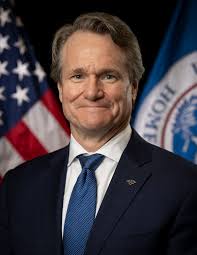
Brian Moynihan, chairman and CEO of Bank of America, coming up on 17 years. He got the job the year after the financial crisis started and led Bank of America out of the financial crisis. Bank of America not quite 250 years old, but its earliest legacy institution goes back 242 years. Now 212 people, 35 countries around the world. Just last week, BFA was a returnee on Time's best companies list. It's on people's companies that care list. Brian, who is a very loyal Brown graduate as chancellor of the Brown Corporation, the pride of Marriott, Ohio. Brian Moynihan, welcome to Axios.
Appreciate it. You have your fan band here. You can if you don't like them or kids don't like you can trade them on eBay for some money. So.
Yes, definitely take it to some.
You may need some revenue, Mike. So we'll work on that for you. But no, it's been a great thing. I went to the one in Boston the other day at the game. It was a four o'clock game and they had to cut the line at 2:45 to ensure that people could get into the game on time. So it's been fun to watch it play out and people have enjoyed it. So we'll get about two million, I think, at the end of the day. So it'll be good. So, Brian, we'll start with our World Cup theme, and you scoff at a lot of the surveys that we obsess about because you have real-time data from 70 million customers and clients. And something fascinating BFA discovered in their internal data that I saw in your update the other day was that World Cup host cities are seeing a real increase in credit card spending, debit card spending, retail spending, brick and mortar, restaurant and bar spending. What are you finding about the World Cup effect on host cities?
Well, that is a zoom in part of a zoom out story. And Brian, over the years that I've been privileged to interview you, you always talk about the resilience of the American economy. But now there's a real story of the resilience of the American consumer. And some of the data points that you were sharing with Hans and me backstage surprised me.
Because we know people don't feel good, but what are you seeing in your data?
So if you look at the broad-based consumer sentiment surveys, they say they're lows, etc. And you and your colleagues can tear them apart by political affiliation and all this stuff. But if you actually, I always say there's a say-do paradox. The question is, what are people actually doing? So in the first part of July, the American consumer has moved 6% plus more money in and out of their accounts in the economy. They did that in the first part of July, and that's going to buy cruises and going out to eat and things like that. So yes, prices move it around a little bit, but the second thing we're seeing which is encouraging is we're seeing income growth as paychecks come in to our consumers. We can see the direct deposit. We're seeing income growth for the lower third of household income generators. We were seeing that grow at the fastest rate. That's picked back up. It grew about 4% plus last month. That's good news because it had grown faster, it lagged, now it's growing and it's caught back up. So all income cohorts are growing together. That's good news. And then what they're spending on is indicative of them feeling decently pretty good about what's going on. Affordability is a real issue, and that's people saying, I worry about what I can do, housing costs, inflation, food inflation, gas prices. I'm not saying that's not a real issue, but what people are doing is still spending money. And that's good for the US economy in the broadest context because at the end of the day, about two-thirds of activity is generated off of what a consumer does. And unless that breaks, you're going to have a solidly growing economy. We have this year 2% plus.
And are people spending in new places or new ways?
It, the numbers are so big, say four billion dollars a month. So you see nuances, but it doesn't change dramatically. And so when gas prices go up, which is only about 6% of credit card and debit card spending, which is only 25% of the total spending, it's a small thing. When they go up, you see people spend a little more and you see some other things coming down. When people are feeling more or less confident, you'll see them spend a little less going out to eat, a little more at stores buying food. And you see those kinds of trade-offs. But the good news is, with the unemployment rate at 4.2% and population growth very low, the prospects for high unemployment in the United States are very low. And that's a good thing because that means people are employed by companies like ours, and we're paying them well, and other companies, my colleagues are doing it, and that's good news for America.
Axios has Erica Pandy. Fortunately Bank of America has Erica, your virtual financial assistant, who has helped 21 million clients. What have you learned about how people use AI? What people are willing to tolerate? What can we learn about the trajectory of AI based on your Erica learnings?
So a couple things. One which is instructive now is the quality of the AI models and stuff. Ten years ago or more, when we said we wanted to have a model that the customer could ask a question to and get an answer, we tried to use the then-existing search engines and we got answers that made no sense. 'What's my balance?' A picture of a scale, you know, things like that. So we said we had to build a model. So we went to Stanford and they built what we call today a small language model. Nobody would call it that. What was the key of that? The key was to sit there and say, as Erica opened up in 2018, there were 200 things you could ask it and it could get right. And I'll come back to that. Now there's 700 or 800, last quarter 200 million times it was used, and 20 million customers, you said. But what's the bridge? The lessons: the data has to be perfect because people won't tolerate a wrong answer when they're asking about their financial affairs. Other things you may tolerate a wrong answer — who's older, X or Y, Mike or me, may get it wrong, but life's not going to end because of that. But you won't tolerate a wrong answer about your financial affairs. So your data has to be perfect, the model rules then have to be perfect. They can't fantasize about what the answer is. And then you have to do it immediately with no latency. The person on the receiving end could be driving down the road with a cell phone with connectivity that's in this neighborhood, which I don't know is good, bad, or indifferent. Right? So people think this is so easy. All those things have to be in place. We spent $3 billion on our data to get it arrayed right for a whole set of reasons. That was a precursor to be able to entertain the idea you could use this stuff. Not to let you use it, just to entertain the idea. And so the growth of this will be unbelievable. We're seeing it. We have some use cases, 40 or so are active, and we put another one each week. It's across all the different aspects. We took the Erica model and put it into our tech break fix. So when you want to change your password or something, it's all done by that same technology. We put it into our cash management platform. Then we brought in agent force, we brought in stuff for the investment bankers and things. So there's a lot of stuff out there and we're pushing it ahead. But the lessons learned from the implementation area is: for the business we're in, you own the answer whether the model does or not. The data has to be perfect. The technology to manipulate the data in a set of deterministic rules have to be perfect, and they have to get an answer. There are other ways you can use it less deterministic, let it free form, but you have to have a human step in front and make sure the answer is right because it'll once in a while go off on a tangent. So we're trying to think, you work that hard. We use it in computer coding, 18,000 programmers are getting benefits out of it. We use it a lot of different ways in the company. But you had to start with this: data has to be right, the rules have to be right to either train the model on or put in a deterministic type model, and then you have to have the output available with a pace that the customer expects. That's actually harder than people think.
Brian, on AI, as I've talked with you and listened to you over the years, you're neither a doomsdayer nor a utopian. If I'm a CEO, if I lead an organization as many in our audience do, how should I think about how I train people, how I retain people? How do I think about the future when for the first time ever in our business lifetimes, you really can't forecast?
Right? Well, I think this is a people transformation of high order first, and then the technology second.
Wait, sorry, say that again. It's first a.
People transformation. You have to adopt it and use it. Our customers have to use it, our teammates have to use it, our technologists have to learn how to use it. So what we did is we learned lessons all the way back in the dotcom era where we had e-catalysts and stuff like that. We said, let's create an AI catalyst team. Let's put very talented people, but let's do something different. Let's go out and do listening sessions across the company. We did four or five thousand teammates sat in groups of 10 and told people what they were doing, heard about it, thought about it, and said, okay, give us your ideas. And it's a bottoms-up process about how to incorporate it and use it, with principles top-down on security and platforms and model management, not using high-powered models and all that stuff. But you really have to make it about the people. And then I think it's incumbent upon business management to also manage the retraining and movement of people. So in 2025, we had 14,000 people move from job A to job B at Bank of America. That retraining and reskilling going on inside our company will intensify as we find productivity in areas and then move people to other areas. And if we manage that well, then the human side of it can be handled better. And frankly, we are even participating with workforce development efforts, including the one recently called Raise Us by Gina and the former governor in Indiana, Eric Holcomb, to figure out how to take that kind of thought process and apply it in communities outside of companies that are big because we can do it because we have lots of people, lots of time, lots of thought to think about it. So I think you need to think about it from the teammates that are doing the work to the center, not the other way around. And once you start thinking about that, I think it'll be more effective and more transformational. I think the teammates will be harnessing it and empower themselves.
Brian, there were some grim forecasts about the effect on the early career workforce where my nieces and nephews are, or from early career white collar workers. What are you hearing from your biggest clients about what's actually happening?