Back
Jensen Huang
Co-Founder, Chief Executive Officer, President & Director, NVIDIA

Full Event: Nvidia CEO Jensen Huang Joins Japan's Landmark Physical AI Summit | DWS News | AI1F

🎥 Jul 16, 2026 📺 DWS News ⏱ 23m 👁 7155 views
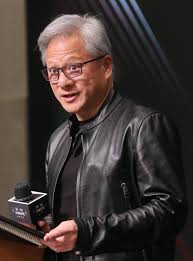
Nvidia CEO Jensen Huang joined Japan's top government and technology leaders at a major event promoting the country's Physical AI strategy. The gathering featured Economy Minister Ryosei Akazawa, SoftBank, Sony, AIST and other leading organizations as Japan unveiled its vision to accelerate AI innovation, robotics and next-generation industrial technology. For more details, watch our story and subscribe to our channel, DWS News. Live from Tokyo, Japan, as Nvidia CEO Jensen Huang delivers a keynote speech at an artificial intelligence policy event hosted by Japan's Ministry of Economy, Trade a...
Watch on YouTube

About Jensen Huang

Jensen Huang, CEO of Nvidia, has been active in promoting the expansion of AI infrastructure, particularly in Japan and the United States. In Tokyo, he announced a partnership with Japan's Ministry of Economy, Trade and Industry (METI) and Noetra Corp. to build what he described as Japan's first national AI infrastructure for "physical AI," stating that "Japan cannot outsource its national intelligence." He later returned to Japan to participate in a government-led AI strategy event alongside executives from Sony, Honda, and SoftBank, and also reunited with former SEGA president Shoichiro Irimajiri, crediting SEGA's $5 million investment from 30 years ago with saving Nvidia. In the U.S., Huang joined Coherent CEO Jim Anderson in Sherman, Texas, for a groundbreaking ceremony at a manufacturing facility, where he argued that AI is driving a "reindustrialization" of the country and called for the U.S. to become "pro-energy growth" to support AI's energy demands. Huang has also addressed the societal and economic impacts of AI in multiple interviews and public appearances. He stated that AI's impact will be "largely wonderful" but acknowledged the need for "new social norms" and careful regulation, comparing the transition to the advent of automobiles. He rejected claims that AI is reducing jobs, citing data that software code commits have nearly tripled and arguing that AI is increasing demand for software engineers. At Nvidia's annual shareholder meeting, he declared that "useful AI has arrived" and described the data center as an "AI factory of digital assistants." He also announced Nvidia's first foray into PC technology with a partnership with Microsoft, unveiling the RTX Spark superchip, and discussed the role of open agent systems and connectivity in AI infrastructure during appearances with LangChain and Marvell.

Source: AI-verified profile updated from Jensen Huang's recent appearances. Browse all interviews →

Transcript (19 segments)
P
Prime Minister0:14
I am the Prime Minister. I extend my heartfelt congratulations on the opening of the Frontier Project kickoff event. This event aims to advance the social implementation of physical AI, in which Japan has great potential, and to build the development platform. The core companies are Notre Dame, Honda, NEC, SoftBank, and Sony, and we have with us Jensen Huang, CEO of NVIDIA. I understand this is a kickoff event gathering major Japanese and American companies. Physical AI is essential for upgrading manufacturing in areas such as information and communications, defense, aerospace, and robotics, and manufacturing, logistics, and infrastructure where Japan has strengths. The important data accumulated on the ground will become a competitive advantage and a winning technology field for Japan. Based on Japan's strengths in manufacturing culture, passion for precision, and quality, it is important to gather Japan's wisdom and connect with global intelligence to create trustworthy AI from Japan. The Cabinet has set out a growth strategy and will accelerate strategic domestic investment based on a 17-field public-private investment labor map. For physical AI, we envision 80 trillion yen in public-private investment by fiscal 2040, including in robots, and the first step is the Frontier Project starting today to build a development platform for physical AI. While dependence on foreign entities for domestic AI development is a challenge, it is very encouraging that a domestic model development platform for physical AI will be built. Let us make the Frontier Project Japan's banner to create trustworthy physical AI here in Japan and launch it to the world. Thank you very much.
A
Announcer2:48
We have just presented the greeting from Prime Minister. Thank you, Prime Minister.
Next, Minister of Economy, Trade and Industry, Ryo Akazawa, will deliver a greeting. Minister Akazawa, please.
R
Ryo Akazawa3:33
Hello everyone. I am Minister of Economy, Trade and Industry, Ryo Akazawa. I feel there is more applause than usual. Today, I am very pleased that we can hold this event online and in person with many participants, and also welcome Jensen Huang, CEO of NVIDIA. I myself want to express my heartfelt welcome and respect to NVIDIA and CEO Huang, so I came here today wearing a Kawaii jacket. Now, in the era of big data multiplied by AI, the key to advancing AI transformation in various fields is on-site data. As I have been saying for about ten years, Japan's winning strategy in the era of big data multiplied by AI lies in being a super-aged society and disaster-prone country. There are more elderly and disasters than any other country, and that is big data. What looks like a crisis is actually a winning opportunity. I have repeatedly said this. Having experienced the Fukushima Daiichi nuclear accident, we have the only decommissioning site in the world. The conditions are extremely harsh. We need to make sensors and cameras work in high radiation environments. That is big data. Japan has the world's best manufacturing sites. Addressing issues like elderly healthcare, disaster response, and labor shortages in manufacturing, as well as the decommissioning of Fukushima Daiichi, by using on-site data and physical AI that works globally is important and will be a major driver of Japan's economic growth. We need to spread these efforts to local regions, connecting to local realization. It is important that all regions, companies, and people are involved. By connecting to a broad data infrastructure, we will build physical AI that can be used in various fields, and support AI transformation at each site. It is extremely important to make this physical AI ecosystem grow ahead of the world. It is a lifeline. By leveraging Japan's position as a developed country with many challenges, we want to take the lead in contributing to solving common global challenges such as aging and disaster response. The Frontier Project, which kicks off today, is at the core of the physical AI ecosystem. Its name comes from the initials of words meaning a reliable AI foundation that naturally understands the real world. By combining Japan's strengths in on-site technology and manufacturing with advanced AI R&D capabilities from domestic and international sources, we will build a reliable multimodal foundation model with high intelligence and the ability to understand the world. A new challenge begins, gathering excellent engineers from Japan and the world, organized by the consortium of Notre Dame and the National Institute of Advanced Industrial Science and Technology. I sincerely expect that the engineers leading this project will fully demonstrate their abilities. Learn cutting-edge technologies and needs, take on difficult challenges, and open the frontier of a world where humans and AI coexist. I warmly welcome diverse talents with such passion to join in the future. We will implement trustworthy physical AI in society, advance AI transformation throughout Japan, and contribute to solving various global challenges. Japan has been said to win in technology but lose in business, but we aim to win in both technology and business. I express my strong determination and conclude my greeting. Thank you.
A
Announcer8:05
Akazawa, thank you.
Now we will take time for a stage change. Please wait while we prepare.
Next, we will have a commemorative photo session. For the photo session, we have: Chairman of the New Energy and Industrial Technology Development Organization, Taro Saito; Vice President and Chief Operating Officer of the National Institute of Advanced Industrial Science and Technology, Kazuhiko Ishimura; Representative Executive Officer and CEO of Sony Group Corporation; Representative Director, President and CEO of SoftBank Corporation, Junichi Miyakawa; Representative Director, President and CEO of NEC Corporation, Takayuki Morita; Representative Director, President and CEO of Honda Motor Co., Ltd.; Representative Director, Chairman of Notre Dame, Nami Nami?; and NVIDIA founder and CEO, Jensen Huang.
And Minister Ryo Akazawa will participate.
Now we will have time for a photo session. Media representatives and photographers, please take photos from designated positions. Today's photo session will proceed in the following order: first, the center recording camera, followed by still photography by each media, and then video photography by the press. Time is limited, so we ask for your cooperation.
First, the recording camera will take photos. Please face the center camera.
Next, please look to the left from the speakers' perspective. Please look at the camera on your left. Thank you.
Next, please look to the right from the speakers' perspective. Please look at the camera on your right. Thank you.
Thank you. Media, that concludes the still photography. Next, we will have video photography. Please face the video camera at the front of the venue.
Is it okay? Is the left side okay? Okay.
Thank you, media. Video photography is complete. With this, the photo session is concluded. Thank you all for participating.
Now we will have a stage change. Please wait while we prepare.
Now, we will receive a message from the strong partner of this project, NVIDIA founder and CEO, Jensen Huang. Please.
J
Jensen Huang18:11
Hello. Minister Akazawa, nice to meet you. I'm so happy the two of us have a similar sense of style. Distinguished ministers, leaders from Notre Dame, industry, academia, and the Japan startup community, thank you. It is great to be here with you. Great to see Japan build Japan AI. Japan's industrial expertise is national intelligence, your national treasure. For more than a century, Japan has set the standard of excellence in modern manufacturing. Made in Japan means the highest quality, the highest precision. Takumi, kizenkan. Japan's generations of expertise in shipyards, factories, roads, hospitals, networks, and the people who operate them. That knowledge cannot be lost. Japan cannot outsource its national intelligence. Japan must own its own AI technology. And now physical AI has arrived. Years of work on physical AI, here the foundation of the next industrial revolution, and it will be made in Japan. Join the journey to build Japan AI. A new kind of infrastructure is needed. We are honored to partner with Notre Dame to build the world's first national AI infrastructure for physical AI. This is not the first time Japan has been first. Hamada-san at Nagasaki built a supercomputer from NVIDIA GPUs with fans for quantum chemistry, and at Titech built Subame, the first GPU supercomputer—the world's first GPU supercomputer. Japan saw that NVIDIA's GPUs could be a new kind of computer before anyone else. NVIDIA is honored to provide the computing systems for Japan's first national AI infrastructure. We will also provide the full-stack AI platform that makes this possible. Nemotron, the open frontier language models for agents; Cosmos, the world foundation model that is the backbone of physical AI; Omniverse and Isaac, the virtual worlds where robots learn before entering the real one. Across Japan, 44 enterprises are using NVIDIA open foundation models, taking them into Japan's factories, roads, hospitals, networks and homes. With Notre Dame, we will scale Japan's AI infrastructure to support every company, startup, and university. My personal hope is that Japan AI will serve all of Japan, from its great industrial companies to monozukuri factories, to AI small manufacturers, to teach new processes and pass craft to the next generation. Japan's industrial expertise is its national intelligence, your national treasure. Today, Japan's industrial expertise becomes Japan AI. Thank you very much.
A
Announcer23:04
Thank you.