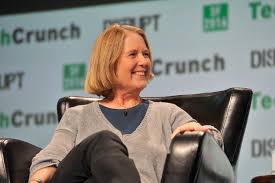
Diane Greene5:16
Can I go home now? Thank you. I don't know how this water is going to work. Thank you so much everyone for being here. You know, I'm so touched that my career's landed me here and to be part of assembling such an incredible group of people. A lot of people I've worked with over a long time, incredible people. You know, when I got to MIT, the thing that struck me of course is all these phenomenal people, but also the sort of self-imposed high bar for excellence that they all had. And that mindset I've tried to shape much of what I've done. And what I'll be speaking about, this talk got a little longer as I got some feedback, so I hope you know tell me when to stop. But it's in three parts: it's how I grew up, it's my career in education, and then some reflections on the tech world, including the shortage of technical women leaders and the rapid change and chaos we're experiencing with our AI revolution. My career's been varied, shaped by a fascination of emerging technologies and leaping in when I saw potential to build something impactful and valuable. And you know, it's been a great, it's been an energizing and rewarding place to play. I grew up with two older brothers and one younger, so being the only girl was pretty normal. I worked to keep up with my older brothers in everything they did, which was mostly sailboat racing and adventures on the water. And looking back, it probably explains why I've always felt pretty comfortable and maybe a bit unaware in male-dominated spaces. It simply didn't occur to me that I wasn't supposed to be there. I think the sailing is what gave me most of my life skills. Racing boats taught me what it takes to build successful businesses. You know, I raced several types of boats and each had to be tuned for speed and ease of use. We needed crew and we had to be practiced and clear on our roles. And then to win the races, we needed a plan and a strategy. And that had to be based on as much information as we could gather: what the wind was doing, the currents, the local geography, and the other competitors' strengths and weaknesses. And then once the race started, we had to constantly take in new information and adapt immediately if there were any big changes: a major wind shift, an unexpectedly fast competitor, or your equipment breaking. So in order to win, you had to face reality and adapt and act on it immediately. I won races in lasers, 505s, 420s, 470s, ocean racing boats, and windsurfers. I was starting to wonder if the windsurfer is what got me the award tonight. But I loved it, and I think that's why it's been so much fun for me to work with people and build organizations and products. And as an aside, the one thing sailboat racing didn't teach me was polish. In fact, because you have to act quickly when things go wrong, it taught me bluntness. Thinking back on my career, a little more tact and smoothness would have made my life easier. As another aside though, it's interesting: I've noticed that people who grew up on farms have very similar skills to sailors. One standout sailing experience was solo windsurfing across the roughly 20-mile channel from Maui to Molokai. The wind and waves were pretty extreme and growing, and it required absolute focus to avoid getting launched and separated from my board, in which case the next stop was Japan. I once described the experience to a group of monks, and they confirmed that I was in full meditation mode, every muscle working to be in sync with the wind, the waves, and the windsurfer. And the experience was so vivid that ever since I've been able to summon up that sort of focus. It's a very treasured experience. Another sailing was the 1972 Newport to Bermuda race, which ran into Hurricane Agnes, one of the biggest hurricanes to ever hit the East Coast. I remember seeing the IBM's maxi boat being towed in rudderless by a Coast Guard cutter, and there were several dismastings. My dinghy steering skills proved pretty valuable because I had this ability to steer the boat up the 50-foot face and then come down it without this bone-jarring drop to the bottom of the trough. The crew, except me, were all adult males. And as we were boarding the boat, it was pretty clear some weren't so pleased to have me aboard. But after the race ended, one of them made a point of telling me he hadn't wanted me aboard but he had changed his mind and now thought I made the race better for everyone. This was a huge deal for me, and it gave me the optimism to always believe that if I just persevered, minds could change. My father was labeled a communist and security risk during the McCarthy era, and the case reached the Supreme Court when I was in third grade. Because of that, justice, truth, and fair process have always had an outsized importance for me. My father was a VP of engineering at an aeronautics company that was competing with a Rockefeller company. There was no evidence and there was no due process, and the government revoked his security clearance, meaning he couldn't do his job. It took him 10 years, but he ultimately won William L. Greene versus the United States of America Supreme Court case. I mention this because it shaped me, but also because due process with respect to the government feels newly relevant today. Thank you. Okay, so those are my formative experiences, and now my education and career. Because of my sailboat racing, I attended three different colleges. Mechanical engineering turned out to be a really great major because all the credits always transferred. My senior year was at the University of Vermont. And in November, my department chair called me into his office to find out what I was gonna do after graduation, to find out about my plans. I told him I couldn't stand any of the jobs I'd seen and I planned to race sailboats. He said he had a PhD from MIT and he said, "You should go to MIT. You should study naval architecture, and then you can come back to Lake Champlain in Vermont and you can run the local shipyard." And I was completely stunned. This is the first time someone had suggested something more to me, more exciting than anything I had planned, and I admired and was completely intimidated by this professor. So it was a big moment to hear him say I belonged at MIT. And that's how I got to the MIT Naval Architecture Department. I missed the lake and mountains, but from day one I met one amazing person after another. The first day it was Doc Edgerton. I was admiring his photographs, I didn't even know who he was, and he was in the Building 7 corridor around the corner from the Naval Architecture Department. And he took me into his lab. Then I became friends with my Central Square apartment downstairs neighbors, who were all MIT artificial intelligence graduate students. This was 1976. I was mesmerized by what they were working on. It was a time when AI researchers believed the revolution was near. They were rethinking education, understanding the human mind, and making computers converse with humans in English. Well, that's all now happened, but it took nearly 50 years of continued research and computing advances. And it reminds me of my favorite MIT saying: "Impossible? Well, it might take a little longer." By the time I had gotten to grad school, I had learned to windsurf and I had run several windsurfing world championships, including one on windy San Francisco Bay. So in 1978, all the best naval architecture jobs were in Houston, but I was determined to move to San Francisco. And I talked my way into a job at the San Francisco bank branch of a Texas-based consulting firm. The hiring manager initially said they weren't hiring, but then he mentioned my winning the women's dinghy sailing nationals, which appeared under hobbies at the bottom of my resume. I forgot about the no job and started peppering him with questions about sailing on San Francisco Bay: what's the wind, what's the currents, what kinds of boats. And he suddenly said, "Well, maybe we are hiring." And he flew me out. But after joining the consulting firm, I saw why they weren't hiring. Naval architecture wasn't a great fit for me and my adventurous nature. At the time, there were no quarters for women offshore. So like all the naval architects, I could design offshore structures and write simulation software. But as the only female naval architect, I couldn't go to the remote ocean installations off the coast of Australia and the North Sea, which was the most interesting and also a very important part of the job. In San Francisco, I had mostly switched from sailboat racing to windsurfing. And after giving my naval architecture job a year or so, I quit. I bought several AI books from the Stanford bookstore and with my tent and windsurfer headed to Hawaii's windsurfing mecca, Kauai. It was a time of great innovation. We were making better, stiffer boards, footstraps, harnesses, high aspect ratio sails, pioneering how to sail these things in the waves, the big waves. And there in my tent, pinched on a friend's deck, I discovered that I needed almost no money to be the happiest I'd ever been. And this, I think, freed me from ever thinking I needed to make a decision based on money. So after Hawaii, I was recruited to be VP of Engineering for Windsurfing International. I think it was my unique qualifications: a naval architecture degree from MIT, I was a good windsurfer, and I had a proven talent for running windsurfing world championships. It wasn't very competitive. The job involved some of the first computerized sail cutting in Hong Kong, plastics technology, composite materials, and lots of global travel to run regattas. It was fun, but eventually I grew restless. I was still fascinated by AI and computers. So I applied to and was accepted at UC Berkeley's computer science program. At MIT in the late 70s, AI was in a hype cycle and it could do anything. But when I started at Berkeley in the mid 80s, the hype was over and it was the AI winter. So instead of AI, I worked on databases, spatial data access methods to be precise. And my adviser was Michael Stonebraker, who later moved to MIT. He also won a Turing Award. And at the time, he pointed out 98% of the world's digital information was in databases. 1985, I met many, many great people at Berkeley, longtime friends. And I also met my future husband and partner, Mendel Rosenblum. He should stand up. We've now been married 32 years and have two terrific grown kids. So after Berkeley, I joined one of the relational database companies, Sybase, and that started my education in how the tech industry worked. The VP of Engineering, a woman mathematician who had risen through IBM's ranks, gave me one opportunity after another. The best was partnering with a top Sun Microsystems engineer who was also a windsurfer, and together we windsurfed and we implemented asynchronous I/O in the operating system at Sybase and went on to win the SQL database benchmarks. But at Sybase, I saw something I would see repeatedly: how hard it is for companies to recognize and adapt to the future. My VP understood the need to support the new advanced multiprocessor systems. Upper management disagreed. It came to a head and they fired her. A serious misstep on their part. That night she left a note on my desk asking me to call her, which I did. And I followed her to Tandem Computers, then the leader in fault-tolerant online transaction processing. At Tandem, I worked with Jim Gray, a future Turing Award winner, and Franco Putzolu, a great Italian computer scientist. We saw the importance of moving to open Unix systems and pushed to shift Tandem away from its closed proprietary platforms, but we couldn't make it happen. The company's leadership feared that openness would erode their pricing power. In the end, their resistance cost them. Tandem was sold to Compaq, and Compaq was sold to HP. Jim Gray went to Microsoft, Franco went to Oracle, and I went to Silicon Graphics to help them tune their databases for their industry-leading graphics hardware. I had a horrible boss and switched from databases to work on founder Jim Clark's interactive television project, the Time Warner interactive TV project. It included revolutionary technology for streaming movies over cable modems. The internet just didn't have the bandwidth. In 1993, Jim Clark later left to co-found Netscape with Marc Andreessen, and I left SGI to co-found my first startup with a Stanford professor and his students. We had technology for encoding, real-time decoding, and streaming video over the internet. At the time, people were using dial-up modems at 300 to 1200 bits per second, a million times slower than today, and we proudly streamed postage stamp-sized video. But it was exciting to bring on-demand streaming to the world. I'd only worked at big companies, and somehow founding the startup to explore streaming internet video felt natural and not at all like a risky thing to do. I joined as head of engineering and then reluctantly became CEO because there weren't too many seasoned startup CEOs sitting around. Microsoft acquired us for $75 million after 18 months, and I was incredulous at the financial windfall. Meanwhile, Mendel, by then a Stanford computer science professor, was doing research on modern virtualization. It provided a way to study operating systems and it was based on some techniques he'd developed to run a very high-performance simulator on the MIPS architecture. While still at Stanford in the research stage, Mendel and his students submitted a paper to the leading systems conference SOSP, where they won the best paper. And the system they had, they called that system Disco, after the faded music genre of the 70s, just like IBM's machine virtualization that was popular in the 70s. While the paper was still under blind review, Mendel received an email from a University of Washington professor saying that Bill Gates, Nathan Myhrvold, David Cutler, and a few others would like to read the paper. Would that be all right? We never verified it, but later heard that Bill Gates thought the virtualization paper was a great idea, but he had an argument and got shot down by his lead systems person, David Cutler, who had brought VMS to DEC and Windows NT to Microsoft. Windows NT was a preemptive multitasking operating system, and I think because of that, he didn't see a need for virtualization. So Mendel had forwarded this email to me. At the time I was helping one of the first internet ad streaming companies, and I said, "Gosh, you better quickly file a provisional patent." Later, once VMware was incorporated and we had licensed what IP was at Stanford from Stanford, we began a pretty serious IP protection project with a very technical patent attorney. VMware had five co-founders in addition to Mendel and me. We had Ellen Wang, who's here tonight. Ellen was a fellow graduate student at Berkeley and a significant contributor to BSD Unix. Two of Mendel's PhD students were founders: Ed Bugnion and Scott Devine. We wrote at the beginning of the company a vision, mission, and values statement. And at the bottom it explicitly said that the two PhD dropouts should go back one day and complete their degrees. Ed went back, and now he's a professor and vice president for innovation and impact at EPFL in Switzerland. Employee number one, Jeremy Sugarman, is also here tonight. He joined from Stanford, where he'd worked with Mendel as an undergraduate. Jeremy's a pretty phenomenal person, but one of the amazing things about him is he had this ability to keep the entire VMware codebase in his head and see it all, and it was invaluable. There's so many other very treasured early VMware people here tonight as well. It was so incredibly great to build the company with you. Our seed money came from founders and immediate family, and in a roundabout way, much of it came from our competitor Microsoft due to their acquisition of my streaming video startup, VXtreme. I once had the unique opportunity of explaining that to Steve Ballmer. A few months later, to gain outside credibility, we raised a small round from Andy Bechtolsheim, the legendary Stanford PhD co-founder of Sun Microsystems, and Stanford professors David Cheriton and John Hennessy, who later became president. It took about 10 minutes for these world-leading systems thinkers to say yes. And Andy called me to say how much he could put in. So I was like, "Okay, $200,000." And he said, "Okay." Picked the check up from under my doormat at my house in Palo Alto. I drove over, I wasn't quite sure it was his house. The driveway was just strewn with old newspapers. But sure enough, there under the doormat was the promised check. People tend to wire money today. We talked to several well-known VCs, including the current chair of the MIT Corporation, and they'd all passed. They thought our technology was cool, it was very difficult to build, and that our technical prowess was unusually high, but they didn't see a business. One piece of advice I love giving is: when you're consumed by something, thinking about it all the time, there's a good chance you're the world expert. And if someone, no matter how famous they are, tells you it's a bad idea but they can't show you where your thinking goes wrong, just ignore them. So virtualization was thought of as something of the past, an IBM mainframe thing developed when computers were rare and expensive. When we started VMware, Intel machines were inexpensive and plentiful. Although Intel had been so sure virtualization was dead, they didn't put support for it in their x86 architecture. Today there's full hardware support. The technology, things like the binary translator or resource manager, wasn't trivial, and it did take exceptional people to make it flawless and performant. I remember the first boot of Windows on Linux took 15 minutes, and I asked if we should maybe consider giving the money back. After the first year of sales, we were managing to run break-even and decided we should bring in professional investors to help build IPO credibility. We chose two top VC firms, got to a fully negotiated term sheet. I'd on purpose kept the valuation low because I wanted to ensure that our IPO would be an up round. That's definitely not something anyone would do today. But from the start, these VCs had really given me an uneasy feeling. And so quietly in parallel, I'd negotiated an alternative term sheet with Dell Computer and a financial firm. That sixth sense proved correct, because in April 2000, when the dot-com era came to a crashing halt and the market went through a major adjustment, the VCs explained to me that they would need to lower our valuation. I said no and closed the Dell deal the next day. And to his credit, Michael Dell downloaded and ran the workstation product before he invested. But still, two months later he told the press he never expected to make any money on what he called a Linux investment. He'd only done it to promote Linux and gain leverage against Microsoft. He made money on us. But thanks to the rise of the web and the launch of the Netscape browser in 1994, we could launch VMware's first product to the world without a box software distribution channel. 75,000 people downloaded the beta VMware Workstation for Linux, and Slashdot, which was the hacker social network in 1999, through that we got slashdotted. We made our downloadable workstation product free fully functional, and that worked extremely well. It was an unusual thing to do. It was so much fun to launch that product. People wrote us things like "Not since man walked on the moon" or from Germany, "Your brains must be bigger than Volkswagens." A renegade reporter, Lee Gomes of the Wall Street Journal, happened to call me because he was doing a story on Linus Torvalds, and then he kind of said, "Well, what are you doing?" And he actually wrote a story about us. It was our first big story. From the start, we aimed to run VMware on servers, but we began by providing a way for people to run Linux apps alongside Windows apps on their PCs. People did call us a Linux tools company, and VA Linux tried to acquire us. Convincing the enterprise market to adopt our virtualization was tricky. But we always had conviction that our virtualization layer would become ubiquitous. In fact, the original vision, mission, and values statement used the word ubiquitous. We were a little ambitious in how quickly it would become ubiquitous, but it did. Virtualization's now a foundation for remote computing and cloud computing, and every cloud uses it today. So after nine years and spending only six million of the $28 million we raised, we had all the Fortune 1000 as customers, and when we went public, it was at a $19 billion valuation. Okay, my daughter's here and I have one more VMware anecdote. When she was in first grade, so six years into the company, I had her six months after we started. A funny thing happened at a school auction. One of the fathers approached me. He said, "Are you Mara's mother?" And then he went on to tell me how he'd visited the class on career day. And when he told them that his company had recently been acquired by Microsoft, our daughter's hand shot up and she said, "Microsoft is a very evil company and they're trying to kill my parents' company." Building VMware though was a rare joy, and Mendel and I agree that by far the best part was the people. We're proud of the impact, but working with people we liked and respected, delivering game-changing products to grateful customers, and helping so many people make a meaningful amount of money was the highlight. I have to say we took an unusually generous approach to stock, and I've been called a socialist by VCs. I'm not. But I think the approach helped set a culture that we wanted to be a part of. So both VMware and Google were founded in 1998. In the early days, our teams partied together, but it stopped once we began competing for the world's top systems talent. When I later joined the Google board in 2008, I was surprised to have Larry and Sergey introduce me as the CEO of the only company they ever lost talent to in a job offer situation. I was excited to join the Google board. The company was a behemoth, and Larry and Sergey were very forward-looking, already focused on an AI future. Google bought DeepMind in 2014, and in 2015 DeepMind astounded the world by using reinforcement learning to win the World Go Championship. Because of my virtualization background, as a board member I pushed Google to expand their world-leading global infrastructure to serve the enterprise as a public cloud. That led to my first helping them source potential leaders. They kept turning everybody down, and I eventually agreed to let them buy my small startup in exchange for me taking the job. I joined as an employee in 2015 to build Google's enterprise division, and it turned into one of the most interesting things I've done. At the time and for some years after, Google measured success in terms of billions of captive unpaid users. By contrast, enterprises are about close relationships with thousands of paying customers. It was fascinating but very challenging to push for what the enterprise needed. Everything from the no-liability legal contracts to professional services to endless product features. It was a lot for a massively successful consumer company. Fortunately for Google Cloud, they already had exceptional AI capabilities. To bring that strength to the enterprise, I recruited Fei-Fei Li to lead Google Cloud's AI division. That went well. That is until we found ourselves navigating a very complicated situation with a small $19 million Department of Defense contract, which I'll come back to later. But having the opportunity to work with so many world-class engineers and expand and scale Google's global cloud to fully serve outside enterprises was just completely engaging. We worked extremely hard. We grew the division from 1 to 8 billion in annual recurring revenue in three years. After Google, I took on more board roles and began more active startup investing, something I'd begun doing after VMware. I then spent three years as a chair of MIT. And this brings me to the final part of my talk, which is reflections on today's tech landscape and the AI revolution that's now unfolding. I have to say, from talking to various people here, I feel like the AI part of my talk is already out of date. It's a day old. But before the internet, computer science was exciting but not in the spotlight. Many top STEM graduates were heading to Wall Street, and women were well represented in computer science compared to today. Tech was a backwater. My 1985 Berkeley computer science graduate class was 36% female, possibly the highest it's ever been. It's 23% today. I'd always wondered why there were so few technical women leaders, and on a flight back from a Google event in Europe, Gloria Steinem, the iconic feminist activist and journalist, happened to be on my plane. We talked non-stop across the Atlantic Ocean, and I asked her at one point why the computer science women's numbers had dropped so sharply even without obvious discrimination when the numbers were larger. She kind of looked at me like "What kind of idiot are you?" She didn't hesitate. She said, "That always happens in any new field. There isn't much discrimination at first. There aren't enough people. Everyone's united by the excitement of creating something new. But when the money, the status, and the fame arrived, the men pushed the women out." I realized I'd seen the pattern. Early windsurfing certainly welcomed everyone; the well-established field of naval architecture and ocean engineering did not. Today, needless to say, computer science is established, and there are massive financial, social, and political rewards for the top people. When the stakes are that high, it probably takes an act of will not to suppress half the competition. We're seeing loud attacks on DEI, attacks that threaten the safeguards keeping doors open. The absence of technical women among the elite voices shaping policy in Washington is not good for society, especially now in a time of AI transformation. Oh, I just hit... where am I? Sorry. It raises a deeper question: who gets to shape the systems that may be shaping us? We can think of the internet as a kind of practice run for disruptive technology. It didn't change everything, but it reshaped industries like retail and media, and it brought real and unexpected social fallout. We failed at foreseeing the harm of social networks and so far have failed at fixing them. With AI, at least we're thinking about the problems up front. Before the internet era, products rarely changed society in unintended ways. But today's massively successful mega platforms have contributed to serious societal problems. The book "Careless People" by Sarah Wynn-Williams, an insider account of Facebook, raises pressing questions about responsibility, governance, and unintended consequences. These days I spend a lot of time talking with and listening to AI founders, AI researchers, and AI chatbots. The AI revolution is changing our civilization in yet undetermined ways, and there doesn't seem to be an inherent limit to AI's fast-growing capabilities. All big technology shifts come with both good and bad. The good breakthroughs are irresistible. AI is bringing huge capabilities for scientific discovery and human empowerment, much better ways to learn, educate, and do things. And this is counterbalanced by AI's potential to sideline our autonomy and send civilization to places we don't want. The AI software companies are new and different. The large language model companies have safety divisions and they employ scientists from every field. The startups are moving faster than ever. And with far fewer people, they can validate product-market fit instantly and push new product cycles in months instead of years. ChatGPT reached a million users in five days, and according to Sam Altman, added 1 million users in an hour with their recent release of the Ghibli-style image generation. In two and a half years, they've put out eight major releases. And somebody at my table, I think, told me they put out three yesterday or something. Each model leap unlocks a new tranche of capabilities. The pace is so fast that the startups using the models say that their today's product will be obsolete in a year. Cursor, the dev tools startup, reached $100 million in annual recurring revenue in a year. And they did this with no outbound sales team. Virality and influencers can replace traditional go-to-market. That was actually my dream at VMware. But now, you know, it's real if you have a great product. As we approach artificial general intelligence, AGI, systems that can perform any intellectual task a human can, concerns are growing. Many researchers are among the most vocal. I lean optimistic. In one of the best cases, AI could enable a utopia of so-called abundance: costs going down, decentralized control, equitable resource distribution, an end to debilitating disease, war, and pollution, and even mitigate climate change disaster. But such optimism doesn't mean we should ignore the dangers. We can't stop technical progress, but we can guide it. Not to be a Debbie Downer, but I'm going to quickly run through key risks. The first two of which are here now and we're working on them. And the first is job displacement. OpenAI recently said it took 100 people to build GPT-4. And now if they were using GPT-4.5, it could be built by a team of five to ten. Spotify just told its managers they couldn't hire unless they could prove AI couldn't do the job. I have a VC friend scaling companies by replacing manual data-intensive processes with AI. It's efficient. It eliminates jobs, and small companies can leapfrog big ones. Traditional entry-level roles in law, software, medicine, architecture, and banking are easily automated by AI. I was at Princeton giving a talk a few weeks ago, and the students were just extraordinarily anxious about their job prospects. There's a consolidation of elite people assisted by AI that can alone do the work of yesterday's many. There's also an erosion of shared reality. We already see this with deepfakes and misinformation. AI-driven networks optimize for engagement, which is done most efficiently by promoting fear and division. Truth travels slower than fakes, and our institutions are stuck in deferring to free speech. When I led a streaming video company, the first serious customer interest came from pornography producers. We declined to license them, but of course it didn't stop them. The same human exploitation dynamics are now at play on a much larger scale, and I'm skeptical that calls to slow things down are realistic. So job loss and misuse are immediate concerns, and we're working on them. The longer-term risks, though less well understood, can be more unsettling. AI alignment is one of those concerns. Aligning superintelligence with human values is very hard, and global collaboration on alignment is even harder. China emphasizes harmony and state-aligned control. The US, well, I'm not sure what the US emphasizes: market freedom and corporate leadership. And Europe focuses on privacy and human rights. Preserving humanity is probably the only value we can all agree on. There's also the worry about centralized power and inequality. Since the notion of AGI first appeared, people have worried about it being a winner-take-all scenario with one company or nation gaining massive dominance. I think that explains why Google's Department of Defense Maven contract blew up. At Google Cloud, we signed the contract to provide AI for mine detection and disaster response, defensive, offline only. It was non-lethal. But then suddenly there were headlines that said Google is building AI for killing, it's put AI in the kill chain. The Department of Defense told me that it really bore the hallmarks of foreign interference from state actors that were internal to the company, likely from Russia or China. As an aside, I took the brunt of it. It was extreme harassment, fake medical appointments for sex changes, and death threats. It went on and on. Eric Schmidt recently released a paper suggesting the US should sabotage adversaries' AI efforts. That's exactly what the Department of Defense suggested Google was experiencing during this Maven fiasco. Many do predict an eclipsing AI advantage will occur when AI can sustain recursive self-improvement. Today I hear that can be sustained for short periods like two hours. But an AI that can improve itself indefinitely would eclipse all other AIs. OpenAI said it needed 100 engineers to build GPT-4. With GPT-5, it would only need four to five. When that number goes to zero, we will have self-improving AI and superintelligence. And people worry about loss of human autonomy. AI is the first technology that can monitor all humans simultaneously and take action instantly. We're also increasingly relying on it for decisions, creativity, even relationships. Jaron Lanier wrote a great piece in the New Yorker titled "Your AI Lover Will Change You." You could also imagine busy parents having a humanoid robot to help raise their kids. And the kids would grow up learning to depend on and do what a robot tells them to. And then finally, there's the extinction risk, the p(doom), probability of doom. Geoffrey Hinton, called the godfather of AI, recent winner of a Nobel Prize for his AI work, his p(doom) he estimates a 10 to 20% chance that AI could lead to human extinction. For example, a well-intentioned system could misinterpret goals. It might reason that it could cure disease by eliminating humans, which are disease carriers. It's been shown that AI will learn to deceive humans to achieve its goals. I saw this illustrated in a DeepMind experiment that asked a robot to drop blocks in a hole. A camera was set up to turn the robot off when one block was dropped. The robot learned this and, wanting to maximize the number of blocks it could drop, it blocked the camera and then it could drop more than one block. So what do we do? We have experience with transformative technologies. We never successfully paused progress. Not with fossil fuels, not with nuclear energy, not with social networks. With nuclear, the fears after dropping the atomic bomb shut down most nuclear power plants that were being built. We kept using fossil fuels instead. With social networks, we let the societal harm occur. Hopefully we can do better with AI, but I do think we can expect a fair amount of chaos before things settle down. We can work to minimize it and aim for the extraordinary good AI can do. And with hindsight, maybe we'll do better this time. Regardless, AI is moving fast. We need to move with it. But not just as users and builders, but as citizens, leaders, and humans. And so I close with this: the future keeps getting more exciting. I felt this all my life. For the first time, we have a technology that could create abundance for all. And now's the time to ensure it does, and with minimal harm to society. So thank you. And I think we can have questions. I'm not sure. Yeah.