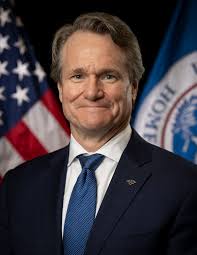
About Brian Moynihan
Bank of America chairman and CEO Brian Moynihan has been discussing the state of the U.S. economy and the bank’s investments in technology and sports sponsorship. Moynihan said that Bank of America’s research team projects 2026 U.S. GDP growth of about 2.2% and global growth of around 3%, noting that growth forecasts have been slowed by the war in the Middle East and resulting higher gas prices. He described the consumer as resilient, pointing to aggregate spending growth of roughly 5% year-over-year on debit and credit cards, while also acknowledging affordability challenges in housing and food. Moynihan stated that the bank plans to hire 4,000 campus recruits, including interns, and said he does not believe artificial intelligence is a threat to jobs, describing it as a tool that employees should learn to harness.
Moynihan has been a proponent of the bank’s “Sports With Us” program and its sponsorship of FIFA World Cup events, and he announced that Bank of America gave $2 million to buy tickets for veterans and first responders through the organization Vet Tix. On technology spending, Moynihan said Bank of America spends $13 billion annually on technology, with $350 million allocated to AI-related initiatives in 2026, and stated that the market has absorbed this spending “smoothly so far.” He has also cited the aftermath of the financial crisis as the most challenging period of his leadership, emphasizing that the bank’s approach has been to run the company independently of regulatory sentiment. Moynihan described his hoped-for legacy as “capitalism done right.”
Source: AI-verified profile updated from Brian Moynihan's recent appearances.
Browse all interviews →
Transcript (16 segments)
J
Jim Cramer0:00
So let me start with one of the favorite questions I have for you, because you at Bank of America have a window into so much of America, consumers and businesses of all sizes. You sure have a sense of where the pulse of America is. There's been a lot of changes announced and talked about in Washington. Do you see from your customers much reaction to that, either to the talk of tariffs or the one big beautiful bill to consumers or business? Are they changing their plans because of that?
B
Brian Moynihan0:23
So if you look on the consumer side, in our 70 million consumers who engage with the economy every day and they send through their accounts and their spend in cash at about 4 trillion. $5 trillion a year that grew a 4% plus the second quarter, 25 of the second 24. So they because they're employed and because of wage growth and that's not every single consumer it's but in the large in the main they are continuing to grow and spend more and that's helps the economy. And so you're seeing in some of the moderate income households, there's a little bit of shuffle moving around to different things. You're seeing people trade from one thing to another, less planes, more cruises earlier. That's leveling out now. A lot more go into movies because the movies are good. But the other day they're spending discretionary necessarily about the same percentage they traditionally spend. They've got money in accounts, they're employed, and a wage growth has been relatively strong. And, you know, so they're in pretty good shape. But credit quality is good. They have equity in their homes, rate financing the mortgage. So consumers pretty good. When you go to small businesses, that's more the question, small, medium sized businesses, because the interest rate environment hits them harder because they borrow on lines of credit short term for a lot of their activities at that rate went up substantially. And then you think about the if I'm a $100 million company, a $50 million company here in North Carolina, and I'm engaging in the world of finance, I'm importing goods and manufacturing and further manufacturing. I'm selling them. You know, it got pretty interesting here trying to figure out all the trade and tariffs. So I think the certainty on a tax rate helps them. Meaning the big, beautiful bill passing in the tax rate, that's a very good thing. The alternative would not been good if their tax rates would change. A satisfactory resolution to the trade so that they could learn the rules of the road over the next 30, 60, 90 days and get their plans for next year put together. And I think ultimately they're going after a satisfactory resolution on immigration and population growth because and what I'm hearing more from construction companies, farming companies and travel entertainment type companies is I'm starting to worry about I'm I'm starting to struggle with labor availability at any price. And that's not that we've got to make sure they have the workers because they will supply a great service economy continue to grow.
J
Jim Cramer2:40
One of the things you reported today was net interest income, which is really important to all banks, but particularly Bank of America, and just steady growth that you're showing in that. How sensitive are you to the rates set by the Fed is that comes down substantially? Does that affect Bank of America much?
B
Brian Moynihan2:59
So embedded in our estimate. So we we've told the world that this quarter we had $14.8 billion in net interest income and that is the fourth straight quarter of growth and came off the floor last year. This quarter when I was talking to you was the lowest it's been. This quarter was a record in the company's history and we're saying we're going to grow from that record to 15, 5 to 15 seven in two more quarters. So third quarter in the fourth quarter that embeds in it the rate cuts in the market that are expected by market. We don't we only show it that way if you have rate cuts over above that, that would hurt that number. But it was still growth, frankly. And so and that's the good thing about that is because of great loan deposit growth, 7% loan growth, 4% deposit growth over the last year, that's in the system that's capitalized it. I mean, that's here. It doesn't go away. It is that continues to stay. And we add to it. What you're starting to see is that sets us up great for next year for further and I growth and further EPS growth. So this quarter was the trickiest quarter to get through because you have a year. We finally got some added growth, but year over year the markets business doing strong expense growth is a little more robust that I'll get line in and you'll see and I dropped a bottom line and it will set up for 2026.
J
Jim Cramer4:08
We did have more growth when you talk about 2026, one of the things we're going to have is an all like a new Fed chair. There's been a lot of talk even today in Washington about the Fed chair and you said you believe in an independent Fed. But if in fact, President Trump gets his wish as his his right under law to appoint a new chair who will be more in line with his views, he said he thinks the interest rate at 1% or even below that, is that good for Bank of America? Is that good for the economy?
B
Brian Moynihan4:37
Well, let me make two things. One is you're absolutely right. In May of next year, the term the Fed chair ends after being reappointed. And it's the right of the elected president to appoint the next successor and go through Congress. And I think in that dialogue around that, there'll be a lot of dialogue about, okay, how do you set interest rates? What do you think about interest rates? Because the Fed is an independent agency and they're meant to be outside the purview of the executive and the Congress. They are called to task and they're monitored and reviewed and all the things. But the reality was is set up to be independent so that our Central Bank of America was independent. So I think no matter who gets in, they're going to look at it and have to look at the facts and make a decision because we drop rates too far, inflation may kick up and then you have to raise them back quickly. On the other hand, if you think the prior Fed has been slow to lower rates, you might lower faster. Our team believes that the Fed will lower rates in the second half of next year by 100 basis points. No change until then because inflation is still going through the system. If that brings the Fed funds rate down closer to three, which they think is probably more of a long term rate and frankly is more similar to what we had for most of American history. What's been unusual is the period after global financial crisis, a very low interest rate structure that is really not a good place to be. Honestly, we'd rather have a higher interest rate structure, a little more inflation, a little more robust economic growth. So I think everybody has to be a little careful about keeping that engine going, because if this engine fails, a whole world fails.
J
Jim Cramer6:02
You also reported increased loans from Bank of America, which is good news for you. And tell us about your competition for that. We now have private credit really coming in to that area substantially. There's talk that maybe that would be peaking. Is that the way you see it?
B
Brian Moynihan6:15
Well, I think that if so, if you think about all our loans, a trillion won of loans, say half from the consumer. And so there's not that competition's always been there. Half of what goes on for consumer lending goes on outside the regulated banking industry. That's been true for a long period of time. We saw growth across all the segments. We feel very good about that. We go to commercial. The private credit affects sort of the the leveraged finance and some of the areas, and it's been an effective competitor. It's grown. I think we in the industry and we in the company, Bank of America have come back with a way of operating we think is consistent with our credit quality, consistent with who our customers. And we'll also deliver a competitive product and we grow commercial loans. Leave aside the market based business. We grew commercial loans, I think 70%, excluding the CRE office that we are running down still in the middle market, which is as strong as anybody. And we feel very good about the credit quality, those loans. But more importantly, we feel good about the 30, 50, 70 years of corporate relationships we have. And if they want a different kind of financing, we'll bring it and take it to the market for them like we've always done.
J
Jim Cramer7:19
You also had a great quarter in terms of trading. Give us a sense about where you're going with your trading activities and your investment bank. In the past, you've added more balance sheet strength to that. You've come up in that. Do you plan to keep doing more of that?
B
Brian Moynihan7:33
Yeah. So, Jim, tomorrow and the global markets business, which is a trading business as you call it, they are up 15% year over year. Both fixed income and equities were up. And he has had 13 straight quarters, I think it is of year over year quarterly comparison growth. And so there are some adding flows in that business. But this quarter start off a little interesting with Liberation Day and I think the first four for the biggest days ever in equity stock trading occurred in the first week of April or something like that. So it was a pretty wild time. But over the course of the quarter it got more stable and I made it. We have given him more capital and more balance sheet, him and a team more importantly, and that team under his guidance has delivered on it is getting a good return on it and we have lots of capital. If he can put it to work, there'll be more of it. The trick is he's also got to use it efficiently and get that return on tangible common equity return allocated capital straight. When you go to investment banking, look, April was kind of quiet, especially M&A side for us. It came back and you saw us, you know, as recently as three or four weeks ago, we thought we do a 1.2 billion. We did 1.4 billion. And with pipelines for Mexico to a team or out there, drive it at it, we did we lost some deals to other people in M&A. We are on the wrong side of the trade that happens. But the reality is what really changed over the course of the months was the financing side kicked in and that that, you know, that's three quarters of our revenue and that that was good and that's why the revenue came up. And that team does a good job. There's lots of places to grow that is going to be much more dependent upon the IPO markets being open, the M&A markets, the M&A taking place. And I think with stability again, back to the tax bill, some trade stability and then frankly, deregulation, you're going to see, I think, that activity keep kicking in as we move through 2025 and 26, which will be good for the economy because it creates a lot of activity, investment changes in businesses and all those things that we expect to see.
J
Jim Cramer9:28
You took time out from your earnings announcement to really focus on artificial intelligence, something you have been talking about for quite some time and adopting, for example, with Erika that you have. Give us a sense of how that's changing the business of Bank of America, for example. On the expense side, does it really lead to saving some costs?
B
Brian Moynihan9:46
So in the end of the day, the artificial intelligence as we know it is an extension of a series of technology capabilities that allow us to take work and have machines do the work in people and enhance the people's ability to do more work and do more things and spend more time on things they aren't capable of going through. That just gives you a different sort of a different attack surface like a better term. In the past year, we had three 2000 people 15 years ago in our company. Today we have 212,000 people. The company is bigger, complex, more transactions. Yeah, for that time our digital log ins are probably, I don't know, ten, 20 million a quarter and we felt good about it. They were several billion billion a month, just to give you a sense. So think of all the investment to do that. But that digitization was customers doing things on their own at 10:00 at night and 7:00 in the morning. And that allowed us to save our time for our people to go out and help customers solve difficult problems. What are the places we think has real help is in the preparation of our relationship management force and our small business bankers, our business bankers, our commercial bankers, our wealth management, our investment bankers allows them to be much more prepared. So we're using that those tools to prepare the information, pull it together because it can take text and manipulate it and put it into the forms and the capabilities. So that's a big thing in front of us. We've done five or 700 pitches so far and that cranking up, we see it in employee self-help. If you had a computer, what down at Bank of America, you can click on Erica for employees and a chat bot will take you all the way through the replacement of your computer process and evolve know people and you'll get the computer delivered to you. So, you know, that's that's how we took that same Erica model that for, you know 20 million consumers use 200 million times a quarter and turn it internal. And so there's all these applications and we think it has high application for the services business at Bank of America is in an ability to keep doing work. And in the end of day, we'll have teammates who will harness it and take it and use it to their advantage to make themselves even more successful. So, you know, we talk to teammates, we say, embrace this, let's drive it, and then let's figure out what jobs, what job you're going to do. But you're going to need this to be able to do any job in this company.
J
Jim Cramer11:56
As you move forward with artificial intelligence, is it changing what you're looking for and the people coming in the door, the entry level people?
B
Brian Moynihan12:03
Now we are just in the process of bringing in our 2000 plus kids new hires. It just started, I think, this week. So think about that. 2000 kids arrive. 1% of applications and less than 1% were accepted. So we 190,000 applications, adolescent and around 2000 people coming in. So we're getting the best and brightest with we love them. They're coming in. The point I'm making is there is a group that has to use computer skills and data skills and that that's one set of things. But everybody has to be able to use A.I. to help them be a better employee of Bank of America. So as you think about that, you know, every teammate and I have high confidence kids coming out of colleges are going to be a lot better than you and I might be, David, but we'll catch up to them someday.
J
Jim Cramer12:47
One last question, Brian. You've said that you're moving toward Stablecoin, as some other banks are as well. You saw Mr. Bailey, who's the governor of the Bank of England, really said that might have systemic risks because it takes some of the money out of the banking system. You'd be better off going a different direction. Are you worried about systemic risks from Stablecoin?
B
Brian Moynihan13:05
So one of the questions and I think what Mr. Bailey was talking about is a question I think the banking system, the United States, the policymakers have to think about, which is think about the money market mutual fund, about $6 trillion in deposit banks move to money market mutual funds, and their utility was to invest in short term deposits, Treasury bonds, etc. a commercial paper. They can't invest long term. So their ability to help the economy is really a limited amount. That 6 trillion is out outside the system. If you said we're going to take the 18 trillion or whatever the bank is today, another 6 trillion out. You have to think through the policy ratifications because to keep it stable, you have to have it invest in a very narrow place. And I think that's what Mr. Bailey was talking about. I think that dialogue is going on. Now, there's another side of this, which means those deposits will come back in the system if we hold the deposits effectively in escrow custody for our customers who are out engaging Stablecoins. So I think there's a lot of turns in the track between where we are today and where we might be on this. We are view is pretty simple. Ten years ago you would have said the clients don't need a thing called Zelle and now they use it twice as much as they use checks. And it is use more times than the amount of checks written by our consumers in the amount of cash transactions taken to cash all the time. So it's become the dominant payment network for consumers outside of card that did exist ten years ago. So we got to have the consumers adopt this. If they want it, we'll build it and they'll use it. And if it's a way to transact, we'll be there to help them transact with a small balance cross-border transfers, in-app sort of verification purchases, all these types of things. Applications for by the other day, it's our customer who needs to say, I want to move money, I want to move money into Europe, euros. I want to move money to Stablecoin. So we've got to be able to do both for.