Duolingo teaches 41 languages and is used by nearly 100 million people actively. The total number of people who have ever used Duolingo is around 1 billion, but 100 million use it actively today.
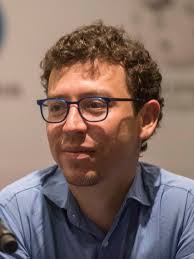
I'm Luis von Ahn. I'm an entrepreneur and scientist, a university professor, Guatemalan, and I think that's it. I was born and raised in Guatemala, in Guatemala City.
I had a very happy childhood, honestly. My mom's family — my mom is one of 12, meaning she had 11 brothers and sisters, and each of them had a bunch of kids, so I had about 70 cousins, and I had a great time. I'm an only child of my mom, and I didn't grow up with my dad. My mom and dad never married, so I only grew up with my mom, but I lived very close to all my cousins, and there are a lot of them, so I spent my time playing with them. That was pretty much my childhood.
I've always had a lot of energy. I think if I had grown up today, they surely would have given me medication for hyperactivity, but when I was growing up, that wasn't given to people. So I simply had a lot of energy. I spent my time climbing onto the roof of my house, and the adults couldn't climb onto the roof of my house, so they always got angry because they wanted me to come down, but I didn't want to come down. And what I did on the roof of my house was build antennas to be able to communicate.
I started building radio systems to be able to communicate with people, but I never managed to communicate with anyone. I only heard things — I did hear other people talking on the radio, but I never managed to send a signal. But I built really ugly antennas on the roof of my house.
Well, when I was 8 years old, I asked my mom for a Nintendo because everyone had a Nintendo — the first Nintendo, the original Nintendo. For some reason, my mom didn't want to buy it for me, but instead of buying me a Nintendo, she bought me a computer and brought it home. And my mom didn't know how to use a computer. In fact, she never learned. Today, at 86 years old, she has never known how to use a computer. But she brought me a computer and told me, "I didn't buy you a Nintendo, but I bought you this. So do whatever you want with the computer." I didn't even know what to do because I was 8 years old and there was a computer there. And back then, computers were really hard to use — it wasn't like today where you just turn it on and there are applications and everything. It was simply a screen with text, and it took me several months to get the hang of it. I had to — well, it came with a book, a manual. I had to read the manual, and eventually I learned how to use the computer and started learning to program. That's how it went. But I really had a very happy childhood in Guatemala.
I've tried to start companies, and two have done well. The one I'm working on now, which is Duolingo, is a publicly traded company here in the United States, and it's done quite well — valued, it depends on the day, it changes quite a bit every day, but valued at around 7 billion dollars.
What the company does is we mostly teach languages — it's an app for learning languages. Now we're getting into teaching math and music, but mostly what we do is teach languages. We have users in every country in the world. We have around 100 million active users who use Duolingo actively. And we have offices — here we are in Pittsburgh, but we have offices in Pittsburgh, New York, Beijing, Berlin, and Detroit.
The previous company — this is the current one — the previous company that also did well is called reCAPTCHA. It was a smaller company than Duolingo, about 20 people. But we made a product called reCAPTCHA, which most people in the world have seen. At first, they were those distorted letters you had to type. Nowadays, what they are is a box with nine images or 16 images of traffic lights or bicycles or something like that. You have to click all the ones that are traffic lights or bicycles or cars or whatever. That company is used by most major internet sites. I started it, and after about 3 years of building it, Google bought it. And after Google bought it, I worked for a year and a half at Google on all the systems that existed before Google so they could be integrated into Google's entire system. That's what I worked on for that year and a half. Those are the two big ones. Beyond that, I've had a bunch of failures, but those are the two big ones.
Yes, my companies usually have social purposes, especially Duolingo. The bigger I get, the more time passes, the more social mission I have, and that's why Duolingo, my newest company, has a strong social purpose. And what inspired me — several things, but what inspired me most was having grown up in Guatemala. Simply having seen — well, when I was there I didn't realize it, but after leaving Guatemala I realized the amount of poverty there is in Guatemala and how much the country can improve. And then I started realizing that there are other countries like Guatemala in the world that really need to improve a lot, and that's why I believe that I've tried to make my companies able to help the world. In Duolingo's case, we're trying to help with education, and that's why what we try to do with Duolingo is give free education to as many people as we can. And the other thing is that we've hired a lot of people at Duolingo who come to work for us especially because of our social mission. So today, even if I wanted to change — even if I wanted to, if today I decided, you know what, all we're going to do is make money and we don't care about anything else — more than half of the employees would quit.
I never imagined I would even start a company — that wasn't it. I never thought I would; I thought I was going to be a university math professor for my whole life. The first time I really thought I was succeeding with a company was when I saw reCAPTCHA being used by Facebook when people created a Facebook account, which was around 2006 or so, and I said, "Okay, this is working." With Duolingo, the first time I really thought it was working was when Apple chose Duolingo as the app of the year. Out of all the apps there were, it chose one, which was Duolingo, as the app of the year. That's when I realized, hmm, this is probably going to work. And then when it all became a reality at Duolingo was when we became a public company on the stock exchange here, which was in 2021. Everything changed, because before being a public company, when it was just a private company, everyone who works at Duolingo — by the way — has Duolingo stock. The owners of Duolingo are all of us; everyone who works at Duolingo has shares. I have more shares than the rest because I started it, but everyone has shares. Before becoming a public company, the shares weren't worth much. I mean, they were worth something, but it was very hard to sell them — they weren't real money. Once it became a public company, anyone can sell their shares liquidly at any moment, and everyone who had shares immediately became millionaires. Most of Duolingo's employees became millionaires the day we became a public company. And that really changed me — I don't know if it changed my life, but it definitely changed the way I think and everything. Many of them were my friends, or people I'd worked with for a long time, and I felt a lot of pride that people who had been working with me for 5 years, for 7 years, suddenly went from being a middle-class person to being someone with a lot of money. And that, well, that made me feel really good.
The food and the climate are the things I like most about Guatemala. My favorite place — Antigua is my favorite place. I also love Lake Atitlán, I love Cobán, I love Río Dulce.
Yes, in Guatemala what I did was start a foundation. I started thinking about starting a foundation several years ago. The reason was because I really wanted to help the country where I grew up, and thanks to luck and the work I've done, I reached a position where I had more money than I could spend for the rest of my life, and I started thinking about how I could use it. And I thought, well, why not help Guatemala? I started thinking about this seriously around 2019, but I didn't do much about it because I was busy. But a couple of years ago, in early 2021, I said, I'm going to do something to start. What I did was use an agency — the agency we use at Duolingo to hire our employees internationally, not the ones we hire here in the United States, but internationally, the ones who do our searches. I contacted them and said, "I need you to find me an executive director of a foundation in Guatemala." They did a search and found Rodrigo, who is the executive director of my foundation — well, they found several people, but Rodrigo was the person I decided to hire. And what a great hire, he's incredible. And with him we got together and I said, "Okay, Rodrigo, what I want to do is eventually give all my money to a foundation in Guatemala. Now, I'm not going to give you all my money tomorrow, but over several years I want to do that. Let's start with 3 million dollars a year and increase it over time. What do we do?" And together we arrived at three main areas we could help with. The first is the education of girls in Guatemala, especially girls. The second is environmental conservation, and the third is democracy.
In the case of education for children, some people in Guatemala have criticized us — why not boys? And of course we also want to educate boys, but we focus a lot on girls for two reasons. The first is that especially in the poor areas of Guatemala, if a family doesn't have enough money to educate all their children, they give priority to the boy and not the girl, which is not right. But the second, which is even more important, is that if priority were to be given to only one gender, it should be given to the woman and not the man. Because what ends up happening is that when they grow up, the boy becomes a father and the girl becomes a mother. And it's much more important that the mother be educated than the father, because the mother is the one who interacts more with the children. So for two generations later, it's much more important to educate girls than boys. That's why we say we're going to put a lot of focus on educating girls in Guatemala in particular. And the environment is obviously something that is extremely important in Guatemala, and then there's democracy — I don't know if you can say today that Guatemala is a true democracy, but we're trying, and that's the idea.
Many are captured at Duolingo — we have something called our operating principles. Some of my favorites are: one is to always try to do everything with excellence. In English it's "try for excellence." The idea is that everything we do is truly excellent. It's very hard to do excellent things. Most things in the world are mediocre. The vast majority of things in the world — restaurants, most restaurants are mediocre. Most clothes are mediocre, most things are mediocre. And usually the first version of what one does is always pretty bad, but then you have to keep improving it and improving it and improving it, and that's something we do a lot at Duolingo. We continuously improve everything.
Another one is to take a long-term view — in English it's "take the long view." Everything we do here, we always think about what impact this will have in 5 years, in 10 years, instead of what impact this will have tomorrow. Another one for Duolingo is that the most important thing is our students. That has helped us a lot. There are times when we're trying to decide, should we do this or not do this? And what we do to decide is what can help our students or our users the most. And that has helped quite a bit.
Most very good things in the world take years. So I have patience with that, and the idea is to work a little bit every day and make it a little better every day. And that's what I try to do with everything in my life — make it a little better every day. That, for example, writing a book takes a lot of effort, but writing one page a day isn't that hard. And if you write one page a day, in a year you've written a book.