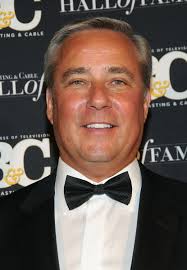
Tell us a little bit about just you growing up, where you came from, and your story so we can get a little bit of that background.
Sure. Well, first of all, thank you all for coming. Thank you for having me. Hello to all the members of the Nexstar Nation that showed up today. I appreciate all of that. I also want to say a special hello to all the students in the audience. I certainly understand the appeal of a free meal as an undergraduate student, but I also appreciate the fact that you took time out of your schedule to come and spend some time and listen. And so hopefully we'll make that worth your while.
I grew up in a small town in western Pennsylvania. It was kind of a strip mining town and came from a very blue-collar background. Second in my family to go to college. My mother went to college at Penn State back in the day and so it was a very ordinary upbringing I think. My dad never made more than $50,000. He was in a blue-collar job but he and my mother both knew the value of education and offered to pay for secondary education or post-high school graduation for myself and my brother. My brother took the money and bought a car. But I decided to take the money and make the investment in higher education and my chosen field was radio and television.
My first job in this industry was in Punxsutawney, Pennsylvania, which is famous exactly one day a year, home of the Groundhog. And I was still in high school at the time. So I just stayed in that business my entire career and went to school for it. Got a degree in communications which was an emphasis in radio and television and an emphasis in management. Even though I did spend some time as a news anchor, I realized very quickly that on-air talent is not a title that should be used universally because I was on air but I don't think I had a whole lot of on-air talent. And also chose to go into the management side of the business and the sales side of the business was the quickest path to future advancement there.
So I think from my perspective, our family had very strong values, was a fairly strict family. Faith was an important part of our life, accountability was an important part of our life and I look back on it and say that may have been kind of a sheltered upbringing but I didn't know much different at the time. It just was what it was. But then I found out what everybody else in my high school was doing that I had no idea about. And then I realized there's a whole wide world out there that I didn't know a lot about. But I think it was a strong underpinning. My dad had a very strong work ethic. My mom was a stay-at-home mom and placed her time and effort into growing two knucklehead boys, you know, and so I think that was a good grounding for me.
And I tell people all the time that I started Nexstar in a converted Kresge's department store. Now, for those of you not old enough to know Kresge's or know what it is or who it is, Kresge's was the predecessor to Kmart. So, this was an old-timey department store on Lackawanna Avenue in Scranton, Pennsylvania. And I tell people when particularly when I go to visit Washington, I said, 'This is about as far from the media elite as you can get when you start a TV station in an old department store.' So, I think my ordinary upbringing was a grounding in the values and not to forget about the people that not only watch us but the people that are in our communities that we're there to serve.
And that media elite is a term that gets used a lot and there is a media elite out there. And when we founded and I started NewsNation which is a national cable network, I said we're going to focus on the people that are not on the coasts that are in the flyover states, the forgotten parts of America and celebrate that and tell those stories and also try and make sense of what's happening in New York or Washington to the rest of the country. And it's I think my upbringing provided that emphasis for me to make sure that we were representing the part of America that I came from.
Can I ask you about Kissimmee, Florida?
Well, so you know, you have these forks in the road, right? So, I went to school with this kid called Matt Lauer, who you may have heard of, used to anchor the Today Show. He was famous until he was infamous. But he and I, well, we went to school and he went into the news business. He and I ended up working at the same TV station after graduation. And I was in sales. And funny enough, now we own that TV station in Huntington, West Virginia.
But before that, in the summertime, I was working in a small TV station as a news anchor and realized that this probably was not going to be the career for me being in front of the camera. And I got offered two jobs on the same day. One was with a bunch of other kids from college to go out to Flagstaff, Arizona. And we were going to staff up a newsroom and I was going to be the weekend anchor and weekday reporter and my buddy was going to be the sports director. I was best man in his wedding and all of that. And that was going to be fun. Then I got offered a job to sell radio time in Orlando, Florida for 25% commission. And those of you that sell TV time or radio time, 25% commission is unheard of. Well, turns out so was the radio station.
So the radio station was in Kissimmee, Florida, which at that time, this was in the late '70s. Disney World hadn't grown out that far. In fact, they had just opened the main park and the other pieces didn't exist yet. So, it was a lot of flat land and the radio station was an AM daytimer, which meant it signed off when the sun went down. And it just changed its format from big bands to country. So there was no audience, limited number of people that could listen to them. And so my first week on the job I made the biggest sale they ever had in the history of the radio station regardless of format was a mobile home dealer that I sold. And when it came time after he paid his bill for the owner to pay me commission, 'Oh, I need, I got a part at the transmitter I got to replace. I'll pay you next week.' And then the next week became next week and next week became the month after. And so I decided his major asset to me was using his telephone to find another job which I did. But that was my brief time in Kissimmee, Florida.
So there's successes and failures all along the way. Can you explain to us because I truly don't understand but the purchase of stations throughout the nation. Sometimes you can't own two stations in one town. Sometimes you can manage it. Can you explain kind of the process of how you went about acquiring and then managing some stations as well?
Sure. I got to ask Albert Gutierrez to come up because he lives this every day in managing a station as well as owning and running KTAB. But so the FCC rules and regulations, we're operating basically under the same rules and regulations in both radio and television that we were in the 1940s, the 1970s. And as we all know, nothing's changed in media since then. But it says that you can't own two of the top four TV stations in any community. And so you know, KZEN and KTAB would both qualify for that. So we have another company that we support financially that owns the license of that station but we entered into joint advertising sales agreements. We provide facilities for one another. News production comes out of the same building even though it's two different studios and two different anchor teams and points of view. And so it's a way to mine an economic benefit out of a second station in the marketplace without actually owning the FCC license.
Now, you know, I don't know who still believes that, gee, owning two TV stations in Abilene, Texas, is going to give us so much power that we're just going to run Facebook out of the marketplace or, you know, run Google off the air. You know, when you look at the world we compete in today there's more digital advertising revenue spent in Abilene, Texas than there is in television by a factor of almost four times. So the idea that there's market concentration in local television is kind of hard to defend but you know there are plenty of people who just defend the status quo even though the quo's lost its status as I like to say. But we have found a way to kind of work under the current rules.
Now, the good news is, at least for us, is that the 8th Circuit Court just said that the top four prohibition is arbitrary and capricious and threw the law out. So, here as soon as the government reopens and they start publishing things in the federal register, that'll become law and that will remove one of the impediments to entry for us. But it's kind of a hybrid existence, but it was a way to grow the company and take advantage of opportunities because what we see is I don't want to get too wonky while we're here for, you know, what we hope is a light-hearted and enjoyable lunch, but if you look at where you get your local journalism from, and you may watch it on TikTok or you may watch it on YouTube or something, YouTube Tech is right. It lasts about that long.
But in terms of who produces that content, who creates the stories, who reports on them, it's local broadcast. There's not much local news on local radio. Now, we own one radio station. It's a very good one in Chicago, but not a lot of local news on local radio. And local newspapers, you know, it's a much different business than it used to be. In fact, when we announced the acquisition of Tegna, I was in Dallas flying to San Diego that day and I picked up the Dallas Morning News and the story that was written about the acquisition was a reprint of a Reuters story. So, there was no local reporting on a big acquisition for a big company based in North Texas.
I get out to San Diego where we had just acquired a TV station and we're having a big open house for clients and I looked at the story they had written on the acquisition because there's a Tegna station in San Diego as well and it was written by the Associated Press. And so I like to believe and I think it has the added benefit of being true that local television journalism is really the last bastion of journalism in local communities. And I tell this in Washington, I said, 'You don't want your news delivered by a chatbot, do you?' Because if you don't allow local journalism to be supported by companies allowing them to get bigger and maintain the resources that we invest into this medium, local journalism could just go away, you know, and yeah, it'll be exactly what Google or YouTube would tell you that it is. That's the news. It's on a chatbot. You hope what they say is true. And you hope the chatbot is based somewhere in the United States.
And you know, I'm not a sky is falling kind of a guy, but from my perspective, that's the cliff that we're on. And so, why consolidation? Why allow me to own TV stations reaching in 80% of the country? Because I want to be able to compete with Netflix for NFL games. And you know, I can't do that when the current rule says you can't own TV stations that reach more than 39% of the country. How that number was arrived at is, you know, put your finger in the wind and that's probably how it was come up with. There's no way to defend that. I said, at least allow me to compete on a level playing field across the United States. A bigger company, a stronger company that can continue to support, defend, and grow local journalism.
And we have a very good track record. Our company Nexstar, we own 200 TV stations across the country or operate them through our sharing arrangements with Mission and other affiliated entities and we produce about 30% more local news on those TV stations than they were doing at the time of acquisition. So a lot of times putting two TV stations news operations together in the same building allows one or the other to survive. And that's really the choice. You're not losing a voice. You're maintaining a voice for the local community. And our business is very simple. We're a local service business even though we do $5.5 billion dollars of revenue and just a big company. We produce local content that hopefully is relevant, interesting to the local community and we help local businesses sell stuff. That's our reason to exist.
What do I spend the most time talking to investors about? How's your affiliation with the networks and how's your distribution with satellite and all that which is part of our business but it's not our core reason to exist. And I think if you boil it all off I think there's a vested interest in maintaining our ability to produce local content for our communities and to provide an avenue for businesses to reach consumers and that's at our essence what we do.
So your true competition is probably just social media out there as opposed to maybe a local in-town television. It's advanced that far that you have new competition coming in versus that old law that was put into place before then. Gotcha.
You mentioned chatbot, but AI, how is AI affecting your industry?
Well, we're using AI primarily in business processes. You know, mundane things like reconciling invoices and payments and things like that. I was exposed to a product last week that could help newsrooms. You know, our assignment editor when he shows up or she shows up every morning calls around to every police department, say, you know, anything happened overnight, anything I should know about? Well, AI can gather that information for you and rather than spending an hour doing it, you can have it in like 10 minutes. We will never have an AI anchor as long as I'm running the company. We will never have an AI journalist trying to do the work of journalists. I think we can use it as a tool for research, but it's not going to be a substitute for the people that are known and trusted in the local communities because that's really our franchise and it would be very shortsighted to try and save your way to prosperity by eliminating local journalists.
I do want to take a little side step. Baseball.
Well, that's kind of my motivation to get into the business is I wanted to be the play-by-play announcer for the Pittsburgh Pirates when I grew up because we had a very colorful announcer by the name of Bob Prince who was probably known as much for his antics out of the booth as he was in the booth. But I quickly realized that to get to Pittsburgh, you'd have to start in, you know, Fort Wayne and go to Charleston and maybe go to Harrisburg and maybe then you get to Pittsburgh. And I was just too impatient for that. And I also realized when my brief time I spent in talent is that you got a lot of bosses, right? The viewers have an opinion, your boss has an opinion, the salespeople have an opinion, everybody has an opinion. And one of the reasons I started my own company is because I felt I didn't like taking direction from all that many people. So I kind of wanted to be my own boss.