We did a lot of pre-buying in the early part of 2025 to enable us to try and keep prices as low as possible for customers. And a lot of our third-party sellers did a lot of forward staging in our fulfillment network for the same reasons. And that supply has run out in the fall. And so, you start to see some of the tariffs creep into some of the prices of some of the items.
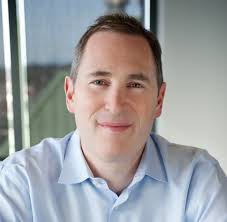
Amazon CEO Andy Jassy, an extended interview on tariffs and consumers at the World Economic Forum in Davos, Switzerland.
Consumers have been pretty resilient. They continue to spend. They continue to shop. I think that wherever they can, they are trying to trade down in price.
Power has been short in the US, around the world. There is a power shortage. I think that it is better than it was 18 months ago and still not as plentiful as we all need.
Plus, how Amazon fits into the entire AI ecosystem with NVIDIA semiconductor chips and with chips of its own.
If you're building a big inference business like we are and you want to have reasonable margins, if you're not pursuing your own custom AI silicon, you're going to be structurally disadvantaged.
I'm CNBC producer Cameron Costa. SquawkPod reports from Davos. Amazon CEO Andy Jassy begins right now.
It is Davos week. So many of the world's CEOs, politicians, and journalists are in a small town in the Swiss Alps, crunching through snow for panels, speeches, interviews, and yes, a few parties. Most of CNBC's Davos coverage comes in the form of our interviews on TV. On Squawkbox, we bring you conversations with Anthropic CEO Dario Amodei, for example, or the heads of banks like Bank of America's Brian Moynihan, Morgan Stanley's Ted Pick, even with heads of state like President Donald Trump. But Joe Kernen, Becky Quick, and Andrew Ross Sorkin are busy the rest of the day in Switzerland, sometimes moderating panels and interviews at CNBC's home base in Davos.
Welcome to CNBC house. Please take your seats.
Hello everybody. Welcome to CNBC at Davos. It's so great to see all of you here.
That's where this next conversation took place, a longer format morning interview with Becky Quick and Amazon CEO Andy Jassy.
Thank you to Andy Jassy for joining us this morning. And thank you to all of you for being here, too. This is new for me. First time I'm doing one of these interviews like this, and I'm really excited to do it with Andy. He covers so much ground and I know everybody here knows Amazon and everybody here knows Andy Jassy, but I think it's really hard to understand the scope of the company, what it is and what it does without knowing Amazon by the numbers. So, let's walk through that just a little bit. Amazon, first of all, has a market cap of more than $2.5 trillion. If you take a look at their employees, it's one and a half million employees. They are the second largest private employer on the planet. If you're looking at revenue for the company for the most recent year that was reported, 2024, it was $638 billion. And I think if you want to break down just the rate of growth at some of their units that have been pretty spectacular, AWS, the cloud services unit of the company this year, I think, is on an annualized run rate to have revenue of $132 billion. That's up from $108 billion last year. And if you roll back 11 years, it was only $4.8 billion. That just tells you about what Andy has done just in terms of the unit that he used to run, where things are going and how much growth there is. They run everything from projects like Vulcan, which looks at robotics. They've got AI projects like SageMaker and Bedrock. They have things like Amazon Pharmacy. They have Amazon Prime Video. So, it's hard to really understand the scope until you start looking through some of those things. Andy, I thought we could start today by talking a little bit about how you spend your time. Not because I want to know everything you do in your day, but because I think it would show a little bit about what your priorities are for the company. How would you break down a typical day or week?
Well, first of all, thanks for having me. I appreciate it. It's great to be here with all of you. You know, I would say that it obviously varies day to day and week to week with what's going on. When I started doing my current job in 2021, if you'd asked me whether I would spend a lot of time in the retail business, I would have guessed not that much and then all of a sudden we had an issue with cost to serve in our fulfillment network in 2022 and I spent a lot of time in 2022 and 2023 on our retail business. But, you know, so it varies depending on what's going on, but I would say roughly there are three big buckets. One is our existing really big business areas like retail and AWS and our ads area and then I think the second bucket which is probably the place I spend the most amount of my time is on new businesses either businesses that are relatively new or that haven't launched yet. So these are areas like Prime Video or healthcare business or our low earth orbit satellite that we call Amazon Kuiper or Zoox and I would say AI more generally. AI, we have a big piece of AI in every single one of our businesses and we're building models. So that would be the second bucket, kind of new big new initiatives and the third would be really around just the company and particularly the culture. And that's another one I didn't really think I would, when I was thinking about coming into this job I didn't spend a lot of time wondering would I spend time on the culture but you know when you, for most companies who've had success of any size especially as you get larger the culture has historically been one of your secret sauces in your being successful and that's true for Amazon too. But just as you get bigger, there's a lot of ways the culture gets stretched and it takes work to kind of make sure that you operate the way you want to. We want to operate like the world's largest startup and it takes work and it takes energy and the leadership team and I spend time on that too.
What does that look like in an example of something to say you spend time on culture? What do you do differently?
Well, you know, one of the things that I have a group of people that I spend time with on a regular basis just on the culture. We actually call it culture club when we get together, a nod to the old band. And we talk about the things that we think are going well in the culture and the things that we think are getting stretched in some way. And one of the things we realized over the last couple years as we had grown so quickly and added so many people as we were growing so fast in retail and AWS and ads and a bunch of these new businesses was that when you add people you add layers and when you add layers it means that historically the group of people that we had always hired really smart ambitious customer-focused owners who did the work who own their destiny on the two-way door decisions which is majority decisions that our folks make. Then when you add layers, you end up with pre-meetings for the pre-meetings for the meeting. And you know, people show up at meetings and they don't make recommendations anymore because they know it's going to be two meetings later before you actually make a decision. And we didn't like that. And we weren't moving as fast as we thought we could move. And we want owners to really feel like they own their own destiny. And so we spent a lot of time talking about that as a group and deciding that really one of the big issues that we had to address was we needed to flatten some of the layers. And so if you want to move like the world's largest startup, you need to be as lean as you can be in pursuing the surface area that you mentioned earlier that we're pursuing. You need to have as few layers as you can possibly have and you need the people doing the work to be able to make those decisions quickly and learn from them if they don't work out right and advance them when they do. And so that's an example of something we just decided we were going to flatten the layers and we were going to increase the ratio of individual contributors to managers by at least 15% across the entire company. And to take an initiative like that across our service area, you know, it takes effort. It takes a team being on the same page and then you got to go make it happen.
Can you talk a little bit about Rohit Prasad leaving AI and the incoming Peter DeSantis who's kind of got a larger portfolio that's going over that? What was the meaning behind that move? What's it going to mean?
I like you calling him DeSantis, too, by the way. We're all going to use that a lot. But, you know, I have a lot of respect for Rohit. He was at the company over a dozen years. He was an instrumental part of building Alexa and all the natural language understanding and the automatic speech recognition and I think that he did a lot in helping us not just move quickly to pursuing our own models, our own frontier models but what he built in the first couple versions of Nova. I think that we have conviction that over time the very best frontier models are going to have to work very closely with the chip in which they operate on. I think that the best models are going to be really optimized on chips. They're going to run really quickly. They're going to have low latency. They're going to be very cost-effective. And we wanted to bring together the teams that build our own custom silicon, Trainium, which is our own custom AI silicon and the team building our largest frontier models which is Nova. And Peter DeSantis has been at Amazon for I think he's been there about 27 years. He has done a lot of things but I've worked with Peter since really the start of AWS. Peter had just become a director of the company when we asked him to go run EC2 which is our compute service but he started working on that about six months before we went to launch. Built that, ran all our compute pieces. He ran all our infrastructure which for us are our data centers, our network and our hardware. Then he ran all the different AWS services for a while. And but one of those was he ran all our chips. And so I really, we felt it was important to bring those together. Peter is incredibly strong technically and has been involved in our model building as well as our chips and I'm very optimistic about bringing those together and I think Peter's going to be a great leader for it.
Let's talk a little bit more about chips because that's a huge initiative for you, multi-billion dollar business already. And you wrote last summer that or I think it was in your April letter to shareholders that chip prices can and will come down. Do you think that Nvidia is charging too much for its chips right now?
Well, you know, it's, we learned this lesson before AI, in the CPU business where we had this very deep partnership with Intel, which we still do, but customers always want better price performance. And I would say that a lot of times when you have a significant leader, they have a lot of other features and priorities and that often isn't the priority for them. And so we acquired a team in Israel called Annapurna which is a very talented chip designing team and we built our own custom CPU that we call Graviton which has been very successful for customers and for the business. 90% of our top 1000 customers use Graviton very expansively. It's 40% more price performant than the other leading x86 processors. And we saw this same movie playing out in AI. And about five years ago we asked that team to build custom AI silicon and you know we have a deep relationship with Nvidia, we will for as far as I can foresee but it is undeniable that customers want better price performance and if customers are going to be able to roll out AI as expansively as we believe they want to and they should the cost of inference has to come down and so that's why we pursued Trainium. Our Trainium 2 chip is about 40% more price performant than the other leading GPUs. It's fully subscribed. It's a multi-billion dollar business as you talked about. Anthropic's building their next version of Claude on top of hundreds of thousands of our Trainium 2 chips. We just released our third version of Trainium which is 40% more price performant than Trainium 2, which was already more price performant than other things out there. And I just think that if you want to allow customers to have lower prices for inference, which we do, and if you're building a big inference business like we are, and you want to have reasonable margins, if you're not pursuing your own custom AI silicon, you're going to be structurally disadvantaged.
When you say price performant, that means how much power you get for the amount you're...
It's when you look at the performance combined with the price. What is that? You know, you can have a higher price on something but be way more performance. You always want to look at the combination of what performance you get for the price.
Now, the deal that you have with OpenAI, or this has been reported that you were going to take a 10 billion or larger stake with them, they recently signed with you, I think a couple of months ago, to take $38 billion in AWS usage that they're going to be using, too. We've been watching from the outside. There's so many more deals that are happening. Some of these are called circular deals. Doesn't look like that's what you guys are involved in. But what do you think about the activity that is taking place, the deals that are taking place right now? Is this just a reflection of the demand that's out there or do you feel like some of these things are circular?
It is so unprecedented how much compute is being consumed right now. You just have to only look at how much power is needed, how many data centers are being built. The AI labs are consuming gobs and gobs of compute right now and so those AI labs believe they have opportunities if they train models very expansively to keep changing the intelligence of these models so they need a lot of compute but they need money for the compute and so they're trying to find ways to fund that compute and I'd say a lot of the companies who provide that compute want to serve those customers and then have opportunities to also invest in those companies as those companies are looking to find ways to fund what they're doing and I think those companies are impressive companies. So I think when you look at a company like Anthropic, a company like OpenAI, I mean these are unusual companies who've been building amazing models for 10 plus years and are reshaping the way people use applications and so I just think it's a function of the time where tons of compute being asked for, they need ways to fund it, companies have opportunities to invest in companies, those companies are impressive companies and you're just seeing some of that but I don't know if that'll continue or not.
Do you think it ends well?
I think it could end well. I mean, you know, anytime you make substantial investments, if you look at the history of M&A and investments, not all of them are successful and the hit rate is pretty variable. So, I think whether the investments end well or not, we'll have to see. But, I do think the companies that we're talking about just in the last few minutes are impressive companies.