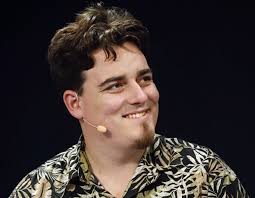
And this year will start producing autonomous fighter jets at its new Arsenal 1 production facility in Pickaway County. This is a $1 billion project that will bring 4,000 jobs to central Ohio over the next decade. The excitement is certainly building. And now on 10TV Plus, we hear from the man behind this vision, the founder of Anduril, Palmer Luckey. Thanks so much for joining us for this special presentation of 10TV Plus. I'm Angela Ann. Let's start with what we know today. Anduril first made its announcement of coming to Ohio in January 2025. Since then, it built out an existing spec warehouse to become the first Arsenal 1 building. And building number two here is near completion. When it is all said and done, the Arsenal 1 campus will encompass 5 million square feet.
And that is what will be coming off the line by this summer in Pickaway County. YFQ-44A, the Fury autonomous fighter jet. You're looking at a test flight last October after it took Anduril less than a year to build this prototype for the US Air Force. Now, I had the chance to talk exclusively with Palmer Luckey during his recent visit to Pickaway County. He met with local leaders, firefighters, even construction workers, saying he wanted to meet the people who are all part of history and helping to rebuild the arsenal. Here now is my exclusive conversation with Palmer Luckey from inside Arsenal 1.
Angela Ann here exclusively inside the new Arsenal 1 facility with the one and only Palmer Luckey. How are you?
Thank you for coming. Welcome to building one of Arsenal 1.
Looking around, is this what you expected? Do you feel it?
You know, it's pretty exciting. We've been expecting it for a while. There were a lot of people who said we weren't going to be able to build a factory this fast. We announced the project a year ago. So, we've gone from announcement to this building and we actually just finished all the exterior building and construction on building two. So, we're moving really fast. We're going to be starting fighter jet production here of the FQ-44 Fury in a matter of weeks.
You say weeks. I mean, when you talk hyperscale, this is what a hyperscale looks like. Fast, furious. We're on it.
That's right. I mean, there are certain things that you cannot build at small scale at a reasonable price. There's certain things where it only makes sense if you can scale up production. That's true for a lot of cars. That's true for a lot of consumer electronics projects. You know, my last company was Oculus VR, which I sold to Facebook. You can't build one VR headset for an affordable price, but you can build a million of them. And the same way, you can't build one fighter jet for an affordable price, but you can build hundreds or thousands of them.
You had the chance to meet with some of our local representatives, really the boots on the ground folks. I want to take a pause here because as we look around at this massive expansion, what is it that you wanted them to see first?
So, a lot of these are people who we've been working with for, you know, a year or more. And so the thing that I wanted them to see was that the things that we told them they were going to do, we actually came through. We've been hiring a bunch of people. We've been actually rotating those people out to our headquarters in California, training them, bringing them back here, putting them to work on the line. We're actually building these facilities. It's actually working. We're getting all the permits we need. We're getting the customer traction we need. So I think most of my talks with local legislators, local leaders has been, hey, look, what we said we were going to do, we actually did it. Because if I can get that track record, prove that I'm somebody who does what I say, that I'm a man of my word, then they're going to trust me the next time that I come to them with something and say, 'Hey, time to do even more. We're not going to end at 5 million square feet. We're going to start there.'
Walk me through. I see 22 stations around this huge massive facility. What is going to happen around us?
So, these stations have just been finished in terms of construction of the stations. We're about to start bringing in all the equipment for the work they've done. So different stations all in different role. You're going to have the aircraft moving down around this line as you have wiring harnesses installed, weapons systems installed, sensors installed. You're going to have stealth coatings applied to the composite airframe and then over there tested to make sure that it actually has the low radar signature that the Air Force needs for this to be a useful platform alongside F-35s and F-22s. If you're going to have robot fighter jets, you need to make sure that they're coming off the line absolutely perfect. So, this is everything you need to build a fighter jet from nothing all the way to a ready to go flying fighter jet. And we're going to be able to take those off right from here and fly those directly to the customer.
What makes this so different than a traditional defense manufacturing facility?
There are a lot of nuances here and there. I mean, one of them is we've built this as a very modular facility. So if you look around, you'll notice we don't have what we call monuments, meaning big parts of the facility that are locked in place, trapped in place, made of concrete and steel, welded together as an integral part. The reason for all of it remaining relatively mobile and easy to move, even things like our gantry cranes is that you can reconfigure the factory. So if I need to scale up production or if I need to build a different aircraft or suppose the Department of War comes to us and says we need you to focus on this particular model of the aircraft not this other one or we need you to make a bunch of cruise missiles in this part of the factory we can reconfigure it to do that. So that's one of the things we've done differently. The biggest difference is Anduril is a defense product company. We're not a contractor. We're a product company. We use our own money to decide what to build, how to build it when it's done. We work with the customer closely in that process. But we've invested hundreds of millions of dollars in this factory already because we believe in putting our own money towards these programs. I think that when we trip and fall, we should lose our own money. It's good to live in fear, not just lounge on the taxpayer dime. And I think that makes a really big difference between Anduril and a lot of other competition. I'll end by saying this. The first page of our first pitch deck to our investors was that Anduril was going to save Americans hundreds of billions a year by making tens of billions of dollars a year. We're not there yet, but we're getting there.
We're trying to rebuild the arsenal of democracy.
I love that clarification because I feel like, and you tell me if I'm wrong, that that might have been the most misunderstood part of what Anduril is doing with Arsenal One.
Sure. You mean in terms of what we're actually building here? I mean, look, what we're building here, not a weapons factory. What we're doing is we are trying to build the tools that are maximally deterrent to the enemies that the United States doesn't want to get in a fight with. The goal here is not to build the weapons that will win a war with China. It's to build the things that will make China never want to go to war with us in the first place. It's not to build the things that will make North Korea lose in a fight against South Korea. It's to make them realize that they can't win a fight with us. Now, there are certain actors in the world who are irrational actors. You can't play game theory with people who believe that they win by dying.
You're not going to deter them by building things like this at Arsenal 1.
So there will always be fights with people that you can't reason with. But the things that we really need to be worried about as a country are toe-to-toe fights between superpowers and hyperpowers. And we are building the tools that we need to protect Americans, protect American interests, and protect American allies around the world by making it clear we are not a force that you can overcome.
I have to segue. You talk about the conflicts around the world. Obviously, what's going on with Iran?
You're watching very closely. Of course, we've
So I mean Anduril does a lot of work on US bases all around the world, including in that region doing air defense, drone defense, a variety of other missions. So, we've been very deeply involved.
Is Arsenal or is Anduril, I should say, and the building of Arsenal 1, you think, going to give us that advantage that we need for conflicts like against Iran and other future conflicts?
It's going to give us the advantage we need and the magazine depth that we need. One of the issues right now is that every day of this conflict, we're burning through months or even years of certain weapon systems.
If our adversaries know that they can just wait us out or out produce us or that we'll fight a hard fight for 10 days and then run out, they're not going to be very threatened by that. They need to be of the belief that America can fight a war on day one, day two, day 10, day 100, day 1,000. That's what real deterrence is.
Do you feel like autonomous weapons are what's going to win this weapons arms race?
I do for two big reasons. The first is that autonomous weapons can be used in ways that you could never morally use a manned aircraft. I can put them into harm's way. I can trade them against an enemy. I can put them out as the tip of the spear, engaging in tactics that are likely to get it killed because the strategic outcome of that mission is worth it. Imagine trying to play chess without pawns. Imagine if you didn't have pieces that you could put in harm's way without fear. I think that autonomous weapons like Fury are going to be a critical part of the way that we deter wars and win wars. The other side is economic. The thing about autonomous weapons is that you can buy a very large number of them without having to increase the amount of manpower required to operate them. If I want to buy a ship, and I want the US Navy to go from 300 ships to, let's say, 600 ships, I need to hire literally tens of thousands of additional sailors just to staff those ships and maintain them and build the parts. And then I have to sail them all over the world to keep everybody trained continuously. You kind of have to play pretend at being at war continuously when you have a manned system. With an unmanned system, I can build a ship. I can build a fighter jet. I can build a submarine. I can put it in a warehouse like a Twinkie in a wrapper. It lasts for a thousand years.
I was gonna ask you about that. You compare weapons to Twinkies.
I've talked about this concept before, but we need to be building things exactly. And that's what allows us now. We could have a navy of not 600 ships, but a thousand ships. And we don't have to have the absolutely unmanageable cost of the people it would take to staff a thousand person Navy. When we can wait 10 years, 20 years, 50 years. We can break these things out. Maybe you're going to put in a new brain chip or you're going to upgrade the sensor.
Stuff is going to advance so much faster.
Stuff is going to advance. But think about it this way. There are bombers over Iran right now that were designed almost a hundred years ago.
The United States is very good at taking systems that work and upgrading them and upgrading them and upgrading them. We're building Fury here in a matter of weeks. I think 50 years from today, there's going to be aircraft that look a lot like Fury and they're going to have new engines and they're going to have new sensors and they're going to have new weapons. But just like the F-15 or the F-16 or even the F-22, you're going to have these platforms flying for decades, maybe even a century.
I've heard you talk about this when it comes to these autonomous systems. So my question a little philosophical here for you. Should AI ever be allowed to make that lethal decision about a human pressing a button?
Reasonable people disagree, but I strongly believe yes. And my reasoning is this. Life and death, matters of life and death are too important. They are too fraught to not apply the best possible technology to minimizing collateral damage, minimizing harm that need not happen. For example, people will say things like, 'Palmer, but can't you agree that an algorithm should never decide who lives and dies?' I say, 'Well, I don't see the moral high ground in making, for example, an anti-vehicle landmine that can't tell the difference between a Russian tank and a school bus full of kids.' I just can't see it because in the real world, the question that we have to ask ourselves, it's not a question of no weapons or smart weapons. It's a question of dumb weapons or smart weapons. And if I can build weapons that are able to reduce the number of civilian lives lost in war, I'm going to take that every single time, however spooky that might feel. Now, the key is, of course, we need to hold humans accountable for that use of force. And that's where the question comes in.
I think that the responsibility must lie with humans and we need people to take responsibility. If I'm deploying those landmines in a place where they're able to make a mistake and they make a mistake, a person needs to be held accountable. You say, 'Did you use them appropriately? Did you trade the risks appropriately? Does this actually make sense?' It's the same thing that we use for existing air defense systems. If I turn an air defense system into full automated mode, shoot down anything that's incoming, and then it shoots down a guy in a Cessna who wasn't doing anything, there's going to be an investigation and they're going to say, did this warrant that? Like, were you in a situation that warranted this? Are you in an area that warranted this? Did you do enough of a review to understand what the consequences were? The answer is not to say that you cannot have an autonomous air defense system. Because you do that, all someone has to do is they break communications or break your command and control or use an electromagnetic pulse that fries the laptop that controls it and now your enemy can pummel you without stopping. And so I think we do need to get comfortable with the idea that there will be certain systems that are making decisions of life and death and we need to be very careful about how we deploy them and how we take responsibility for the actions of those systems. And so if the systems were to say something happens, malfunctions, whatever, you would be the first to say, 'All right, we take responsibility. Let's fix it. Let's figure it out for the next.'
Correct. And I'll go a step further. I think that people have actually been building autonomous weapon systems for thousands of years. They haven't been powered by AI. Exactly. But you can go back 3,000 years and find records of the Chinese building pit traps that were designed to let some soldiers walk over them and then the heavier soldiers carrying armor or horses fall straight through. That is a weapon system that is making targeting decisions based on the intent of the engineer who created it. Is it using AI? No. But the real question is, are we comfortable with technological weapons that act independent of the immediate oversight of a person? And the answer, I think, has to be yes, with the right restrictions, with the right accountability. And the accountability, by the way, cannot be to corporate executives like me. It cannot be to executives who run AI companies. It needs to be to the people who elect civilian leadership that is tasked with overseeing the military and holding it accountable. No, we can't live in a world where corporate executives have more practical power and control over US foreign and US military policy than the president of the United States, than the US Congress. And there are people who I think would love to see that. I am not one of them.
You don't want to be that. You don't want to be the Pentagon's IT guy making those decisions.
I want to be their IT guy for making their weapons, for making their tools, but I need to be kept on a short leash on a strong chain. People come to me all the time, 'Palmer, would you sell to this country? Would you allow your weapons to be used in this way or that way? Would you cut them off if they tried to do this?' I say, this is crazy. You're asking me if I as a corporate executive should have the power to shut off parts of the US military unilaterally against the will of the president of the United States or Congress or the people who elect him. Like that is a dystopian future. You should stay as far away from as possible. Even people who trust me, they shouldn't trust who comes after me. They shouldn't trust anybody else. These have to remain again in the realm of civilian elected leadership. People you can elect into power and that you can get out of power. Nobody's figured out a way to have the American people vote me out of my role. So, I better not be in charge of these decisions.
But could you sell to another country if you wanted to?