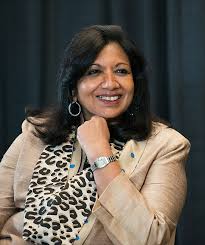
About Kiran Mazumdar-shaw
Kiran Mazumdar-Shaw, Executive Chairperson of Biocon, announced in May 2026 that her niece, Claire Mazumdar, will succeed her as the company's leader. Mazumdar-Shaw stated that she had long planned to groom Claire for the role and decided the time had come to announce it because Claire had "earned her stripes." She cited Claire's work building Biocara Therapeutics, including raising capital, obtaining a breakthrough designation for a bispecific antibody, and listing the company on Nasdaq in 2024 as a billion-dollar company. Mazumdar-Shaw said the transition will be gradual, with Claire expected to take over in five years, and that she herself plans to step back into a guiding role rather than an active one. She also stated that family will remain at the board level while professional management drives day-to-day operations.
On the company's financial performance, Mazumdar-Shaw reported that Biocon closed FY26 on a strong note, with Q4 operating revenue at Rs. 4,517 crore, up 10% year-on-year after adjustments. She said the company is now operating as "one unified biopharma entity" with a stronger balance sheet and that the heavy capital investment phase is behind them, with the focus now on improving utilization, expanding margins, and driving return on capital employed. Mazumdar-Shaw described the outlook as "very bullish," citing new product launches, a growing pipeline, and opportunities in biosimilars and GLP-1 therapies. She also noted that the FDA's decision to waive phase three clinical trials for certain biosimilars has reduced development costs by 50% and accelerated product timelines by three to four years. Separately, Mazumdar-Shaw hosted the 25th annual St. Patrick's Day celebration in Bengaluru in her capacity as Honorary Consul General of Ireland, alongside Ireland's Ambassador to India, Kevin Kelly.
Source: AI-verified profile updated from Kiran Mazumdar-shaw's recent appearances.
Browse all interviews →
✨ AI-enhanced transcript with speaker attribution
V
Vikram0:00
Kiran Mazumdar-Shaw, just wanted to get your sense on what is happening in the world when you're looking at the technologies to fight cancer. Over the last couple of weeks, I've been hearing and reading about some of the new work that is being done, more targeted, because essentially at the end of the day, cancer is about genetic mutations. There are lots of specific mutations that can take place. Increasingly, people are talking about targeted treatment, targeted medication once the data for that becomes available. Possibly immunological, you know, you can do it with your body's own immune system. Would you like to share some of your thoughts on the technology in this first before we go any further?
K
Kiran Mazumdar-Shaw0:44
Well, you know, it's becoming increasingly accepted that cancer is an immunological disorder. So the research on cancer immunology has really thrown up some very, very exciting therapies which are referred to as targeted therapies, which are really targeting certain immunological factors that have really brought about the cancerous phase of cell development. And therefore, by targeting these rogue factors, you can actually arrest cancer and now you can cure cancer. You know, there have been some wonderful discoveries made in recent times. PD-1 is one such target, and then of course in the past you had many other targets, HER2, EGFR, and many, many other targets have really helped to improve the outcome of cancer treatment. Now, in addition to that, of course, there are ways of combining immunotherapy and chemotherapy and radiotherapy. And I think the results speak for themselves because as you've heard from many of the participants in today's program, the outcomes are just getting better and better and many are being cured. And of course, when you talk about children's cancer and leukemia, you're also talking about bone marrow transplant, which is really a concept of using the body's stem cells to really correct what has gone wrong. And this of course is today known to cure these leukemias, especially in children's cancers. So I think we've come a long way. And when you talk about gene mutations, yes...
V
Vikram2:37
So just to take that point forward, you know, sometimes we say let's try and find the cure for cancer. Easier said than done, I guess, because there's no one such thing as one cancer. Cancer in a sense is sometimes people say 100, 200 different types of diseases because it depends on where specifically and what part of the DNA the mutation has come in. Can there be one cure for cancer or a series of cures for cancer? And again, better database management is one of the things that many international experts are talking about. It then helps us find the specific targeted treatments if you can coordinate all the databases on this, not just in India but around the world as well.
K
Kiran Mazumdar-Shaw3:20
Yeah, absolutely. I think cancer is a very heterogeneous disease, and different types of cancers have to be treated and dealt with differently. But as you very rightly said, it is about cancer management, it's about proper diagnosis, it is about early diagnosis which is preferable. But many cancers are not really easy to diagnose that early on, so many cancers do get diagnosed at a slightly later stage. But even that now is showing hope of being managed and even cured. I think the biggest problem with cancer is really metastasis, because as long as you contain the cancer, as long as you localize the cancer, and if you can deal with it in a localized way, then it's almost as good as a cure. But the moment rogue cancer cells escape the localization process, then I think that's where the metastasis starts. But that's where I think the immune system can kick in and actually prevent metastasis. So that's the exciting research that's going on in cancer today, which is really about dealing with cancer metastasis.
V
Vikram4:34
Right, metastasis probably the singular... everything is about understanding the genetics of cancer, the immunology of cancer, both from a diagnostic and treatment point of view. All right, so just to explain that in words of one syllable before I go to Arun Bharatram, metastasis has been from the original site of the tumor where the cancer began, it spreads through the lymph nodes and others to other parts of the body. And actually, if you look at people dying of cancer, from what I understand, 80 to 90 percent actually die from those secondary tumors rather than the first one, and that's called metastasis. Is that roughly correct, Kiran?
Could you hear me? Okay. Well, let me go across. We'll try and continue to understand that. Mr. Bharatram, you of course had a tragedy in the family when Manju Bharatram, one of the country's best known and leading educators, actually passed away thanks to cancer. Was that one of the factors that really caused you to start CAPEC, where you're really looking at prevention and early detection? That tragedy must have really also spurred you to this.
A
Arun Bharatram6:03
Yes, Vikram, that was one of the major reasons for my involvement in cancer prevention. And I just want to share with your viewers that cancer is something which is very often in Indian society looked at as a disease where the patient becomes a pariah. And it's important for us in our culture to understand that if you have got cancer, it should be treated with sympathy and it should be treated with a sense of having bad luck in getting cancer. So this is my first message to people who are viewing your program: do not in any way look at somebody getting cancer as having had bad karma or having had some kind of a history which led them to get cancer. So this is my first message. Now coming to CAPEC, which is something that a few of us started in Delhi, this is short for Cancer Awareness and Prevention and Early Detection. And we are focusing largely on cervical cancer. It's not very well known that cervical cancer affects young girls to middle-aged women much more than even breast cancer does. And the fact that this is not known widely, particularly in India, is unfortunate because this is a very, very treatable disease. And I would like my colleague in CAPEC, Gupta, to talk a little bit about what we are doing in CAPEC and how we are trying to prevent cervical cancer.
G
Gupta8:15
Yeah, hi Vikram. So CAPEC, as the name says, it stands for Prevention and Early Detection of Cancer, and we are trying to spread awareness of this prevention. Cervical cancer, India is the single largest contributor to cervical cancer deaths in the world. One-fourth of the world's cervical cancer deaths come from India. And it is a needless waste of life because it is the most easily detectable and most easily preventable cancer. In fact, since you are doing children's cancers, there is a vaccine available for girls from the age of 11. 70 percent of cervical cancer is caused by a viral infection, the HPV. It's a virus infection, and the FDA clears the vaccine for administration from the age of 11 to 45 years of age. So if children were to take it at that age, they would be protected. It's efficient against almost 70 percent of cervical cancers. It's that easy to prevent. Other than that, of course, you have the Pap smear that must be taken once after the onset of sexual activity. And all you need to do is get a Pap smear done and along with that an HPV DNA test done, and then if both the tests are clear, you're clear for four years. So that's once in five years you need to get a test done, and you are 100 percent cervical cancer free. And yet we lose so many women, one woman every eight minutes we lose to cervical cancer in our country.
V
Vikram9:52
Right. So the fact that there's a vaccine for this is something which is obviously very major. But Mr. Bharatram, if you come back to the real problem in a place like India, about early detection, the cost of these things is very high. How many people can actually afford to go in for things like screening or testing? It becomes a big, big concern. So to be able to get low-cost detection or find ways that they can be more low-cost, I believe in some parts of Ethiopia and even in parts of India, things like vinegar swabs can be sometimes used to get some sort of detection done. Is that one of the ways to go? If you can bring the cost of detection down a lot, then maybe it makes it much simpler for people to be able to find out what's happening.
A
Arun Bharatram10:41
Vikram, there's no doubt that tests must be devised which are relatively inexpensive and they can be done very easily by even less qualified doctors, even by physicians, so that one doesn't have to spend a lot of money going to a hospital to get these tests done, even in primary health centers, etc. So we do need to bring down the cost, and I think there is enough technology, there are enough scientists in India and elsewhere in the world who can actually drive the costs down. And this is one of the things that I hope that we will be able to do with the kind of support that we are now seeing for prevention of cancer. I would just like to add one thing that Meeto said because I think it's important to understand this from the context of India. In the United States, there are virtually no more women who get cervical cancer because every child from the age of 11 onwards is inoculated against cervical cancer. So the incidence of cervical cancer is almost gone in the United States. Now, if we could just do this in India, just like we do polio treatment for children, if we were to just do inoculations for all young girls after puberty, I think we would avoid the costs, we would avoid the heartbreak and heartfelt problems that families have to go through, which would be something which is very easily done. So I would say that we must become aware of this and we must make our people aware of this.
V
Vikram12:26
All right, so something as simple as that, a vaccination that could actually prevent cervical cancer is something that we definitely need to keep in mind. Thank you so much for joining us with some of those thoughts, and let's certainly hope to get back to you.
A
Arun Bharatram12:42
Vikram, if I may just say that I would like to donate some money for the... so I will be giving five lakhs for you, please put that into your account.
V
Vikram12:55
Right, Mr. Bharatram, thank you so much for joining us with that. And I think the more and more people who come forward to try and help, especially with child cancer and people who can't afford it, that's really great. Thank you so much, Mr. Bharatram, for that donation and for being with us. Thanks a lot.
Kiran Mazumdar-Shaw, we were just discussing, you were talking about metastasis just a short while back and why that really is a problem. And I was asking you the question that at the end of the day, the site of the primary tumor is not what kills a lot of people, it's when that cancer spreads through the lymph system to other sites, that's where the deaths actually occur. Is that roughly correct?
K
Kiran Mazumdar-Shaw13:40
Yeah, that's, you know, in a lay speak, I think that's what really kills people. But I think what I was also saying was that today, with the better understanding of cancer genetics, cancer immunology, I think there is a much advanced access that we have to both diagnosis and treatment. And I think that's what is really leading to much better outcomes in cancer. And like many people said on this program before, I think cancer is a disease now which is a manageable disease, a managed disease. And you will not die of cancer, but you will die maybe with cancer. But I'm sure many people would actually be able to overcome cancer. That is the hope that research is giving you today, and I think that's what we should really be looking forward to in terms of supporting research in cancer. And of course, I think people need to understand what cancer is all about. And I think one of the biggest challenges, which you've been talking about, is the cost of cancer treatment. So whilst all these wonderful advancements are there, I think the biggest challenge we have is in making cancer affordable. And that's where I've really focused a lot of my philanthropy, saying how do we make cancer a disease that doesn't daunt you in terms of both the disease itself and the cost of treatment.
V
Vikram15:11
So in fact, on that note, Kiran, just wanted to show people some of the work that you've been doing in that, and then I think you wanted to make an announcement. But let's just first see some of the work that you've been doing in this area.
N
Narrator15:24
Chaya is a case of a miracle turnaround. She's had angioblastoma, a tumor in her eye. Since her family had no financial means, they stalled her treatment for a long time, and then in desperation came to the Mazumdar-Shaw Cancer Center. She is one of the hundreds of patients who arrive here every year and receive world-class treatment. They pay according to their ability and sometimes nothing at all. This ties in with the vision of the founder who wanted to make cancer treatment affordable for the poor.
K
Kiran Mazumdar-Shaw16:27
My own family have actually dealt with cancer in a very difficult and challenging way. And one of my dearest friends is someone who fought cancer bravely, but I also saw the financial burden that she had to undertake. And that made me realize how expensive a disease cancer is, and it has to be made affordable. And with this in mind, I partnered Dr. Devi Shetty in setting up this cancer center as one of the largest cancer hospitals in the country, so that we could bring in economies of scale with which to make it affordable. The hospital pursues a lot of research and methodology to customize treatments for its patients. You know, research is going to be the most important need to address many unmet medical needs. And if we don't invest in research, if we don't invest in innovation, we will just find that India will be left behind in terms of cancer care, in terms of treating cancer, and in terms of finding innovative and cost-effective and affordable solutions.
N
Narrator17:48
Her dream facility has given many poor Indians hope, like Chaya, who now sees the world with her new eyes. The vision, the purpose, the principle, all captured in moments of fulfillment like these.
V
Vikram18:09
Right, and Kiran, you had an announcement you said you wanted to make to us.
K
Kiran Mazumdar-Shaw18:17
Yes, I have certainly been very, very committed to cancer care, and one of the whole purposes of this particular center is to make sure that we look after the poor and the needy who suffer from cancer. So I'm very pleased to announce a contribution of two crores towards the cancer fund, and I'm hoping that this will be used in a big way to help cancer patients who are in need of this kind of treatment.
V
Vikram18:49
Right, Kiran, that's really generous, and I'm sure it will go towards the treatment of a lot of children with cancer. Thank you so much for joining us and for making that commitment to us. We'll hear from you later in the day as well. Thanks, Kiran Mazumdar-Shaw, so much for joining us.