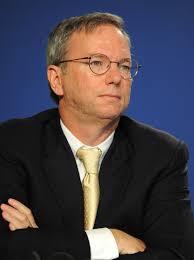
Eric Schmidt6:07
It's a really big deal for me to be here. It's an honor to receive this award, but to me, the most fun thing is the David and Dan, my friends here at Cornell, won a competition to go change the world in a project in New York that I think will have impact at the level that Cornell should be having. I think it's extraordinary what the opportunities are before us as we start literally this year, and I think over the next 10 or 20 years, you're only going to hear good things of the decisions that were made by this leadership team now to try to make innovation, wealth creation, solve real problems, and really solve a problem of creating true entrepreneurship in New York City. I think it's extraordinary. So let me start by asking you all a question: how many of you have used Google in the last 24 to 48 hours? Maybe I should have asked the other side of the question. Okay, good answer. Okay, next question: how many of you feel absolutely confident you'll have a job where you want, when you want, working for the place that you want, maybe six months after graduation? Maybe 15 percent. Okay, another question: do you think that the world will be a better place five years from now than it is today? Who thinks so? Okay, maybe half. For those of you who said that it's not going to be a better place, I'm glad I'm here. I hope I'm the bearer of good news, and I've got some good news. I think that you're wrong. I think the world is going to be a better place much sooner than you think. I think there's plenty of room for optimism, and my goal today is to talk about what those opportunities are. And I actually think it's because of you. It's hard to understand that it's you. You've grown up in it. You take it for granted that you're the network generation. You're going to define who our new networked age is, right, by scale, by master, connected to each other in ways those of us who came before could never even dream of. And you're using those connections to strengthen the invisible ties that hold humanity together and to deepen our understanding of all the world around us. And in the past, it's always older generations standing up on high trying to teach the next generation the ways of the world, trying to make sure you follow their footsteps. It's different now. You're teaching us. This generation, your generation, is the first fully connected generation the world has ever known. What's the first thing that you do when you get up in the morning? Check your phone, your laptop, read an email, comb through your social networks, see if you have to get out of bed, right? I claim that if you are awake, you're online. By the way, that's the definition of connectivity. And you're probably texting your friends right now, tweeting the speech, changing your status. Smile, you're on camera. Okay, so there's this joke about the college kid, you know, getting mugged, who says, 'Hold on, let me update my status, letting my friends know that I'm being mugged, and then you can have my phone.' You don't think I'm making that up? Happens all the time. But it's a telling, and I think it's a stark depiction of how essential technology has come to your generation's identity and your ability to connect to the world. And identity and connection are concepts as old as humanity itself, and they make up so much of who we are. They shape our times. They define the human condition. Identity and connection. It's your task to take those time-worn concepts, spin them around, reimagine them, and make them fresh and new and exciting. You have an advantage, by the way. You have an innate mastery of technology, an ability to find and foster connections that nobody before. And I can say from my position, we are jealous. We're jealous of what that means to the way you're wired, to the opportunities that will happen to you for many decades ahead of you. And it's interesting that people bemoan a generation who grew up living a life in front of screens, always connected to something or someone. These people are wrong. The fact that we are now connected is a blessing, not a curse, and that we can solve many, many problems in the world as a result. Not only is it an advantage that you have, it's also a responsibility that you carry. Now, let's talk about how the world is changing. I would argue that networks are changing our world. There's good examples. There's increasing returns to education. I'm really glad you decided to come here. There's increasing returns to global brands. That's why American firms with brands like Google and others that you know are doing so well globally. But there are not so good examples of networks and network effects: increasing concentration of economic power and elites leading to terrible things. The worst global financial crisis in 60 years, that's an example. There's lots of serious and long-term problems that are popping up now. There's a global demand problem, a lack of global demand for goods. That's why governments are printing money. They call it helicopter. Take a helicopter, drop money in every country, send a helicopter again and drop more money in each country. Somehow, eventually, we'll run out of gas for the helicopter, I guess. You have a permanent group of young people who are jobless or marginally employed, which will not be you by virtue of your commitment to education and the things that you care about. You have a growth in percentage of service sector jobs, and they tend to be in the government or public sector, which are less productive. You have a lack of efficiency in government and public sector jobs due to regulation, union rules, and no tolerance for risks. You have a problem of democracy that individuals will sometimes vote for their own local interest rather than society's interest. You have a loss of the traditional role of media, and you have the fact that political systems can actually fail. These are very serious, weighty problems. So I look at this and I say, well, what's the upside? We've got lots of capital. We have lots of money floating around this global system. We need economically viable projects in the world. And what are some of the best solutions that we know now? Let me give you an example in education, in STEM education. There are plenty of examples. STEM is basically the math and science stuff. There are plenty of examples of internet-enabled education. Right, universities are now looking at various startups that are doing this. I'm on the board of something called the Khan Academy, which is revolutionizing sort of really high schools, think about how they should teach various classes and so forth. These are all video internet solutions of one kind or another. We want as many of those choices as possible, and we want to measure the hell out of them to see whether they work or not. And there's promising results in each. You have universal language translation, and everybody goes, 'Oh yeah.' Do you have any idea how important that is? People have searched for universal language translation for thousands of years. Wars have been started and fought and lost and won over the fact that people could not communicate. In a few years, we just solved that problem, and no one gives us any credit as computer scientists, right? Dan, I mean, this is you. We've been talking about this. Where are all the awards for the fact that we've now translated everything to everything else? Everyone can talk to everybody. I mean, come on, guys. Come on. Here you are. Here you are. You are Cornell, and you know you've got some loopy professor who's got some assignment in some weird language. Just type it into Google. Okay, you're done. Sorry. Sorry, sorry, sorry, David. I didn't mean that. Well, sort of I did. Let's keep going. Give you another example: with modern tracking, financial tracking systems, we can develop a global financial asset model where we can actually solve the tracking problem for illicit goods and money. We can actually figure out the source and elements of corruption, and we can fix it and eliminate it. That has more impact on a whole bunch of countries and people than you could possibly imagine. We could establish a principle that you should always have two choices: government services and educate people. That keeps everybody efficient in one way or the other. There are lots and lots of examples of this. Innovation is disruptive and often occurs from outside of the system. You could build a consensus on how new jobs are created. Right, two-thirds are done from small businesses. Let's celebrate entrepreneurs. Let's figure out. Of course, by the way, this is the audience that did this. Right, this is the whole initiative around Cornell is to try to understand entrepreneurship. You have a very successful program here, which I visited this afternoon, as an example. It's important to establish a culture of fact. When you see a debate on television about facts, demand a follow-up analysis on the truth. And if they're lying to you, turn off the television. Now, many of you, you don't watch television anymore, which solves that problem, but you get the idea. You can actually know whether things are true or false. You can actually decide if political leaders are misleading you or not. You have an ability to know things that we didn't before. An example: when it wouldn't, you can think about food distribution in the developing world. The food is stolen and spoiled and so forth. Demand that the ultimate recipients send you an SMS that says, 'Hey, I got the food,' and then figure out why it didn't get there. So when I look at it, I look at technology, which is sort of what we all do, and a whole bunch of you do with me, and we say, what can technology help solve? The education problem, the corruption problem, delusive networks, the terrible tyrant problem, the small business growth problem, the language problem, the energy problem, which I haven't talked about, which is amazing, and the bad government problem. Pretty good list. Right, reason to be optimistic. Now, don't get me wrong. I mean, political systems, governance systems do matter, but real leadership is very hard to find, and that's why we turn to you. The leaders will be stepping up to assure some sort of a new. You're going to listen to me, and you're going to figure it out, and you'll figure it out better than I will. To me, the question remains: what does the technology future lie? And keeping in mind that predictions are a great way to look foolish, it's important to point out that the future will come sooner and be stranger than any of us think right now. Everybody here knows that connectivity is changing the world in ways that none of us could possibly imagine. Everyone can dream of a far-off future where everyone is connected, everyone lives longer, and the poor are lifted up and given a new voice, a new hope. But the truth is, we don't have to dream. The technology that can truly change lives and nations and planets, much of it is already here or will be very soon. So here's what I predict that all this technology will allow to make happen. It's a future that in some ways is right around the corner, but in other ways is already here. We're going to be more efficient. So you wake up in the morning and imagine a fully integrated living space. No alarm clocks. The coffee is made. Your windows open to let in the sunshine, and there's a back massage, not a loud buzz that nudges you awake. By the way, REM-timed sleep alarms exist already. You've got a mattress sensor monitoring your sleeping rhythm, and it coordinates with your home to not wake you up and interrupt the cycle. You skim through the daily news on transparent screens, holograms of your email to decide whether you really have to get up. And of course, then you get into your driverless car. I mean, come on, we let humans drive these things. I mean, the concept of human drivers will be seen as antiquated. You let humans drive things that are two tons that can kill people. We can do a better job. Now, I've been in the Google Fiber car, and it's hair-raising, trust me. And there's a really big red button that stops. So we're not quite there, but we're getting there. Voice recognition, instant transcription of emails, texts, no more texting and driving, even though you're likely they won't be driving anyway. Think about social robots that recognize human gestures and respond to them. Your life is centralized. Your small tasks streamlined, leaving you more time to tackle the big tasks, the deep tasks, letting you get away from work, learn a new language, climb a mountain, meet somebody new, free you up to live your life the way you want in ways that your generation before you could never have done. Pretty neat. That's not the most important story. There's an even more important story in the developing world. 1.5 billion people live on less than a dollar a day, and hundreds of millions of children go to bed hungry at night. Half of the world's people don't even live under democratic governments. The rights that we all enjoy are a rarity, not a norm. And when it comes to the internet, we think everyone is online, but only a billion people have smartphones, and two billion have access to the web today. So for most of the world, internet cafes are far-off digital oases in technological deserts. But in this century, there's a chance for change on this horizon. Connectivity can meet and revolutionize every aspect of our society: politically, socially, economically. And I would tell you that to connect the world is to free the world. And here's how it can happen. Village fishermen and women can keep fish on the line and wait for calls instead of waiting to bring them onto the market. You can allow formerly isolated people to connect with people, be part of the world, exchange information, learn from and teach the world. Digital data changes society. Data as a tool. Governments can measure the success of programs. The media can check the government's claims. Markets expand by better metrics, reshaping economies. Newly discovered talents. I mean, perhaps the best graphic designers come from a part of Botswana because of a particular aspect of their culture and their sets of style, and all of a sudden those become the wealthiest citizens in Botswana because they can practice their work from where they live and serve a global audience. Newly competitive advantages for disadvantaged economies. New opportunities for collaboration, for ways for parents to educate their children. Any child who cannot attend school because it's too far or too dangerous or expensive, now they have a lifeline to this limitless world of learning. But I even don't think that's so impressive, although it's life-changing. Many of our most pressing public and individual health issues, right, some of them anyway, obesity, diabetes, can be brought under control. Now, bear with me. How are you going to do that? The next step of medical technology, medical science, is devices that transdermally, that is, without invading your skin, without pricking your skin, measure what's going on, and ingestible pills. We think of these as microphonic robots that track blood pressure, detect early hints of heart disease or even cancer. You used to say, 'Is he making this stuff up?' There is already a pill approved by the FDA that collects information about a patient's response to a drug, relays information to a doctor over a Wi-Fi network. In case you're wondering how important Wi-Fi is. So think about what this means for chronic sufferers and the elderly. Automatic and intensely accurate reminders to take medications, constant digital interaction with your doctor. So when I think about it, what I want is a 'How's my mom doing?' app. And my mom, by the way, would take the smartphone that I gave her, because you know, she's like my mom, right? She's like my mom. And so she's going to basically run this thing, and it'll alert me if there's some significant change in her life patterns. It says, 'Call your mom, see how she's doing.' So my point is, you follow that reasoning. Each of us has access to our own personal health care systems. We detect something's wrong with us, find the closest and best-equipped doctor to handle it, and get that doctor all the information that we need before we walk into his or her door. The doctor calls you, not the other way around. You better get your rear end into this hospital right now. Don't ignore this text message. Think about it. So I want to talk a little bit more about the distant future. I've talked about what I think will be in the next five or so years, but I think that we see beginnings of what will happen with you all 10 years out, 15 years out, and your new career is with the impact that you're going to have. The current structures of the world are going to come under much more pressure. The aging of the Western world, the demographics of smaller families mean that even for the most advanced countries, the only path is rapid improvement in productivity so that the standard of living can be maintained on a per-generational basis. The countries with demographic dividends today will face this in a decade or two. So China, India, those sorts of things. So for the set of things that bind us together, DNA, health, and human spirit, we'll know so much more about ourselves as the global knowledge expands. This unparalleled explosion in simultaneous science means knowledge grows faster, not slower. Now, here at a university, you know this. The average person thinks that everything's been discovered, is already been discovered, there'll be no new progress. This is manifestly wrong. In fact, global collaboration with universities like this one, with everybody else, means more and faster innovation, more and faster and exciting new inventions of all kinds. Global science knows no restrictions. We're all locked in the same physics regardless of our nationality or sect. What's more is globalization means that thousands of local experiments in each country, of which best practice becomes clear. Do you know, those French might actually be useful for something. They might actually have done something better than we did. Shocking. Okay, I'm being facetious. That was a joke. In an age of Twitter, if you tell a joke, you have to label it a joke. Simple rule, easy to remember. Where the problem is lack of awareness and lack of education, these problems are solving over the next decade because everyone is now or soon will be connected. So where there's a lot of information, we can solve those problems. If it's health care or security or cultural problems, can persist longer. The sum of rising expectations, comparison of other systems, puts enormous pressure on our existing institutions. These institutions, riddled with tradition and tuition and special interests, in my view, are going to be overcome by this tsunami of pressure from expectations. By the way, in technology terms, we call this a forced upgrade. Human systems are messy and unpredictable, and the surprises will be causes for disappointment and further conflict. And the autocracies, by the way, will have the toughest time because they're the most change-resistant. At least the democracies will do okay. The twin forces of globalization and automation then put enormous pressure on systems, and government simply replicating what worked in the past is not going to work in the future. And even after security and basic infrastructure is established, developing countries are going to face very stiff global competition unless they can establish a unique advantage in resources, human capital, natural resources, minerals, oil, and the like. It's interesting that if you try to go even farther, now we're really on thin ice, 20 years, 30 years, you actually conclude, what was surprising to me, eventually technology just disappears. The ultimate achievement, my goal if you will, is to make technology just disappear. Now, I don't mean technology will become irrelevant. I mean it becomes part of everyday life. Arthur C. Clarke once said that any sufficiently advanced technology is indistinguishable from magic. That's true, but I'd argue that any sufficiently widespread technology ceases to be magic. Hence my comment earlier about universal translation or Google Maps. Like, 'Oh my god, you know, how do they do this?' 'Oh yeah, I knew that forever. Why are you surprised?' You know, so when it's everywhere, it no longer surprises. In the future, people will have to spend less time getting technology to work, worrying which cables work and with computers where your content is stored, and more ports or prompts or plugins, because it will all be seamless. It will just be there. In that sense, the web will be everything, and it will be nothing. It will be like electricity. And as for the future of the web, if I had to sum it up in one sentence, it will be nothing, and it will be everything. It will be nothing because it will disappear, not by going away, but by going everywhere. So if we get this right, I claim, and I want to challenge you, that we can fix all of the world's most pressing problems, to beam light rays of hope, if you will, to millions who up till now have only seen a flicker. We've gotten ourselves into some sort of weird depressed state about all of us. I think it's wrong. I think it's actually just wrong. And I would argue that each of us, and in particular you, by virtue of the opportunities before you, have that power right in your pockets, right, literally through these devices, my Android phone, my Nexus S. Right now, here's the deal. If it's true, if what I said is true, we have all this knowledge literally at our fingertips. But just because we know so much more doesn't mean that our moral compasses don't go away. Right, the future doesn't just happen. Okay, it's not etched or written or coded anywhere. There's no algorithm that says, 'Sorry.' So no formula or algorithm says technology will do X, so Y is sure to happen. But computers can do amazing things. That's why I do what I do. My colleagues here at the university, this is why we took on the challenge of computing and information technology. We're so proud of these things in your pockets. They contain power inside of them that your parents would never have possibly imagined. They have speed, they have memory, they have intricately complicated wiring and unfathomably complex circuitry. But I'll tell you this one thing that they actually don't have: they don't have a heart. Interesting. All of these connections that you forge, the digital ties that bind our humanity together, it's not possible without technology, but it's not possible without you, and more importantly, without a heart. You have that heart. You will provide the pulse, if you will, with this technology platform for our future. So to finish up, let me say that I studied this a little bit using my favorite search engine. It's a graduate from this university a little while back, class of '92, 180, right? His archives are here on campus, as you all know. He said, quote, 'I arise in the morning torn between the desire to improve the world and a desire to enjoy the world. This makes it hard to plan the day.' Pretty good quote. What's interesting is if you think about it, this is why this is such a neat quote. You don't have to make that choice anymore. You can do both. I urge you to do both, and I expect you to do both. And frankly, the rest of us need you to do both. So please go ahead and plan your day. Technology can be one of our most potent tools, but it's ultimately the users who change the world. That's you. It's up to you to improve our world, to enjoy our world, and because of you, unlike any generation that's come before, you can do both. Thank you very much.