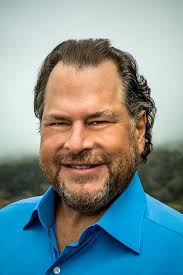
About Marc Benioff
Marc Benioff, the co-founder, chairman, and CEO of Salesforce, has been actively discussing the company's financial performance and its strategic pivot toward an "agentic enterprise." In the company's FY27 first quarter earnings call, Benioff reported that Agentforce, Salesforce's autonomous agent platform, has become an $800 million business, and he raised the midpoint of the company's FY27 revenue guidance to between $45.9 billion and $46.2 billion. He also announced a $25 billion accelerated share repurchase program, part of a larger $50 billion buyback authorization, which he described as a move to return shareholder value during a period of "incredible low prices." Benioff has characterized the current market environment as a "SaaS apocalypse," but stated that it is "not my first" such cycle, expressing confidence in Salesforce's position.
Benioff has emphasized Slack's role as the central user interface for the AI ecosystem, stating that "Slack became the user interface to Salesforce but even to the whole AI ecosystem." He described Salesforce's strategy as a stack that includes large language models, a federated data layer (including the newly acquired Informatica), applications like sales and service, and the Agentforce orchestration layer. He has also discussed the importance of the Model Context Protocol (MCP), an open-source standard from Anthropic, as a foundational piece of AI infrastructure. In conversations about AI's broader impact, Benioff expressed concern about potential labor disruption from AI, stating he worries that it could operate "faster" and be "broader across the economy" than previous technological shifts. On political matters, Benioff described himself as "an American" rather than a Democrat or Republican, and advocated for "economic entanglement" with China as a path to a "no conflict deal."
Source: AI-verified profile updated from Marc Benioff's recent appearances.
Browse all interviews →
✨ AI-enhanced transcript with speaker attribution
I
Interviewer0:00
I recently sat down with Marc Benioff and at the time they had just announced 30 new capabilities for Slackbot all in a single keynote and he told me something that I haven't really been able to stop thinking about.
M
Marc Benioff0:11
I hope that they see that this was the moment where Salesforce became Slack first, that Slack became the user interface to Salesforce but even to the whole AI ecosystem.
I
Interviewer0:21
The user interface to the whole AI ecosystem. I mean that's a massive architectural claim and Benioff isn't the only one making it. I mean Microsoft is building the same argument for say Teams with Copilot. Google is doing it with Gemini inside every workspace. Basically every major platform company is racing to become the single service that every model, every agent runs through. But here's the thing. The reason Slack might actually be able to pull this off has nothing to do with Salesforce's sales team. It has to do with a protocol that most people outside of engineering have never heard of. And that protocol is quietly becoming the most important piece of infrastructure in the entire AI stack. Okay. Back in November of 2024, Anthropic open-sourced something called the Model Context Protocol, MCP. The simplest way to understand it is this. Before MCP, every time you wanted an AI model to talk to an external tool, you had to write a custom integration. For example, if you want Claude to query your Postgres database, custom code. You want it to also pull from Slack, different custom code. You want it to work with say Jira, another integration. Every combination of model and tool required its own bespoke wiring. MCP standardizes all of that. One protocol, any AI model that speaks MCP can connect to any tool that has an MCP server. The analogy people keep using is USB-C. Before USB-C, every device had its own charger, its own cable, its own connector. MCP is doing the same thing for AI agents. One standardized interface between the model and the world. By early this year, MCP had over 97 million monthly SDK downloads. 97 million. More than 500 public MCP servers. Official SDKs in TypeScript, Python, C, Java, and OpenAI adopted it across ChatGPT. Google supports it. Microsoft supports it. Anthropic donated it to Linux Foundation. In about 18 months, it went from an open-source side project to the connective tissue of the entire agentic AI stack. Now, when I was talking with Marc, he kept coming back to that one idea that the pattern he sees across every major tech wave, whether it be cloud, mobile, AI, is the same.
M
Marc Benioff2:36
You've got to build an ecosystem around you. That in our industry, you can't really do it alone. You need to do it in combination with others, other companies, other evangelists, other customers, other influencers. All of these people are critical to making a successful product.
I
Interviewer2:52
That is exactly what MCP enables and it explains why Salesforce is betting everything on Slack as a surface layer. Okay. In February 2026, Slack launched its own MCP server. That meant any external AI client, Claude, Perplexity, OpenAI, could pull data from Slack and take actions inside of it. Then in March, Slack became an MCP client too. Meaning Slackbot itself can now reach outward and call into any external tool or service that runs an MCP server. And that's bidirectional at its finest. Agents can talk to Slack. Slack can talk to agents. And because MCP is an open standard, Salesforce didn't have to build custom integrations with each AI company individually. They basically built one MCP implementation and every model that speaks the protocol can plug into it. Now Marc told me he does basically all of his work in Slack.
M
Marc Benioff3:42
Slack has become my primary interface to Salesforce and all of our core systems. But we have this new Slackbot capability which is just making me a lot more productive. Even today, I was working on a tweet just before we started the show and I just went on Slack to do it because, you know, it understands my business and all my DMs and everything and it also understands what I'm trying to do. Plus, it has Anthropic.
I
Interviewer4:05
And I experienced the same thing before the keynote. I was going through the Slackbot demos and I realized something. I'm a big user of Perplexity's computer and then I'm also a user of Claude Code. And when I was going through these examples today before the keynote, I thought I no longer have to go to any of these other interfaces. I can do it all right in Slackbot. That experience I described using Perplexity and Claude and other tools without leaving Slack, that only works because of MCP. So here's what's actually happening under the hood. Slack sits at the top of the stack as an interface layer. Below that is Agentforce, Salesforce's agent orchestration layer. Below that are the applications like Sales Cloud and Service Cloud. Below that is what Salesforce calls Data 360. That's a data layer that pulls from your CRM, your email, your files, your information pipelines, and it harmonizes it so agents can actually understand your business context. Now Marc described this stack during our conversation. So take a listen.
M
Marc Benioff5:07
You know, you have to think about our overall strategy at Salesforce. One is of course we use these large language models to our advantage to make our products better. Then we have our data layer and that data layer is kind of a federated layer that's also harmonized, that's integrated, that includes our new Informatica capability and others. Then we have our applications like Sales and Service and then our Agentforce layer.
I
Interviewer5:29
That data layer is the part that most people skip over and it's the part that actually matters for engineers. MCP gives agents a way to connect to tools, but the quality of what those agents can do depends entirely on the data underneath it. When Marc says federated but harmonized, he's basically describing a genuinely hard engineering problem. Enterprise data lives in dozens of different systems with completely different schemas. Your CRM stores customer records one way. Your support tickets are structured differently. Then you have things like your email threads that have no schema at all. For an agent to do useful work across all of those different systems, something has to reconcile those schemas in real time. And that's what Salesforce is building with Data 360. It's basically a translation layer that lets agents reason across data sources that were never designed to talk to each other. And MCP is the protocol that lets the agent actually reach those sources. I mean, Anthropic is using this full stack right now. And at the keynote, Salesforce announced the results. So, Anthropic accelerated their deals. It was announced today at the keynote by 60% using Slackbot.
M
Marc Benioff6:34
That is pretty awesome.
I
Interviewer6:35
It's incredible. 60%. And I had to look at the slide twice. That 60% number is what makes this interesting beyond just Salesforce because every platform company is making the same architectural bet right now. Microsoft building Copilot Studio as their agent orchestration layer with Teams as the surface. Going back to Google, Google has Gemini wired into Workspace with their own agent framework. Even OpenAI launched Frontier with the vision where they own the orchestration layer and SaaS companies become data providers underneath. Each one really has a different answer to the same question. Who owns the interface between humans and AI agents? Now, Slack's argument is that a communication tool people already live in with MCP as the protocol layer beats a document editor or a standalone AI chat window. Custom AI agents inside Slack have grown 300% since January. And starting this summer, every new Salesforce customer automatically gets Slack bundled in. To me, and hopefully to you, that really tells you where Salesforce thinks the future of enterprise software lives. Marc told me he thinks the next wave goes beyond language models entirely.
M
Marc Benioff7:41
What is next? We're going to see world models, but we're going to see multisensory models. The idea that it's not just about language, but it's data points that are really coming from lots of different capabilities. And that idea where we need more data, more data points or these kind of different attributes, it's going to make our models a lot more accurate.
I
Interviewer8:00
Multisensory models processing data from multiple sources all at once. That means MCP servers won't just be connecting to databases and messaging apps. They'll need to handle sensor data, video feeds, audio streams. I mean, even things like location data. The protocol was designed to be extensible and that extensibility is about to really get tested. Now for engineers, this is where the opportunity is right now. MCP servers once again are open source. The spec is public. Anyone can build one and the companies that build the best MCP integrations for their particular domain are going to have a real advantage as every AI platform competes really to be the one interface. I'm very passionate about this. So Marc told me about a conversation he had at MIT with a computer science student who was thinking about changing her major and shifting gears a little bit, but it's very fascinating. So I really wanted to include this part in the video.
M
Marc Benioff8:53
I was at MIT last week and I was having lunch with an incredible woman who's a computer science major who's a junior and it was part of a group of MIT students that I was with, maybe about 20 of them. And she was thinking, well, should I change my major? And I said, no, you shouldn't change your major. That, you know, we're in this incredible industry and now you're just a lot more productive as an engineer.
I
Interviewer9:16
He's right that engineers will be more productive, but I would even go further. Engineers who understand how protocols like MCP actually work, who can build the connective layer between the AI models and the real systems. Those are the engineers who are going to be the most valuable in the next 5 years. The race to become the one interface for AI isn't going to be won by whoever has the best chatbot. It's going to be won by whoever has the best protocol layer underneath it. And right now, MCP is that protocol. Marc said it was about the stack, not just the Slack.
M
Marc Benioff9:50
You're using our stack, not just our Slack.
I
Interviewer9:52
He's more right about that than I think anyone really realizes. All right. And I hope you enjoyed this video. It was so much fun sitting down and having a really candid conversation with Marc and especially looking ahead what the future holds for AI and what it means to have that foundational layer with MCP. I think it's something that not enough people are having conversations around. Leave in the comments who else would you like me to bring on the channel for conversations around where tech is headed.