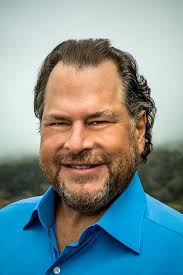
About Marc Benioff
Marc Benioff, the co-founder, chairman, and CEO of Salesforce, has been actively discussing the company's financial performance and its strategic pivot toward an "agentic enterprise." In the company's FY27 first quarter earnings call, Benioff reported that Agentforce, Salesforce's autonomous agent platform, has become an $800 million business, and he raised the midpoint of the company's FY27 revenue guidance to between $45.9 billion and $46.2 billion. He also announced a $25 billion accelerated share repurchase program, part of a larger $50 billion buyback authorization, which he described as a move to return shareholder value during a period of "incredible low prices." Benioff has characterized the current market environment as a "SaaS apocalypse," but stated that it is "not my first" such cycle, expressing confidence in Salesforce's position.
Benioff has emphasized Slack's role as the central user interface for the AI ecosystem, stating that "Slack became the user interface to Salesforce but even to the whole AI ecosystem." He described Salesforce's strategy as a stack that includes large language models, a federated data layer (including the newly acquired Informatica), applications like sales and service, and the Agentforce orchestration layer. He has also discussed the importance of the Model Context Protocol (MCP), an open-source standard from Anthropic, as a foundational piece of AI infrastructure. In conversations about AI's broader impact, Benioff expressed concern about potential labor disruption from AI, stating he worries that it could operate "faster" and be "broader across the economy" than previous technological shifts. On political matters, Benioff described himself as "an American" rather than a Democrat or Republican, and advocated for "economic entanglement" with China as a path to a "no conflict deal."
Source: AI-verified profile updated from Marc Benioff's recent appearances.
Browse all interviews →
✨ AI-enhanced transcript with speaker attribution
J
Jim Cramer0:06
Ever since 2016 began, we've seen a hideous beatdown in virtually all things growth, especially the high-flying enterprise software stocks like Salesforce.com, the king of cloud computing. Here's a stock that plunged from $78 at the end of 2015 down to $62 as of today, on no real fundamental news whatsoever, just a rotation away from richly valued growth stocks. But maybe people have gotten a little too negative because after the close, Salesforce reported a spectacular quarter, much higher than expected revenues and operating cash flow, not to mention raising its fiscal year 2017 revenue guidance, which caused the stock to roar in after-hours trading. So let's dig deeper with Marc Benioff, the brilliant co-founder, chairman, and CEO of Salesforce, here more about the results and where his company is headed. Mr. Benioff, welcome back to Mad Money.
M
Marc Benioff0:50
Jim, it's great to be with you from San Francisco.
J
Jim Cramer0:54
All right, Mark. I'm trying to focus on which ones are the best. I've got quarterly revenue up 27% in constant currency. I've got the full-year revenue up 27%, but this operating cash flow is the highest I can recall, up 38% year over year. Tell our viewers what operating cash flow really means.
M
Marc Benioff1:10
Operating cash flow, Jim, means the amount of cash that we're receiving from our customers, and it just hit record levels. You can see, Jim, this is the best quarter we have ever had. Non-GAAP operating margins up 177 basis points, all-time high in large transactions.
J
Jim Cramer1:30
Let's figure out what does that mean in terms of who you won, what big business you got.
M
Marc Benioff1:38
What business did we not win, Jim? This was a quarter where every single deal that we wanted to take down, we did, including two of the largest deals in our company's history, which were massive nine-digit transactions. We just had a phenomenal end of the fiscal year.
J
Jim Cramer1:52
You got to give us — if you're going to mention nine-digit, you got to drop the names. Who did you win those?
M
Marc Benioff1:59
I can say, Jim, it's one of the world's largest insurance companies and one of the world's largest consulting companies.
J
Jim Cramer2:06
Fair enough. Okay, well, let's talk about two that I am familiar with that you won that I think our viewers know. What are you doing for Charles Schwab and what are you doing for Unilever, which are two good fourth quarter wins?
M
Marc Benioff2:16
Well, you can see there are so many customers like these who have these existing Oracle and SAP systems. They need to modernize, they need to move to the cloud, they need to connect to their customers in new ways, and they need to rip those old systems out and put in new systems. Charles Schwab is a great example where we're converting them from Oracle to Salesforce, and many, many other customers as well. With Unilever, that's our most exciting mobile story ever. Over 85,000 users are going to be on our mobile product, really exciting.
J
Jim Cramer2:50
All right, so I'm a Unilever salesperson. I'm trying to make a call on a supermarket chain in Brazil. What do I need from Salesforce?
M
Marc Benioff2:58
All you're going to need is your phone. Because look, every company wants to do their business on their phone and run their business from their phone. And Paul Polman at Unilever is committed to transforming his company using Salesforce. What Paul wants to do is very simple: he wants to empower and enable every single one of his employees around the world to have instant access to all of their customer information. And they're going to do that right from their phone using Salesforce. We have an incredible new platform called Salesforce One, an incredible new integration with their email system called Salesforce Inbox, and an incredible new analytic system called Salesforce Wave. They're using all of those capabilities to deliver a brand new system for their employees.
J
Jim Cramer3:44
We sat down with John Stumpf recently, CEO of Wells Fargo, and he was talking about millennials and how they love to bank on their cell phone, and how important it is to be able to be mobile, global, cloud. He did not mention Salesforce, but that is your win, right?
M
Marc Benioff4:01
Well, I'll tell you, we have an incredible relationship with many banks, including Wells Fargo. Of course, we have a great relationship with Bank of America, an incredible relationship with Deutsche Bank. There isn't a bank today on the planet that we're not doing incredible new business with. Because look, these customers need to do four things, Jim. One, like I said, they're trying to connect to their customers in new ways, which is the point you're making. Two, they need to run their business from their phone, which is the point I just made. Three, they're trying to build one-on-one relationships with their customers to help them through the journey of being a customer, and how they can onboard, retain, regain, or renew customers that have left. And four, they're trying to get smarter about their customers, be more predictive. And those four things are driving this business forward.
J
Jim Cramer4:50
These are a good point to branch off from. Since we saw you last, there was tremendous turmoil in the sector. A company like Tableau, which is not a cloud company, came down and it brought your stock down. Other people have been saying, 'Listen, there is finally a slowdown in software, in the cloud, or we wouldn't have seen that from LinkedIn.' Is it time to recognize that Salesforce is not of the same ilk as Tableau and LinkedIn?
M
Marc Benioff5:19
I think, Jim, you have to recognize that there's been a great cloud washing, where every company says they are the cloud, but beware of the false cloud, Jim. That's my point. Because there are many false clouds out there. A real cloud company is a company that has a deferred revenue model, that has a subscription service that's delivered in multi-tenancy, that has a customer model built on customer success, and has focused on the things that we've talked about on this show now for almost a decade, like the very core aspects of the cloud: scalability, elasticity, mobility, social integration, data science, and the internet of things. These companies are not focused in that area, and that's why they're not able to deliver the great results that you see from us today.
J
Jim Cramer6:08
I know on Oracle's calls, they seem to spend a lot of time talking about Salesforce. You do not spend as much time talking about Oracle as they do about Salesforce. What would they say if I asked them about why they lost the Schwab deal to you?
M
Marc Benioff6:22
Well, I think Oracle is a great company, but it's a great company of the past. This is a legacy company, a company that delivered great software to companies in the past, in history. They're trying to bring that history forward, but without a new architecture, that's why they're shrinking, they're declining. You look at those growth rates of Oracle, SAP, and even Microsoft, they're all negative. Not that they're not great companies with great CEOs, they are, but they're just not able to bring their customers forward. That's why companies like Charles Schwab, Unilever, Wells Fargo, and many of the great companies we're dealing with around the world are turning to Salesforce, because we're able to help them connect with their customers in these new ways, and to do it rapidly and at a low cost using this cloud model. That's what we want to do for everyone.
J
Jim Cramer7:13
All right now, Mark, recently you came on and you said that the unicorns ought to come public, and they didn't. Frankly, they've just been quietly getting shorn. I thought of you the other day when Chuck Robbins, who's a mutual acquaintance, was able to buy a unicorn for a very low valuation for Cisco. Are you finding it easier to get talent than it was when these companies were offering bomb? And two, are there companies that are not going to make it that would fit in with Salesforce?
M
Marc Benioff7:40
Well, I think we've had a number of really important conversations about that on your show, Jim. Here in Silicon Valley, it's an explosion of innovation. We've never seen so many great ideas and great new companies. But in that same breath, we're also seeing a tremendous acceleration of these valuations, and I think maybe excessively so, especially in these higher rounds like the C, D, and E rounds, where you see these huge valuations. We have public companies now with great valuations with higher revenue levels than these private companies. So why wouldn't you go into the public markets, which I think have to be the measure of where these private companies have to be valued? We've got some great companies in the public markets that I think are on sale. This is a time to rationalize between the private and public markets.
J
Jim Cramer8:40
Well, it's interesting you mention that, because Fitbit, which I know you have a big public position in, I talked to James Park and obviously he's kind of bitten by running the company a little bit like a private company. You deliver quarter after quarter after quarter, and there are very few surprises other than upside surprises. That is not what James delivered.
M
Marc Benioff9:00
Well, I love Fitbit, and I thought he had a great quarter this morning. I opened my mail, look what I got, my new Fitbit Blaze, which I'm really excited to be wearing. I'm a huge fan of Fitbit, I have been for five years. I'm also a huge part of the Fitbit community; I compete with all of my friends on my phone. That's a huge part. I've had 20 Fitbits. Every time he has a new Fitbit, I'm able to kind of put that one on, but I still am in the same Fitbit community. I love Fitbit, so that's why I'm an investor in Fitbit and I'm a bull on Fitbit.
J
Jim Cramer9:32
Well, your Fitbit analysis made me look at my Apple Watch, and I like that my Apple Watch is secure, that it is private. Where do you come down on this very difficult issue rocking between wanting to be a patriot, obviously, and get the bad guys, versus also guaranteeing security on our iPhones?
M
Marc Benioff9:52
Well, Jim, is your Apple Watch currently charged? Because I think the last time I saw it, it had a big red dot on it. And this goes for 5 days straight hours.
J
Jim Cramer10:03
I chose not to go to sleep that day. You know, I pulled an all-nighter. You know, that was an all-nighter. Five days with no charge, Jim, that's pretty exciting.
M
Marc Benioff10:12
You know, you never have to have one of those big red screens again on your watch.
J
Jim Cramer10:15
But the privacy issue is kind of paramount. What are you thinking there?
M
Marc Benioff10:22
What I'm thinking is it's a new world. Privacy and security — there is no finish line when it comes to these areas. We're in the fourth Industrial Revolution, and we are seeing revolution in information technologies and bioinformatics technologies and the biological sciences themselves. The things you're bringing up are things we're going to be talking about for decades to come. This is the new world we're in. We're in a world today that is gripped by this technology revolution, and we are going to also be gripped with things like privacy, but also issues like inequality and issues like sustainability. This is also part of the fourth Industrial Revolution, and we need to have these conversations so that everyone is aware of what's going on in the world today. It's a big change.
J
Jim Cramer11:12
Should Tim Cook cave to the FBI?
M
Marc Benioff11:16
I think that what Tim Cook should be doing is getting down right now to the state of Georgia and going down and talking to those leaders about House Bill 757. Because we're very worried about what's happening to our employees down there with more discrimination, like what we fought back in Indiana last year, just reared its head in HB 757. That's what I think Tim Cook should be focused on right now.
J
Jim Cramer11:39
All right, fair enough. I'm focused on the fact that your quarter is moving the stock up greatly because a lot of people thought you were going to miss for some reason. And I want to thank you again, congratulations on a remarkable quarter, the best that I've seen you have in all the years we've been working together. Mark Benioff, chairman and CEO of Salesforce. Good to see you, sir.
M
Marc Benioff11:56
Jim, great to see you.
J
Jim Cramer11:59
All right, there you go. That was the quarter that everyone told me was supposed to be not good, and it was a blowout, and the stock is not done going higher. Mad Money's back after the break.
Boo-yah! Jim Cramer here from Mad Money. Thanks for watching CNBC on YouTube. Click here to subscribe and get the jump on my exclusives with CEOs, plus market news, investing advice, and a whole lot more.