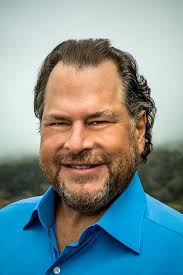
About Marc Benioff
Marc Benioff, the co-founder, chairman, and CEO of Salesforce, has been actively discussing the company's financial performance and its strategic pivot toward an "agentic enterprise." In the company's FY27 first quarter earnings call, Benioff reported that Agentforce, Salesforce's autonomous agent platform, has become an $800 million business, and he raised the midpoint of the company's FY27 revenue guidance to between $45.9 billion and $46.2 billion. He also announced a $25 billion accelerated share repurchase program, part of a larger $50 billion buyback authorization, which he described as a move to return shareholder value during a period of "incredible low prices." Benioff has characterized the current market environment as a "SaaS apocalypse," but stated that it is "not my first" such cycle, expressing confidence in Salesforce's position.
Benioff has emphasized Slack's role as the central user interface for the AI ecosystem, stating that "Slack became the user interface to Salesforce but even to the whole AI ecosystem." He described Salesforce's strategy as a stack that includes large language models, a federated data layer (including the newly acquired Informatica), applications like sales and service, and the Agentforce orchestration layer. He has also discussed the importance of the Model Context Protocol (MCP), an open-source standard from Anthropic, as a foundational piece of AI infrastructure. In conversations about AI's broader impact, Benioff expressed concern about potential labor disruption from AI, stating he worries that it could operate "faster" and be "broader across the economy" than previous technological shifts. On political matters, Benioff described himself as "an American" rather than a Democrat or Republican, and advocated for "economic entanglement" with China as a path to a "no conflict deal."
Source: AI-verified profile updated from Marc Benioff's recent appearances.
Browse all interviews →
✨ AI-enhanced transcript with speaker attribution
J
Jim Cramer0:06
At a moment when it seems incredibly likely the Federal Reserve will raise rates in December, just witness last month's hawkish Fed minutes that were released today. We need to remember what groups work in a rising interest rate environment. And you know what cohort tends to outperform when the Fed's tightening? The consistent turbocharged growth stocks that won't even notice the sting from higher rates or a softening economy. Case in point: Salesforce, the company that practically invented cloud computing. It's one of the fastest growing enterprise software plays out there, if not the fastest of all time. Now Salesforce just reported at the close today. The company delivered a direct 2-cent earnings beat on a 19-cent basis, higher than expected. Revenue up 24% year-over-year. Management raising its full year guidance. Tremendous margin expansion. Let's take a closer look with Marc Benioff. He's the visionary founder, chairman, and CEO of Salesforce. Hear more about the quarter and his company's prospects. Mr. Benioff, welcome back to Mad Money.
M
Marc Benioff0:52
Great to see you, Jim.
J
Jim Cramer0:54
All right, Mark. You put it out there. You got a well on the way path to reach $1 billion faster than any other enterprise software company. Your confidence on $10 billion is based on what?
M
Marc Benioff1:05
Well, Jim, it wasn't that long ago that I was sitting here with you and we were talking about our first billion-dollar year. Now I'm so excited to announce that next year we'll do more than $8 billion, and we're still the fastest growing enterprise software company ever.
J
Jim Cramer1:20
Now it's important for people to understand that when you say an $8 billion, it's not like you pull a number out of your hat. I am reading that you have deferred revenue on the balance sheet of $2.85 billion, and then off balance sheet $6.7 billion, up 24% year over year. People at home should know that that kind of money does indeed flow toward that $8 billion.
M
Marc Benioff1:40
Well, Jim, as you know, when we actually conduct business in the quarter, very little of that actually appears in this quarter's revenue. It's deferred revenue, and it's kind of like a subscription service, like a magazine or a newspaper. Our customers subscribe to our services, and so we recognize the revenue as we deliver those services over time. And that's why we're able to give you such aggressive revenue guidance for next year of over $8 billion.
J
Jim Cramer2:09
At the same time, I have to believe that there were eight-figure contracts that you won this quarter that can get you to that level. Federal government, that was one of the rumors I heard. Some big contracts, utilities. What is the makeup of some of the larger contracts that got you here?
M
Marc Benioff2:23
We had great revenue growth across the board, and I think you can see from our revenue growth here in the United States, in Europe, even in Asia was really strong. And we had quite a few marquee deals actually. And to your point, we had an amazing transaction with Intel, we had an amazing agreement put together with AECOM, and we even did some amazing work with General Motors. But I'll tell you, the customer I am most excited about for the quarter is AECOM, the world's largest engineering company. Their CEO, Michael Burke, is running his business right from his phone, able to collaborate and communicate with his employees all over the world, manage his construction projects, connect with his customers. I mean, this is our dream of how companies can operate.
J
Jim Cramer3:07
Well, you can ask him. He knows that we love this company for a long, long time, and they're fantastic operators. Service Cloud in particular looks great. A couple of accounts that you have on your marquee page that I think are marquee. Here's one: Sprouts. Now that is in a business of natural food where many people feel that there are companies that are no longer gaining steam, but you put Sprouts right on the homepage. What are you doing for them?
M
Marc Benioff3:34
What company doesn't have to connect with their customer in a new way? And that's a great example where they're using our Customer Service Cloud to be able to provide a level of communication, a level of intimacy, a level of responsiveness to their customers that just wasn't before possible. You know, what we see our customers doing is creating one-to-one journeys with their customers, really mapping out what does it mean to onboard a customer, what does it mean to grow a customer, what does it mean to retain a customer. And by focusing on what we call the front office, by focusing on those customer relationships, our customers are growing. They're just growing much more than the economy. It's empirical: the companies that focus on their customers are companies that grow.
J
Jim Cramer4:17
All right. Now John Stumpf, we saw him when we saw you last in San Francisco. Wells Fargo has always prided itself on being able to cross-sell. Now we always felt that that is a one-to-one relationship business, but they have brought Salesforce in to increase cross-sell. What can you do that they couldn't do by themselves?
M
Marc Benioff4:32
Well, the financial services industry is a very exciting industry right now because it's an industry under huge transformation. And you look at a great company like Wells Fargo, just a few blocks from here in San Francisco. Great CEO John Stumpf, I just saw him last week myself. He's completely reconceptualizing what does it mean to be a bank, what does it mean to be in mortgage, what does it mean to be in retail banking, what does it mean to be institutional, what does it mean to be in every aspect of banking. But in all of these different businesses that he has, and he has a very diversified banking business, he has a single customer and he has a single view of that customer as a 360-degree view of that customer. And as his managers and his executives work with his customers all over the world, they're able to know exactly what the opportunity is. And that's the power of Salesforce with Wells Fargo. And we're so excited to expand our relationship with Wells Fargo.
J
Jim Cramer5:25
Well, let's talk about that because you've introduced me to a number of people who have described as being at these unicorn companies, and I know you have very good views on unicorns that are somewhat critical. But there have been a lot of unicorn companies created to try to take Wells Fargo's clients away because they say, listen, we have an algorithm that's better than Wells. If Wells is grafted to Salesforce, what does that allow Wells to do to compete with the algorithmic guys who claim they're going to take over all of Wells's customers?
M
Marc Benioff5:51
Well, there's a huge amount of innovation going on in financial services. You know that, Jim. I mean, it is amazing what's going on. And you're right, it's happening in startups. It's also happening in our community banks and regional banks, another huge Salesforce customer, Huntington Bank. And even the very largest banks in the world, that could be Wells Fargo here in San Francisco, that could be Bank of America where you are in New York, it could be Barclays in the UK, it could be Deutsche Bank. But it doesn't matter if they're small banks, medium banks, or those large banks, they're all using Salesforce because they all have to manage their customer information. Who does not have to manage their customer information in sales, in service, in marketing, building communities, having analytics, building apps, and also the Internet of Things, which is rapidly connecting all these companies to their customers at a speed that we've never seen before. And what we're trying to do is be that trusted industry advisor with those customers. So when we walk in with John Stumpf, we can show what are the best practices to get to precision banking. How is he going to build the one-to-one relationship with that customer? When I walk into that branch, you want to know exactly what the opportunity is with me. That's what Salesforce is.
J
Jim Cramer7:08
Mark, I need to know. There's just many talks, I think they're often confused with conversations about merging, where you have an unbelievable relationship with Satya Nadella, which is different from the previous management. Microsoft and Salesforce, what are they having in common that they're not trying to steal each other's customers?
M
Marc Benioff7:26
Well, Salesforce and Microsoft is a marriage made in heaven, Jim. I mean, we have the most complimentary product line, and we've been building products together with them. We've shared incredible best practices. And yes, it's also a healthy competition, honestly. I mean, there are executives that go back and forth between the two companies. It's amazing. But I'll tell you, at the end of the day, the number one organization that's benefiting is our customers. And you look at a great company like Unilever, who has really relied on the relationship between Microsoft and Salesforce to expand their customer relationships in a completely different industry, consumer product goods. And as you know, they have a great CEO, Paul Polman. We're doing phenomenal work with them to connect with their customers in new ways, helping them to run their business right from their phone, building these one-to-one journeys, and converting their product experiences into customer experiences. That's what's so exciting. We see all of that happening.
J
Jim Cramer8:29
All right. One last question on this unicorn situation. You have your gross margins expanding, which means you're still able to get talent without having to overpay. I think there are companies that we now realize were valued too high. What happens, put on your venture capital hat, because I know you've invested in a lot of companies. What happens to those companies, and will you be able to pick off the same people who you lost because they were paying way too much, because they should have gone to Salesforce to begin with?
M
Marc Benioff8:53
Well, number one, those unicorn companies, Jim, they are staying private way too long. And I have friends of mine who are CEOs of those unicorn companies, and I'll tell you the same thing I tell them: get out into the public markets. This is the opportunity to really rationalize your valuation. Let the market decide what your valuation is, instead of kind of manipulating the private markets to maximize your valuation. Let the market decide. Look at Salesforce. We've been a public company now since 2004, and of course every market is not perfect. Look at 2008. There's ups and downs. Every quarter is not perfect. There's ups and downs. But it makes you a better company to be rationalized by the public markets. And these unicorns are staying private too long, and it's hurting them. And I can give you example after example where they're getting trapped in their high valuations and then their inability to raise more money because new investors will not come in. And you saw Fidelity writing down quite a few investments that they have in unicorn companies. That's because of this phenomenon. And it's a disservice to the entrepreneur. They're really doing it to themselves. Get out, get into the public markets, let the public market rationalize it. And to your point on recruitment, when those valuations get too high, actually we don't lose employees to those companies because those employees realize they're going to companies whose stock is too high, so they can't provide reasonable compensation. So in some ways it's good for us, but in many ways it's bad for the industry because it's creating this unusual phenomenon, unprecedented. And there's really nowhere to go for a lot of these companies except for down.
J
Jim Cramer10:29
Fair enough. Well, anyway, congratulations on an amazing quarter, sending the stock up of course because you beat every single metric, as you often have, Mark. In the last time in the year since you were a $1 billion company. And thank you for coming to Dreamforce.
M
Marc Benioff10:43
Jim, it was great to have you again in San Francisco. We're so thrilled for you to be here.
J
Jim Cramer10:47
We'll be back there. That's Marc Benioff, the chairman and CEO of Salesforce. Stock's going higher, and it's not done. I think it can go up substantially from where it's trading in the after hours. Mad Money's back after the break.
Oh, Jim Cramer here from Mad Money. Thanks for watching CNBC on YouTube. Click here to subscribe and get the jump on my exclusives with CEOs, plus market news, investing advice, and a whole lot more.