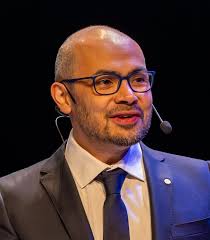
About Demis Hassabis
Demis Hassabis, co-founder and CEO of Google DeepMind and 2024 Nobel laureate in Chemistry for AlphaFold, has continued to discuss the timeline for artificial general intelligence (AGI) and its potential applications. In multiple recent appearances, Hassabis stated that he believes AGI could arrive around 2030, describing the current period as the "foothills of the singularity." He has emphasized that key capabilities such as continual learning, long-term reasoning, and aspects of memory remain unsolved challenges. Hassabis has also discussed the importance of the "agentic era," where AI systems actively solve problems, as a path toward AGI.
Hassabis has frequently highlighted the potential of AI to revolutionize drug discovery and medicine, stating that he believes AI could help cure every disease on Earth within a decade. He described a goal of reducing drug discovery times from an average of 10 years to months, weeks, or even days. Hassabis noted that Isomorphic Labs has test compounds in pre-clinical stage and that he views the first AI-designed drug reaching patients as a potential watershed moment. He has also expressed concern about public perception of AI, stating that the public is "right to be concerned" and that the technology is "dual purpose." Hassabis has called for international standards and cooperation on AI safety, and has advocated for the industry to demonstrate more unequivocal benefits of the technology, particularly in health and science.
Source: AI-verified profile updated from Demis Hassabis's recent appearances.
Browse all interviews →
✨ AI-enhanced transcript with speaker attribution
I
Interviewer0:00
This is Sir Demis Hassabis. He's the co-founder and CEO of Google DeepMind and Isomorphic Labs. For over two decades, Demis has been all in on artificial intelligence. He believes that within the next decade, AI could help us cure every disease on earth: cancer, Alzheimer's, Parkinson's, and even diseases we haven't discovered yet. So when his team at Google DeepMind invited me to Mountain View the day after Demis closed the I/O keynote, I had exactly one question I needed to ask him: what has this mission cost you that success can't repay?
D
Demis Hassabis0:35
It's a great question, I think.
I
Interviewer0:39
Before we get to that question, let me tell you what I was actually doing in that room, because I didn't fly out to Mountain View just to ask Demis what AGI will look like in the next few years. I flew out because for the last 12 months, Demis has been telling anybody who will listen that the most important thing AI is going to do isn't making movies, replacing developers, or running a search engine. He believes that the single most important thing AI will do for humanity is to end disease for good. I wanted to know how he thinks that could actually happen. So that's where I started our conversation. You said something which I agree with. You said the number one application of AI is to improve human health.
I
Interviewer1:12
And so I'd love to dig into Gemini for science. As I noticed yesterday, the most vigorous applause was for the scientific research.
D
Demis Hassabis1:19
Yes. What exactly does Gemini for science unlock for scientists? It's one of the things I'm most excited about. It sort of pulls together a few different projects we've been working on, probably most notably Code Scientist, which you can sort of think of as a fine-tuned version of Gemini that has extra additional tools and harnesses, citations, looking up literature, reading graphs, the kinds of things that scientists need to do.
I
Interviewer1:41
Almost like it's this great researcher system that you have. I've had the chance to sit with a lot of tech executives over the last few years, and almost none of them get visibly excited about a product that isn't going to show up in the next quarter's earnings call. But Demis is different. This is the version of AI he cares about most, the version that turns scientific breakthroughs once thought to be impossible into things that suddenly aren't. To understand why he believes what he believes, you need a bit more context on his origin story. In 2020, his team released a system called AlphaFold. It does one core thing: it takes the amino acid sequence of a protein and predicts what shape that protein will fold into. Now, that might not sound groundbreaking, but trust me, it is. Every single thing happening in your body right now is mediated by protein: your muscles contracting, your neurons firing, your immune system recognizing a virus and fighting it off, all of it. And until AlphaFold, scientists had only mapped the structures of about 1% of all known proteins. It took them 60 years to get there. AlphaFold mapped the other 99%, 200 million structures, in about a year. By every standard that existed before it, that was supposed to be impossible. Then Demis and his DeepMind colleagues gave the entire database away for free to the public. That's the work that Demis was awarded the Nobel Prize for in October of 2024, alongside John Jumper and David Baker. But the AlphaFold story isn't a one-off. Demis didn't get lucky once. He's been at the forefront of AI for over two decades. Back in 2010, he founded DeepMind in London with two friends at a whiteboard. At the time, most of the world had never even heard the phrase 'artificial general intelligence' outside of science fiction. Google bought DeepMind four years later in 2014 for around $650 million. It was the biggest European acquisition Google had ever made, and Demis insisted on one non-negotiable condition: DeepMind could continue doing fundamental science research to push humanity forward. Which brings me to the people Demis is still working alongside on Gemini today, people you've probably heard of. I've heard that Larry and Sergey are actually back and reinvigorated over the mission.
D
Demis Hassabis3:37
Yes, of course. Yeah. They're actually coding away in the weeds of Gemini. And Larry is always around at the board meetings. And strategically, he's very brilliant with sort of far future planning. So it's super fun talking to them all the time.
I
Interviewer3:51
Larry Page is in his early 50s, a billionaire many times over, and he's still in the codebase. The kind of person who doesn't actually retire, whose hands need to be on the thing, pushing society forward. Which is reassuring because there's a problem with the 'cure all disease' mission that nobody has fully addressed yet. If an AI eventually discovers a cure for something humans don't fully understand, if the math is too complex for a human brain to follow, are we supposed to just blindly follow it? That's the kind of question I wasn't sure I was smart enough to put into words, but I asked anyway. A question that I actually wrote down. I was like, you know what, I'm not smart enough to understand this. Let me ask Demis, a guy who is. And I said, if AI discovers a really complex cure, and it works, but the math and the logic behind it the human brain cannot actually understand, are we then at that point just having to blindly trust the AI?
D
Demis Hassabis4:36
Actually, this is a great question. The good thing about the practical sciences is we can test the answer empirically. So with a drug, for example, obviously you wouldn't just trust what the model says. You would need to test it in clinical trials and test it in the laboratory. The thing that takes all the time, and a lot of the cost, is the searching to find the needle in the haystack. But you still need to validate it at the final step. That would be kind of empirical proof that it's safe, but you don't already have to understand how it works. Although maybe if you pair an AlphaFold with a Gemini, a future version of that could explain what AlphaFold did in a way that a human scientist can understand. But even if not, when it comes to solving diseases, we really just care about the efficacy of the final outcome. What they do need to know, though, is any uncertainty around which bits the model thinks it's very confident about. And AlphaFold does that. So it outputs its confidence on the different parts of the structure.
I
Interviewer5:25
That answer reassured me, because empirical validation actually works for drugs. You give them to test subjects, you measure what happens, and you find out if they worked. That's been the standard model for 100 years. But the part Demis kind of glossed over is that empirical validation takes time. I mean, we're talking over a decade and more than $1 billion to bring a single drug to market. Today, Demis has said publicly that AI can compress the discovery part, the needle in a haystack part, from years down to weeks. And I believe him. I mean, he's already done it once with AlphaFold. But if AI cuts the search to weeks and validation still takes ten years, that's still ten years to a cure. Which made me wonder: if the prize is curing every disease, why are most of the GPUs at Google DeepMind going somewhere else entirely right now? And I figured the only person who could actually answer that was the man sitting across from me. You've been really vocal that you think it's a possibility that we can cure all disease in the next ten years. But you've also been vocal that you believe the commercial success of generative AI is actually a hamper in that mission. Do you still believe that?
D
Demis Hassabis6:24
No, I don't think it's a hamper. I would like to see more work going on in the scientific fields, in the medical fields. A lot of the technologies that we're developing for things like chatbots and assistants and so on, not only do they increase productivity and create the commercial flywheel, which then allows us to fund our science work and in some cases give it away for free like AlphaFold, but it also develops some of the underlying technologies which can be used for the scientific domain. I would like to see more work being done in those kinds of medical fields.
I
Interviewer6:50
I read the book. It's phenomenal. You are a humanitarian scientist. You also have to play the role of CEO of a massively commercial entity. Tell me about that tension when it comes to things like allocating computational resources, open-sourcing things versus proprietary things.

D
Demis Hassabis7:05
It is a tricky balance to get right. And I think Google has always been, and obviously DeepMind as well, they've always been sort of research and engineering-led companies with a huge deep respect for research. In fact, the original Google search was Larry Page's PhD project. And people on the board, there's Nobel Prize winners, Turing Award winners, and so on. Of course, you have to pay the bills. You have to be commercially successful in order to be able to pay for the research. If you do that in the right way, that's fuel to be pulled back onto the commercial side. But you can also explore a few scientific branches like we did with AlphaFold, kind of for its own sake. They have both sides. To me, I'm a scientist and an engineer. So on the science side, I'm very interested in the big questions, going after blue sky research. But I'm also very practical. In the end of the day, I don't want to just be philosophizing about it. We actually need to build things. The acid test is, is someone actually willing to pay you for something in order to use it? And then you know it's actually truly useful.
I
Interviewer8:01
That's the CEO version of Demis, the man who has to keep billions of Gemini users happy while still pushing DeepMind's medical research forward without the next earnings call spooking the stock. But the real question about which GPUs go toward chatbots versus medicine all hinges on one number: how far away from this medical breakthrough are we? Actually, if we're 40 years out, this is a fascinating experiment. If we're only four years out, DeepMind's work is the most important thing happening on Earth right now. Out of all the experts that I could have asked this question to, Demis is probably the one whose answer matters most. Have there been any significant or specific breakthroughs in the last year that have been tightening that confidence in that timeline prediction?
D
Demis Hassabis8:42
I think we're very close to AGI now, maybe around 2030, plus or minus a year. It's not sort of unexpected breakthroughs, but things going as expected. If you refer to interviews I'd say two, three, four years ago, I would have been saying a 5 to 10 year timescale. We're still on track for that, at the lower end of that. My confidence interval around when it's going to happen is a bit more tight now because of the things we're seeing: agents and coding systems that are really helpful to top engineers, mathematics breakthroughs, things like Omni Nano Banana. All of those things in aggregate, as we get closer, the uncertainty around that comes in.
I
Interviewer9:10
All the focus is on the line that you ended earlier with, and I want to read it again. The kids would call this line a bar. It's a great line. 'When we look back at this time, I think we'll realize we were standing in the foothills of the singularity, making the choice to end.' I/O on the human mission, sort of the philosophical angle. I'd imagine that was pretty deliberate.
D
Demis Hassabis9:29
Yes, it was. I'm still a bit surprised how much pickup it's got. The singularity, for me at least, that term means the era that will begin when AGI has arrived. Given how transformative the technology will be, perhaps the most important technology ever invented, it's going to be a kind of new era for humanity. I think we can feel the beginnings of that.
I
Interviewer9:47
Demis believes AGI might show up around 2030. From there, he thinks we could be only a decade away from curing every disease on Earth. He's got the Nobel Prize, the platform, and the leadership of one of the most resourced research labs in human history. If Demis is right, he's about to spend the next decade of his life trying to do the most important thing anybody's ever attempted. But the AGI timeline isn't really what kept me thinking about this interview after I left the room. The person behind the timeline did. There's a piece of Demis's story that often gets buried under the CEO title. He never planned to be a CEO. This is the same kid that taught himself to program on his Spectrum at age eight, became a chess master at 13, and got accepted into Cambridge at 16. The same kid who was the second-ranked under-14 chess player in the world before he stopped playing because he believed he was wasting his intelligence and needed to focus it on something else. Demis has been working toward building AGI for decades. The CEO title is just his most recent endeavor. You know, you dedicated your life to this mission, and solving intelligence is sort of a singular North Star. Would the 20-year-old Demis be proud of the progress today?
D
Demis Hassabis10:50
Well, I was a pretty hard to impress kid, I have to say. So I think 20-year-old Demis would have been reasonably satisfied, let's put it that way. I would have been thrilled. This is way ahead of schedule. You should have met me when I was a kid. You would have seen I had a lot of things that needed to be done. But it's true, it's sort of roughly what I hoped.
I
Interviewer11:09
I guess that kid who was so hard to impress is still somehow the man sitting in front of me. And that kid will always push what he truly believes in forward to no end. Now, there was one question I'd been waiting all day to ask Demis, a question you'd normally never ask a CEO. There's a science fiction book a lot of people read as teenagers. It's called Ender's Game. A kid is bred from birth to win an interstellar war. Every adult around him knows it. They isolate him, they push him past what's reasonable, and he ultimately wins. But winning leaves him hollow and unsatisfied. When I was a teenager, I read the book and I thought of it as just a fun sci-fi story. Demis read Ender's Game for the first time when he was 30, and he read it from a very different perspective than I did.
D
Demis Hassabis11:49
Ender's Game. Oh yeah. And you read it at 30?
D
Demis Hassabis11:53
I'm glad I didn't read it when I was a kid. I think it would have messed me up. When you're older, you can look back with a bit of reflection and go, 'Oh wow, I did realize there was this really compelling sci-fi that somewhat explains some of the things I was feeling as a kid.'
I
Interviewer12:04
I wanted to ask. Ender wins, but the victory sort of hollows him out. So the question is, what has this mission cost you that success can't repay?
D
Demis Hassabis12:10
I've always had this sense of destiny or mission with AI from the very beginning, since early teenage years. I also knew how important the mission would be and how proud it would be for humanity. And it's taken a lot. I mean, I barely sleep. I can't remember the last time I took a holiday. But the mission is so important, I think, for the world, and using it for things like human health and advancing science. What could be more exciting and also more meaningful? I think it's just the best thing I can spend all of my energy and life force on, to try and help humanity. So that's maybe a good path forward.
I
Interviewer12:46
There's something Demis said in that interview that I haven't been able to stop thinking about. When I asked him what this mission had cost him, he answered without directly putting a name to it. He just said that he barely sleeps and can't remember the last time he took a holiday. Then he made a joke about taking a long sabbatical when this is all over, much like Ender at the end of the book. And I think he meant it. But I also know he's nowhere near taking that sabbatical. Demis has been actively working on this mission since he was eight years old. He was awarded a Nobel Prize for one of the most important scientific contributions of this century, and he went back to work the next day. He believes he can help end disease for good, and he thinks it can be done in the next ten years. Now, whether or not he's right is yet to be seen, but I can tell you he's not going to stop trying until that mission is complete. This is like this at the forefront, because the media, for clicks, it's always the negativity. And I wish this was the foremost central conversation around AI.