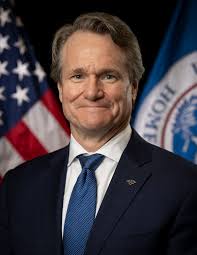
About Brian Moynihan
Brian Moynihan, chairman and CEO of Bank of America, has been discussing the bank's economic outlook, consumer spending, and investments in artificial intelligence. He stated that the U.S. economy is growing at 2% to 2.1% in 2026, and described consumer spending as resilient, noting that credit and debit card spending grew 5% in the first quarter of 2026 and entertainment spending was up 13% year-over-year in May. Moynihan acknowledged affordability issues related to housing and gas prices, and said he advises mayors to "build more housing" to address supply. He also said the bank's economists predict unemployment will remain around 4.3%.
Moynihan addressed concerns about AI's impact on jobs, stating that Bank of America is hiring 4,000 campus recruits, including 2,000 interns and 2,000 permanent hires. He said the bank spent $350 million on AI-related spending in 2026, and that all 200,000 employees have access to AI tools. Moynihan described the bank's approach as ensuring "a human has to stay in the loop." He also discussed the bank's sponsorship of FIFA and its "Sports With Us" program, and announced a $2 million donation to Vet Tix to provide tickets for veterans and first responders. Reflecting on his 17-year tenure as CEO, Moynihan said his leadership approach is to "manage by process" and described his hoped-for legacy as "capitalism done right."
Source: AI-verified profile updated from Brian Moynihan's recent appearances.
Browse all interviews →
✨ AI-enhanced transcript with speaker attribution
I
Interviewer0:00
So Brian, you're in banking. There's been no shortage of news about banking over the last month, starting with Silicon Valley Bank, Credit Suisse, and the earnings, including your earnings, which came out last. The last quarter was very strong. So now that we are where we are, looking back over it, what do we take away from it? Was this a banking crisis? Was it a mild disruption? Was it a tremor? What was it, and what is going to linger from it?
B
Brian Moynihan0:24
Well, I think at the end of the day, 'crisis' is too strong a word, and words like that get used a lot. But at the end, there was a fair amount of disruption for a few weeks there. Certain business models were sorted through. But on the other hand, you could see, and we could see, the stability in the other business models, which were the way banking is done, great granular business and stuff. So the good news is, you're seeing the earnings by the broad industry come out this week, and you're seeing things have sort of played out that way. It was very specific business models because of the unique circumstances of the last 24 to 36 months of a massive amount of cash put in the system, and then rates changing caught people, and those had to be sorted out. The good news is the basic industry reported good earnings across the board. Deposits have come down, but that's intended by the Fed taking money out of the system. It's got to come out of somewhere; the banking system is what they want to do to frankly make credit tighter and help slow down the economy, so that's gone on. But you look at the capital, liquidity, and earnings power of all these companies, it's been tremendous. And that's reassuring to people, and that's good news, because at the end of the day, the banking system reflects the economy in American economies around the world, and you hope it's in good shape, and it is. No question.
I
Interviewer1:43
How'd the regulators do? Were you talking to them through this period of time? They stepped in, obviously took on the deposit insurance. Do you think they should be making changes for the future to make sure we don't go through this again?
B
Brian Moynihan1:53
I think there will be a time to look at the deposit insurance scheme in a rational way. It's never the time to look at any of the stuff the day after it happens, because people have opinions of what happened that never turns out to be as true as they thought. Even in the financial crisis, there were a lot of opinions that it started with Lehman. Well, that was the last part of it; it started in 2006 when housing prices quit going up. So it takes a little more rational thought to think through all the different things that happened. I think the debate will be for transactional accounts. During the financial crisis of 2008-2009, for three or four years, there was a guaranteed transactional account so that individual smaller companies didn't have to be cash-managed every day and figure out where the money was. There's a scheme you could do: either sort of transaction money in a banking system, there's savings money in a banking system. The savings money banking system is there to get rate and return; the transaction money is there to help the economy going. The idea is you could insure that more fully, and that's what they did in the financial crisis to stop people. In the end, a scheme like that would have changed the nature of what went on here, because people were running around trying to figure out if there was $250,000 in a small business or an entrepreneurial thing or a big company. So I think there'll be time to talk about that. We'll see how it plays out. It's worked pretty well. At the end of the day, the industry pays for the deposit premiums; we insure ourselves. The government is a go-between to make sure people believe it's there, and they get the money back from us. We just had our earnings, and we said our deposit insurance premiums before this went up $100 million per quarter from last year to this year. I think we're $2 billion a year plus. So if we insure it, the banking industry pays for its own errors, and then we have a high incentive to clean it up. I think playing with the thought process ought to be carefully dealt with only because it's been in place since the '30s, and it's worked pretty well.
I
Interviewer3:49
Your bank and some others stepped in with First Republic to help them out with some deposits, reported by Jamie Dimon. Is that something we should expect in the future? I mean, is First Republic going to need more, or will other banks need more from the other banks?
B
Brian Moynihan4:01
I don't have any special insight about First Republic. Let me talk about why we did it as an industry. It was to stabilize one of our companies and provide liquidity, because it was a liquidity question. They asked for some help. This is kind of the odd thing. If you're old enough to be around in the late '80s and '90s, that is when the banking crisis went on. People think the GFC, so-called, was a banking crisis. Actually, the issue was those companies weren't banks. Whether it was all different companies you heard about that caused trouble, they weren't banks, and they were brought into the banking system, and we put an umbrella around them so we could fix them. In 2008, in the late '80s and early '90s, you had a highly inflationary, high interest rate environment and commercial real estate, and that was a banking crisis. That's different, and it happens at a slower pace. We were able to step in and help because that was an asset quality problem in the '80s and '90s. Commercial real estate rolling through real estate started in Texas and oil, and it just ran through all the regional economies. These companies had great asset quality; it's just they had a liquidity problem, and that's why we put the deposit in, and it worked.
I
Interviewer5:08
Tell us about deposits, because a lot of focus on deposits these days. You have massive deposits. Last time I checked, really big ones. As I understand, your deposit level is down a bit, although it's up from pre-pandemic. What, if anything, have you learned about the stickiness of your deposits from all this?
B
Brian Moynihan5:26
There's a lot of reporting about it. But the backdrop is: deposits in the industry pre-pandemic are up 30-ish percent. Our deposits are up 34 percent. It's only three years. This is the U.S.; we don't grow that fast. So the nominal economy is up 25 or 30 percent, not the real economy, but the nominal economy. So what happens is, money got shoved in the system, the nominal kind of inflation came out of it, but that's what grew. So the deposits are up. On a rational basis, when the Fed has to unwind—first fiscal stimulus stops, and now monetary stimulus—the deposits will come down. That's unusual because deposits in the industry have very rarely ever gone down. But there's never been as much monetary accommodation shoved into the system as fast as happened this time. So they've got to bring them back down. That's what you're seeing. The industry is drifting down. We're at $1.91 trillion this quarter, and $1.93 trillion at year-end. So it's bumping along at that level, which is $500 billion more than we had pre-pandemic. Based on estimates we make, it's performing exactly as we thought: the extra size of the economy reflected through one of the biggest banks in the country and our peers. It'll work its way back down, but it's much slower. It was a quicker pace and slowed down.
I
Interviewer6:54
Where's that money going? Into the money funds, cash is yielding 5%. That's not exactly an economically energizing activity, to have people put their money in cash.
B
Brian Moynihan7:07
That's what the Fed's trying to do: slow down inflation. Once they break that, the rate structure will come down, and the money will be back to do work. After a period of time, the economy will catch up to the size of it.
I
Interviewer7:18
Are banks at an inherent disadvantage in their business model in this sense? You're funding by demand deposits; people can pull whenever they want. You're putting into long-term assets, as opposed to some of the private credit efforts who get locked-up capital for a long period of time that they can match with the assets. Do you have an inherent mismatch in the deposits versus the assets?
B
Brian Moynihan7:41
Well, we manage that. That's why we have asset-liability management and a team of people, and that's managed to maintain the balance and interest rate sensitivity. So up 100 basis points, we make $3 billion more in NII; down, we make $3 billion less, on a base of $55 billion a year. So it's a little bit of movement of money, but that's how you balance it, because the entire balance sheet moves. Everybody looks at certain parts of it. It's the way you manage money. Our consumer customers—88% of balances have been customers for 10 years plus. Even on the commercial side, it's relationships for a long period of time. These customers are running around for decades, in some cases. So they're very stable. It's just a matter of the ebb and flow of the rate environment will change the profitability. But you say, 'Is the business model flawed?' There are only four companies that made more than $15 billion in America in the last eight years in a row; two of them are banks. So I don't think the business model is flawed.
I
Interviewer8:46
You reported some nice growth in net interest income in your last earnings report. At the same time, you mentioned the money markets. You're competing against some people who are paying higher rates. Are you going to have to pay more for those deposits, and is that going to cut into your NII?
B
Brian Moynihan9:02
It does, except the assets move too. So our net interest margin actually grew. It's been growing over the last year, in dollar amount and percentage. The toughest time for us is zero rates, because we have all these great people who are clients of our company, and we have your checking account balances, and we can't charge you for those. In certain economies, they will say, 'You give us a $100 checking account, we'll get a charge, we'll give you less back,' negative interest rate so-called. We don't do that here. So the toughest time for us is when rates are really low, because the floating rate loans we have are also low. When they expand, they've more than covered up. So we went from maybe a certain NIM, and it went up 25 basis points year-over-year in the first quarter due to that phenomenon. The rate structure went up, the zero interest deposits are always zero, the other interest deposits go up that we pay interest rates on—on the commercial side, high net worth side, and the consumer side—and then the margin is the result of those two. That margin expanded from about 160 to 220-something basis points.
I
Interviewer10:08
What about what you do with those deposits? You said $1.93 trillion, something like that? $1.91 trillion? Do you have ways to make that money work for you? Where are you on loan demand? Are people demanding loans? Do they want the money at this point?
B
Brian Moynihan10:25
Yeah, loan demand is... You've got to step back and think about what's going on. You have an economy which has a higher-than-desired inflation rate, so they've raised rates. What does that do? It stops loan demand pretty quickly in the mortgage area. Mortgage production: something like $14 billion a quarter five quarters ago, and it was like $4 billion now. That shows you the difference. It stops it. Cars become more expensive because the payments go up, so you're seeing car sales slow down. But that's all new activity; the historical balance and stuff, you know. On the corporate side, you have the capital markets owning companies and the leveraged finance markets that have been kind of screwed up for a while now as rates rise, until they settle in. They settled in a little bit in January and February, and then we had the fun in March, and that changed it. But overall, loan demand is mitigating. The economy is slowing down. The Fed tightening is having the intended impact. So our loan growth for the quarters, for you, it's flat-ish. It had been growing 10% last year on a given quarter. That loan demand slowed down.
I
Interviewer11:39
Where do you put the money to work? Is it a challenge for Bank of America, as you have the deposits that are holding up, as you say? You've got to do something with those deposits. At some point, do you put it into Fed excess reserves, because they pay you a nice amount of money?
B
Brian Moynihan11:53
It's a lot. We put a lot of it there, and that's having the effect that they want to do. That money goes outside the system—treasury bonds, money market funds, or bills—or it gets deposited back into the repo program at the Fed. So it's taken out of the productive economy. The rest of it we invest in non-risk assets: treasuries or mortgage backs. That's the investment portfolio. There's been a lot of reporting about the extent to which we have losses on the books. Certainly, we have Silicon Valley Bank, but also about Bank of America that haven't been marked to market yet. Where are you with respect to long-term treasuries? Well, we mark the AFS portfolio to market. The maturity, not the mark, has been going down. We haven't made any investments in all the maturity since the middle of '21, basically because we had all this excess cash and put it to work. We've just been letting it run off. That's the style we take. It's a trillion dollars we have to put to work every day that the loan demand doesn't take up. So it's got to go somewhere. If it goes into no return, then we can't make any money, because a deposit doesn't earn you any money, and the activities that support the customer behavior cost you—you know, all those ATMs and phones and digital and mobile. So the way you make money is you put it to work. If you put it to work on loans, that's always superior. There's only a trillion dollars in loans, so all the rest of it has to go into short-term or long-term assets.
I
Interviewer13:21
Tell us about your trading. You did very well on fixed income, I recall.
B
Brian Moynihan13:25
We did. Tim and Demar and the team did a great job. We're up—I think we're one of the few companies that was up year every year in the quarters, and I think it was the second or third highest best they've ever had. The teams we invested more in that business, and they've done a good job.
I
Interviewer13:41
Using the Bloomberg terminal as well—that's a nice plug. Last one with Bank of America specifically: headcount. I think you were actually projecting you're going to be down, selling 4,000. Is that attrition, or is that a systematic reduction in force?
B
Brian Moynihan13:56
It's really... The colleagues here, I know a lot of tech people. Last year versus this year, you had to grab any human being that you could hire. Last year at this time, it was the Great Resignation. This year, it's completely different. Our attrition rate has dropped in half. The problem was last year, whether it was in technology developments or processing areas or our branch teammates, we were hiring more and more. We hired 38,000 people last year—22,000 in the last six months of the year. We own a group of 8,000 people. This year so far, we've hired about 5,000 people, and we're not down heads. Attrition slowed way down, and we'll probably only hire about 10,000 or 12,000 people this year, and head count will come down. That's how fast you have to turn the engine on and then turn it off. When you have half the attrition across 60,000 people—from 10% to 5%—think about how much less you have to hire. That's good news for the company, because that's a lot of inefficiency to get people up to speed. It was pretty remarkable. We started at 216,000 headcount, and we had 3,000 teammates largely in technology development that we had to bring on because we were stepping up our investment from about $800 million a quarter to $900 million a quarter. In the first quarter, 3,000 came on. During the first three months of the year, we ended up flat. By the first two weeks of April, we're down 500 people, and we'll drift down. It's not that we're letting people off; it's just that attrition allows you to manage it. But we would deploy people. If you were in this job and you asked to go do that job, if you don't want to do the job available in the company, that's a different question. We're trying to do everything we can, because it's the right thing to do for the teammates. We want them to have a career here, which means a lot of different jobs. This will give them a different experience.
I
Interviewer15:57
Let's stay on tech, since you raised it at this Southside Leaders Forum. Brian, as CEO of Bank of America, what role did tech play in the Silicon Valley Bank situation? Because we've had people like Steve Schwarzman and Larry Summers say that the ability to just do a bank run on your phone has made a big difference. Did it?
B
Brian Moynihan16:17
It probably did, but that's not new. We have 60 million consumers, 35 million-plus mobile active customers, 45 to 50 million digital customers across all businesses, from mass consumer to high-end consumers. On the commercial side, digitally, they'll move trillions. You can send a billion dollars off your watch. It's pretty amazing. So that phenomenon exists, but customers don't independently move money by the device; they move it because of who they are and what they're doing. So did it facilitate an easier execution? Yeah, but you could have executed that way a lot of other ways, and that may have changed it by 24 hours or something. But people would have moved. The more interesting question really is how it will be sorted out. We don't see any real difference. We see tremendous digitization of the customer base, but I'm not sure I'd go there as much as I'd think hard about the fact that everything's gotten easier, and this is just one of those trends.
I
Interviewer17:27
You've been an early adopter of a lot of technology for Bank of America in various ways. What's the biggest game changer for Bank of America when it comes to technology?
B
Brian Moynihan17:37
I think it was the smartphone. For those of you who are aficionados of history, when Apple announced the iPhone, you'll see that one of the few outside apps was a Bank of America app. Because instead of going to the carriers—Verizon at the time, I'm not sure they're even called Verizon—they would come and say we'll put software on our cell phone that can be linked to your banking app. By luck or smarts, we had a web app, a browser-based app. Well, guess what? You'd be the only person with it, and how do you demonstrate this new product? We had maybe a couple million people using it, and we just exploded with the smartphone. That was how to make the feature functionality better, and then how do you keep driving and changing? It was the ability to have that amount of computational capacity in your pocket, the networks which were pretty bad then and are all out there now, and the ability to react and actually fulfill behind it. That was the infancy, and it's taken off. When you speak to Erica, which is a voice-activated, artificial intelligence, predictive language engine with a specialized language built because one didn't exist in financial services six or seven years ago, and you have 18 million people touching it a day—when you talk to it and say, 'What's my balance?', it has to understand you weren't asking about a yoga class. Then it has to go find check number 642 in your account, out of 60 million checking customers and all the transactions. And you could be driving a car 60 miles an hour, hopefully not driving, but you could be in a car. There are 110 systems behind that mobile system feeding it. So the combination of the smartphone enabled that breakthrough that just changed everything: having a computer in your pocket and all these specials beyond that. But what really enabled it was the network capacity and delivery, and the ability to pull stuff out of the systems and data arrays we had. Otherwise, you just have a fancy way to get to our website. You had to have a way to go find transaction X or transaction one, and then Erica lays on top of that, then mobile check deposit lays on top, and so on. People missed that. It was the size of networks, speed of networks, pace of networks, availability of networks, uptime of networks, because people didn't want to have it not go through five times in a row and be frustrated, because then they'd call 1-800-Bank of America. So the team's done a great job from that start till now, but that changed everything because it democratized computational capacity to everybody, and made it mobile in a way it wasn't before. Laptops were bulky; it was a pretty clunky experience.
I
Interviewer21:03
As the head of Bank of America, you have an almost unique insight into the American economy, and specifically the consumer. I know you've said that March over March, consumer spending is up. At the same time, you're taking more provisions against possible loan losses. What does that tell you about what's around the corner? Are you seeing the end of the spurt in consumer spending?
B
Brian Moynihan21:25
Three different topics. One: consumer spending in March was up 9% over last March, across all the different forms. In April, it slowed down a little bit. We'll see how it ends up, but it slowed down. It was slower in January and February, picked back up in March. That means the consumer is still doing things. They're traveling; it's a lot more travel, out-of-home experiences, theaters, concert tickets, sporting events. Everything's going strong there. When you look at April, you're seeing it slow down a little bit. The debate's going to be whether that's due to some tax timing and stuff, because that changes. The consumer is in good shape. They have more money in accounts, and by multiples especially with lower-income strategies. The ones that don't have it are the wealthiest consumers on our platform, because they put the money into the money funds. They have money. The credit quality—our charge-off rate this quarter was a number that is about a third under where it was in 2019. That's a 53-year low. So the credit quality is unbelievable. That's good news. Are we putting up provisions? Yeah, because we keep planning for this recession that seems to always be out there that we haven't gotten to yet. The third thing is: consumers have capacity to borrow. The usage of our lines of credit on the consumer side—home equity loans are down from $30 billion in outstandings to $20 billion during the pandemic, and the card lines are down from over $100 billion to about $90 billion. They were down as low as $70 billion and came back up. So there's plenty of borrowing capacity for consumers. That means the consumer is going to be there, and they're employed. That means the job for the Fed is tougher, and that's why the Fed has to be more resilient, because the consumer drives the U.S. economy. The consumer is still in the game. The consumer is still employed. We're paying our colleagues and teammates more than ever, and they have money in accounts. They're spending. That's not true for every single human being in America, but it's true on average.
I
Interviewer23:30
One last question, Brian. You are the chairman and CEO of Bank of America. You've gone through a lot of experiences to get there, developed a lot of experience as well as expertise. What has helped you the most, and will the next generation CEO of Bank of America draw from the same skills, or what would be different? Are we going to have an engineer, a data scientist?
B
Brian Moynihan23:53
Well, I think—I'm not sure. You've got to be curious. I tell myself that, and I tell the teammates that when they ask me that question. You just have to keep assuming you don't know anything, ask questions, get smart people, be able to judge what they're telling you, and figure out how to do it. That trait will be the trait, because you don't run the company. We have 200,000-plus teammates; they run the company. The 20 management team members run the company. But you have to be curious, think about what's going on, try to learn from other people, and learn how to absorb different types of inputs. There was a point in time way back in my career when I almost became the head of technology, for example, and I had no skills to do it. But what I could do is—the people told me they wanted me to do it, and I told them there's probably a better idea here. But it was because they said, 'You can get people to work together and think.' That's what the traits of a good leader and a company are. You've got to be curious, keep learning. But I'm not sure the next CEO of Bank of America has to be an engineer or a data scientist. It has to be a trader, a consumer banker, a commercial banker, an investment banker. It can be any of those things. But they always have to realize, no matter where they came from, they've got to have an ability to absorb and learn a lot of other things, and that's by asking questions.