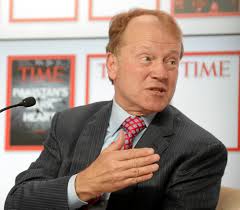
John Chambers0:06
So John, over to you. Welcome and good to see you again. Thank you. You know, it's interesting to watch how far we've come from a dream of what was possible to remaking it a reality between the two biggest democracies in the world on how we can work together at a scale, business connection, society connection, to benefit every citizen in India and every citizen in the U.S. And when we outlined that vision and strategy just a couple years ago, taking what was traditionally a trade organization that was focused primarily on our own needs, how do we do more trade, to realizing that the future of business would be about presenting benefits to society as well as benefits economically. And when you do the two together, that's where the real power is. And many people say, 'I don't really get that.' We were fortunate enough at Cisco to win every corporate social responsibility award in the world, and by the way, we're the most profitable company in history in each of those countries because the two together, people grasp and they understand. You've got to have an ability to catch market transitions, and at this market or business transitions or political, you've got to realize there are new technologies that will suddenly allow these to be successful in a way they've never done before. In fact, I would argue you're not going to have a major business transition or political transition without a new technology enabling it. And we all grasped that in the past, Cisco with the internet, Amazon when Jeff founded Amazon, his biggest issue to shareholders in 1994 was, 'What's the internet and why is it so relevant?' But if you watch great companies or I'd argue great countries, they're going to catch these transitions and they're going to ride them very aggressively. And it starts at the very top within each of the countries in terms of the transition. I tend to bet on people first, and then strategy second with culture. And I believe firmly in Prime Minister Modi, his vision of a future for India and an inclusive vision for all the citizens, and the courage to dream what is possible and then articulate that as part of a political strategy, and then articulate it willing to take using his own capital to be able to achieve these goals. And he's one of the top three leaders I've ever met in my life, and I've met them all multiple times. And I had the honor to get to know now President Macron in France when he was the economic minister of France. And it was interesting what Elon, who was the prime minister, I'm sorry, president at that time, got was even though he was from the socialist party, way to the left, he understood technology could create jobs. And he said, 'If our country doesn't change, we'll get left behind.' And he appointed an economic minister in Macron that truly got that. I had the chance to lecture with him at business schools, to join joint product announcements, etc. But you saw the same exact thing. Keith, good to see you, buddy. Thanks for joining us. The same exact thing in terms of a leader in France who grasped how this could forever change France and the European continent, and then had the courage, just like Prime Minister Modi did, to outline an audacious goal. I mean, if you think it was aggressive for Prime Minister Modi to say, 'I'm going to become a digital India, we're going to drive this digital India throughout all the 10 major aspects, smart cities, startups, 1.2 million jobs being created per month,' you think that was aggressive? You could imagine what it was like in France where you had the president of the country get up and say, 'We are behind, we're no longer innovative, we're leaving our young people behind, and we're going to change and we're going to become the most innovative country in Europe and the best in Europe for startups,' which at the time it was the worst. And none of us would locate jobs there. Venture capital wouldn't even go to talk in France. In fact, one of our key hurdles early on, Keith, was getting the venture capital community to go talk to the leaders in France. And yet in a period of less than five years, in three years he had his engine going. And just like India is now the fastest growing country in Asia with its growth year over year in unicorns. So if you watch in terms of a business momentum, how many of you in the room are venture capitalists? Quick show of hands. You might want to hold on. My power, several of you are looking for funding. You might want to look up the people a little bit later. How many of you are part of the startup community? How many of you are part of the large company community? It is that combination which you bring together between government working together with business working together with startups, with small companies, large companies, that allows this to change. And so by outlining that vision and having the courage to go for it, and you can imagine in India people said, 'Tell me again why you're invested in India. Tell me why you think we can be so innovative. Tell me again, India has always been a very slow follower, it will never lead an innovation.' And these are my friends in India. And yet look at where we are today. The fastest growing major country in the world on unicorns, which is the future of job creation in the country, is India. Now depending on whose data you use, it's a little bit different for last year, but the data that I use said we did 41 unicorns last year in India. This year, even though it's going to be slower, we're still averaging three to four unicorns per month. That is an ability to bring home a vision about what the country could do for the future. And how do you have the courage to dream? But what Prime Minister Modi got, and I'd argue what the U.S.-India Strategic Partnership Forum got, big companies, small companies, government leaders on both sides working together could do something that none of us could do ourselves, enabled by the new technologies that suddenly allowed us not only to be successful in innovation normally, but successful in spite of the terrible change of COVID and the impact it had on society. But we learned how to work together remotely. That is actually going to be an accelerator in this relationship as we move forward. I had the chance to have a front row seat on this. I saw China in the early 1990s. I had an advantage outside of Wang Laboratories. Dr. An Wang knew the president at that time, John C. Men, very well. They were classmates. And I saw how China grasped the implications of what two countries could do working together with the startup community. And they took it a fair ways, and then they lost the momentum in my opinion by looking too internally and saying a win-lose type of mentality. India will not make that mistake. With India, you understand that we will have differences, which Mukesh alluded to earlier. And most things in life we're going to agree on, but when we have differences, that's how we navigate through those to become so key. That's the role that USISPF can play in this. How do we work together, business and governments, to get issues out on the table and to resolve them? Tremendous compliment to what you've done here, Mukesh. Just amazing with you and Gargi Nivya and the whole team. And we were a startup like most in the startup world. We had trouble making payroll. We were nervous about would we really be able to break away. We broke away from the most powerful lobbying organization in the world who had no interest in us being successful. And yet you fast forward to five years later, 350 members, completely financially independent, able to influence the future of countries in a way that no organization's ever done before. And you're just getting started. We had over 120 sessions last year, government and business working together, and again bringing community together through trust that allows us to move with that speed. So hopefully today will be one more step where you'll find our ability to talk on key issues and work together toward resolving those issues is much better with the combination of both a political environment, a business environment, the ability to do startups and innovation. How many members of the press are in the room? Just so we know. Welcome, very, very much. I remind everybody it is on the record, so any comments you make. If you want to give me a compliment, Mukesh, now would be the time to do it. But I want to have that exchange. And I worry about today's society, we're not able to get the tough issues on the table and debate them back and forth because you learn more about the debating process than you do actually taking your stance and talking to people that have the same views you have already. So if you agree with everything we cover today, we have failed. We want to really continue to challenge. We want this to be an organization that was not about business community, was about changing the future of countries, every individual in each of those countries, and do it in a way that truly is a win-win. So with that, let me turn it back over to you. And again, I want to thank you very, very much for joining us for this session.