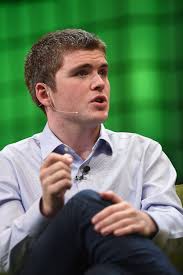
Hear about trends that will shape the next decade of payments and global trade. More information: https://stripesessions.com ...
What John Collison said
Written from the verified transcript and checked against it. Every figure links to the moment it was said.
John Collison, President and Co-founder of Stripe, spoke at Stripe Sessions 2026 about the economy replatforming around AI. He noted that despite a January sell-off in software stocks, SaaS payment volumes on Stripe are higher, and profitability is back in favor. He argued tariffs are still passing through to consumers, and Stripe data shows the income gap in spending is shrinking, contrary to the K-shaped economy narrative. Collison highlighted three trends: a surge in business dynamism with solopreneurs scaling faster, the rise of agentic commerce where AI agents transact autonomously, and the increasing value of complements to AI like chips, energy, proprietary data, network effects, and real-world operations. He demonstrated an agent buying data and publishing a report for $5, and concluded that AI's productivity gains will take time to materialize, drawing parallels to electrification.
Key takeaways
Stripe now processes almost 2% of global GDP, providing a window into the internet economy.
Stripe Atlas celebrated its 100,000th incorporated business, with the class of 2026 tracking to five times the revenue of last year's cohort.
Agentic commerce is live: an AI agent autonomously bought data for 4 cents and published a report for $5.
US data center electricity demand is projected to nearly triple by 2028, with natural gas prices up 104%.
Reddit's non-ad revenue from data agreements is $35 million a quarter, showing the value of proprietary data.
Good morning. It is great to be back at Moscone. You can almost feel the tectonic plates shifting underneath us. Yesterday, Will walked you through the 288 new products that we're launching to help you as the economy replatforms around AI. But today, I want to take you to my happy place, getting deep into the economic data. And I have a few big trends that we're seeing that I want to talk you through. But first, let's take stock of what's happened since we were together here at sessions last year. So, since we last got together, it's been a little wobbly. In January, the software sector lost a trillion dollars of market value in under 30 days. You're all familiar with the worry. AI makes software more abundant, more substitutable, potentially less sticky than prior models had assumed. But interestingly, this is a perspective worry. It's not revenue softness that's happening right now. SAS payment volumes in Stripe, they're actually a good chunk higher today than before the sell-off. So SAS is still growing just fine. What does seem to have come back into fashion though is profitability and not just in software but across the entire equity market. So this is a chart showing how much market cap has historically accrued to the most profitable and the least profitable companies in the index. So you see in the middle here, this is the.com boom where the markets went a bit mad for a moment and briefly the least profitable companies were worth more than the most profitable ones. But if you go forward to today, now despite all the talk about bubbles, it's the opposite. The markets are being tediously rational. The most profitable companies are the ones being rewarded with outsized valuations. We heard a lot about trade policy over the past year. Believe it or not, it's only been a year since Liberation Day. It feels like eight years, but one year. The common wisdom by now is that the tariffs were kind of economically speaking a nothing burger. You know, the dog that didn't bark. And you can make that case. Trade flows ended the year only a little bit below 2024 levels, but there were higher prices to absorb as a result of tariffs. And what happened is early on you had businesses eating the higher costs. But now quarter by quarter, they're starting to pass them through. So we can throw up durable goods prices here. And this is how they behave intra-year in normal years. You might be wondering, you know, why is there this downward trend? It's because you have deflation in durable goods. Manufacturing productivity generally increases. Global trade adds competition and your flat screen TV gets cheaper. Your washing machine gets better for the same price. So you usually in most years get this gentle predictable slope downward. Now you see this only goes up to 24. If we add 25, totally different box the trend. And if we add 26, it's only 3 months in. But same thing is happening and even more so. So our view is that tariff costs are still working their way through to the consumer. The story is not written yet. Another phenomenon you might have heard about is this K-shaped economy. The idea that wealthy consumers are holding things up. They're an increasingly large share of the spending. So maybe you saw this go viral on Twitter. This is the new United 787-9 seat map. And you can see that most of the cabin is now dedicated to business class seats. Or you can look at Delta's ticket revenue. So they reported that premium seat revenue is now bigger than economy for the first time. This stuff gets a lot of retweets, but we don't actually see it in Stripe's data. So if we look at the ratio of high-income to low-income consumer spending in our data, you know, in a K-shaped economy, you'd expect this chart to be going up, but it's the opposite. The line is trending gradually downwards. The gap between high income and low-income spending has been shrinking. So we don't actually see when we look for it this over-reliance of the economy on high-end consumers that everyone has been talking about. The other major economic topic is the worry that AI is taking all the jobs. And if you look at the numbers it's true the labor market is cooling slightly. US unemployment rates are ticking up about a percentage point over the past three years. But you can ask the question, how much of that is actually AI? Part of it is the delayed pandemic hangover. If you look at the hiring rate, companies really binged on hiring in 21 and 22, and they're still unwinding that. And tighter immigration played a bit of a role. And then, of course, you have interest rates. So, the Fed's latest forecast for the end of 2026 is half a point higher than they predicted at this time two years ago. So, money is tighter and tight money slows hiring. So AI is in the mix. It's presumably going to have a big future impact, but it's one force amongst many and probably not the dominant one in the labor market numbers you've seen to date. Now you're probably wondering what we're seeing at Stripe and how it corresponds to what's going on in the wider world. Stripe now processes almost 2% of global GDP. So we have a really useful window into the forefront of the internet economy. And there's three areas that I want to dive into deeper with you. The first is that we're seeing a structural increase in economic dynamism. More firms are getting started. They're keeping headcount lean for longer, but they're scaling revenue faster than we've ever seen before. To explore this more, I'd like to call in some help from an actual economist, Stripe's head of data and AI, Emily Sans.
Thanks, John. There's plenty of talk about AI not showing up in the macro data yet, like the labor stats we just saw. If you're as AI-pilled as most of us in this room, that probably creates some cognitive dissonance. But here's the thing. AI actually is showing up in the macro data. You just have to know where to look. Here's US business formations over the past 20 years. You can see a huge bump during the pandemic. Not surprising. But you can also see it reaccelerating now. Basically, all of the recent growth is coming from what the Census Bureau calls non-employer firms or what we all call solopreneurs. That's the blue line here. Now, these didn't used to be considered serious businesses, but AI means more of these businesses are getting to real scale. This is the number of solopreneurs in the US doing over a hundred thousand in revenue. Yes, solopreneurism is now how close to 5 million Americans earn their living. And we're fortunate to have many thriving solopreneurs building with Stripe. It's a great crew. This isn't just an American story. New business registrations are up 40% in Australia, up 70% in Finland, up 80% in France. So, the surge in dynamism is happening across advanced economies. At Stripe, we're seeing this firsthand.
Yeah, Stripe Atlas is the simplest way to get incorporated in the US. And last week we celebrated our 100,000th Atlas-founded business. Somewhat topically for this talk, that business is Empirical, which is building AI software that optimizes profitability for battery energy storage systems. Sounds like something we're going to need. And I actually think Rana, the founder, is here today. But the point is we hit a 100,000 Atlas corporations way earlier than we expected. The number has exploded. There's more of them and they're scaling up like crazy.
4 more exchanges in this transcript
Sign in free to read the rest of this interview. No card required.