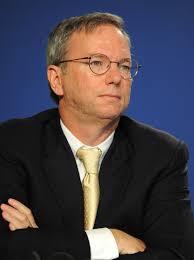
About Eric Schmidt
Eric Schmidt, the former CEO of Google and co-founder of Schmidt Futures, delivered the commencement address at the University of Arizona in May 2026. During the speech, he discussed the potential of artificial intelligence, stating that AI is "already accelerating research at a rate that we could not have imagined even 5 years ago" and that it is "designing new molecules, running simulations, identifying patterns in genomic data that no team of humans will uncover in a lifetime." He also acknowledged fears about technology, saying, "There is a fear in your generation... that the machines are coming, that the jobs are evaporating." Reports indicate that portions of his speech were met with boos from the graduating class. In other appearances, Schmidt discussed the global AI race, describing it as "really an energy race" and noting that the "current number one problem in the AI companies" is a "lack of data centers." He also commented on government concerns about AI, stating that governments "want to win, but they're also concerned about safety for their populations and can it be misused."
Source: AI-verified profile updated from Eric Schmidt's recent appearances.
Browse all interviews →
✨ AI-enhanced transcript with speaker attribution
D
Don Lemon0:14
Hi everybody, welcome to a very special edition of the Don Lemon show. I'm so happy to have this next person on, one of the smartest people I know, smartest human beings I believe to ever walk the earth, a brilliant businessman, a tech legend, and an AI visionary. And that is Mr. Eric Schmidt, the former CEO and chairman of Google, the co-author of the fantastic and fascinating new book called Genesis: Artificial Intelligence, Hope, and the Human Spirit. Eric, welcome by the way. How are you?
E
Eric Schmidt0:43
It's great to see you, Don, and great to be on the show. Thank you very much.
D
Don Lemon0:48
This is really Henry Kissinger's words, yeah? He's writing, you're writing about Henry Kissinger and how he felt about AI and the possibilities in the future, where it can take us or where it can end us in this new era. We're only at the beginning.
E
Eric Schmidt1:15
King Midas of ancient Asia Minor wished that everything he touched would turn to gold. Dionysus, the god of pleasure, granted his wish, but soon Midas's dream became a nightmare. His food and drink turned into lifeless gold. In his despair, he sought relief in the river Pactolus, trying to wash away the curse. What does this tell us about humanity trying to wield a power which they cannot possibly understand? So Henry, Dr. Kissinger, had studied this since he was an undergraduate, before we were all born, the relationships of humanity to the world around us and those sorts of things. So when he learned about AI, he said, 'Oh my God, this is going to change the relationship that humans have with each other.' And remember, we've never had another species that was smarter and more capable than humans. We've never had an alien intelligence that actually could subjugate us under certain circumstances. So he became very... we wrote a book together about the age of AI right before ChatGPT, and this is the one that now talks about what happens to society when everyone is using all these tools all the time.
D
Don Lemon2:40
There, Eric, there's something that you write about in the book where you said that they thought... I forget what exactly how you put it, but Henry Kissinger wanted all of this information or whatever, and they said they thought Henry Kissinger by himself without all this technology was all the smart that we needed at the time.
E
Eric Schmidt3:00
Yeah, I think we forget how humans did everything. You had these polymaths such as... and they literally were masters of the universe because they could see deeper than anybody else. And indeed, in the book we start with a discussion about discovery, and we have a long history of these extraordinary people in society. This is you know Leonardo da Vinci and Einstein, people that everyone in the audience knows. And all of those people invent stuff that has huge consequences. So the question we pose in the book is, at some point we think in the next five to ten years, your phone will have on it something close to Leonardo da Vinci and Einstein and the greatest chemists and the greatest musicians, Mozart and so forth. What will you do with it, especially since every human on the planet will have this? So we've never had this kind of a situation. It means when you go to an art gallery, the phone can explain to you why the art is so exceptional and can diss the artists that aren't as good, right? It's all of this weird stuff. It also means that society will change very rapidly because these systems will become intertwined with us. Your job will depend on it, your social life will depend on it, and much more than social media because they'll be giving you advice how to behave, what to do, how to think. And there are all sorts of implications there: human agency, human freedom, things that we all are concerned about that we don't want to give up to machines.
D
Don Lemon4:28
You say here, you have talked about how AI could either be humanity's greatest triumph or our gravest mistake. Outline both of those outcomes, how that would look, because I'm wondering, are you effectively saying it's sort of a 50-50 coin toss where it's either utopia or it's apocalypse?
E
Eric Schmidt4:52
We wrote the book in order to make the arguments. The answer is it'll be a combination of both. The upsides are obvious. Anybody in the audience have any kind of disease? Of course you do. It's probable that we can identify in the next few years all human druggable targets, which will then ultimately lead to thousands of new drugs. Now how does this occur? The computer, with what is called a drug discovery agent, can actually try something, see if it works, try again, try again, and try again, but it does that a million times an hour. Humans can't do that. Climate change: the only way we'll get climate change fixed is by new sources of energy. In order to design them, we need new kinds of materials, new kinds of ways in which they generate heat and so forth, and they get distributed. The only way to do that is with AI. I can go on. The gains in science... you sit there and you go, 'Science, oh who cares?' Well, I care a lot because science is the beginning of a new business, right? So the material science, the plastics that you use in your house, everything, the built human environment will all be changed to be more efficient, and these systems are organized around efficiency. So the proliferation of services... I'll give you another example. Most people find computers sort of opaque, it doesn't make any sense to them. They're normal human beings, they're not computer scientists. Well, wouldn't it be nice if you could just tell the computer what you'd want and it would just organize it? So an example would be: I want to build a vacation home outside of New York, select the site, figure out what kind of house I can build, consider the regulations, hire an architect, be the architect, submit the plans, hire the contractors, build the house, and pay the bills. Each of those is a function today that can be done better by an integrated computer system of agents. Now what happens to all those people? By the way, they don't go away, they just get more productive. So I'm going to tell you my opinion, which I can't prove, that everyone's going to be at least twice as productive. So in your case, because you're an incredibly well-known journalist, you can do twice as much. You'll literally be twice as better, twice as more, twice as big of a reach. In my case as a business person, I can invest twice as quickly. Scientists can do this, artists can make twice as much, teachers can teach, lawyers can sue twice as many people. Whatever thing you do, you can do twice as much because the systems are organized around making humans more productive, at least for a while.
D
Don Lemon7:33
Yeah, because people worry about these taking their jobs and it's just going to be computers and it'll affect the economy in a way and people will become poor, but you don't actually believe that. You think no.
E
Eric Schmidt7:42
I think that in order to believe that, you have to believe that this time is different. And in every technological revolution, there's been lots of dislocation, right? So the people who drove horses were replaced by people who drove taxis. The number one job shortage in America right now is people who want to drive trucks. We have a huge number of trucker jobs open, and the job is difficult, it's hard, it's long hours away from home, all that kind of stuff. And I spent the last ten years everybody telling me, 'Hey, you know, all those jobs are going away.' Let me tell you, the number one job in America is available to anybody who's willing to do this hardworking job.
D
Don Lemon8:23
Yeah, so that's all the positive. Now on the negative, there's a number...
E
Eric Schmidt8:27
The first and most obvious is misinformation. The systems today are poorly targeted at misinformation. You just sort of make up something and then you spread it in general, but these new systems will be able to lie to you, Don, to me, Eric, directly because it'll know exactly what your hot buttons are, it'll know what you care about and where your weaknesses are, and the system can actually just pounce on you, right? And you know, you're a normal person, you can say, 'Well, it's probably true,' you believe it, and then misinformation works. So the arrival of misinformation at scale from essentially computer-generated content, we've known this was coming, this will get a boost. That's one. Another one would be cyber attacks. We're all working towards something called artificial general intelligence, which means systems that have the kind of intelligence that humans have, where they are more flexible and creative and they are learning and so forth. When that occurs, you can imagine the system will know how, for example, to do a cyber attack to take down the financial system. How is that possible? Well, because the system sees everything, it sees what everyone sees, but it's ultimately able to run through more choices than humans. It can find more potential attacks than a human can, so it's going to be the one that an evil person will use to do their cyber attack. Another one would be biology. Turns out biology is pretty easy for computers in the sense that you can put viruses together and they more or less work, but it makes it easy to make really bad viruses as well. Now these are all issues that have to get regulated, and there are various people working on this, and on balance the benefit is really positive. Now the next question, that's kind of the tactical answer. The next question is: what does it mean to be human when your day-to-day life requires this thing, right? For advice, for helping you make productive and so forth, you become completely codependent on it, right? Is there a possible loss of free agency? Do you feel that you're losing something by being so tied to this AI intelligence? We will see.
D
Don Lemon10:40
But it's also... God, I have so many questions. So let... I mean, people think like it's going to be like 2001: A Space Odyssey, is that correct? And then all of a sudden it'll bring about the destruction, it'll figure out how to destroy us and it'll be over. Let me just preface that saying there's something that you write about in the book and I thought it was the most profound thing you said: that AI can not answer all the questions that humans have, but it will also find the questions and ask and answer the questions that humans don't have. Exactly right. And so should we be afraid of it? That's the thing.
E
Eric Schmidt11:18
One of the questions we talk about in the book is: let's imagine you have a system that generates math conjectures and you have another system that proves them. So it generates a conjecture and it proves it, and it involves something important like energy or dark energy or physics, and no human understands what the proof is about. You know, we know it to be true, but no human, not even the smartest mathematician, could have generated it. What is that? Is that a parody of humans? Is that a new kind of intelligence? We just don't know. So as this technology gets smarter and smarter and smarter, which we all believe it will, you will ultimately have situations which are highly uncomfortable for human identity, right? Frankly, the professor says, 'I'm sorry, I don't really know, but I can ask you know Charlie the computer.' The HAL scenario is not the one I'm particularly worried about, because in order for HAL to decide to kill everybody, it would have to have some self-image of what it is. So it would have had to be trained that it had a consciousness. Now there's an obvious question: let's assume that there's a third thing in this conversation which is a computer that says, 'I'm conscious.' How would you, Don, ask it a series of questions to determine if it's conscious or faking it? Because it could have easily learned how to answer your questions without being conscious. There are real boundaries about how we can understand what these things are. Another example would be: how do you feel about your best friend? You have kids and you have a two-year-old, and you give the computer the equivalent of a bear, and the bear every year gets smarter and the kid does too. So when the kid is ten years later, the kid is like 12 and the bear is giving the kid life advice, and it's the kid's best friend. What does that mean for human development? I mean, for you and I, we're fully formed adults, we can sort of coexist with these, but imagine the impact that this could have on teenagers. We already know that social media is terrible for teenage boys and especially for girls. There's plenty of evidence now that online... people who are unhappy, young people, they're unhappy. Typical scenario would be a young man who's having a very tough time, and the system, because it feeds them what they want, keeps feeding them conspiratorial and negative images, and eventually in some tragic situation, that's what's happening now, they kill themselves. I mean, how is that okay? And so we're going to have to have a language to... we're going to have to have a language about what it means to be human and where is the appropriate point of regulation.
D
Don Lemon14:05
Let me ask you this. There are folks like Altman and I believe Musk and others who are involved with AI. It is a belief among some that it's going too fast, that it needs to slow down. Are you in agreement with that or do you...
E
Eric Schmidt14:19
No, no. In fact, Elon did that back when he had nothing in the space. He proposed that we slow everything down by six months. Today, Elon has a huge initiative called xAI, which looks like it's going to be successful, and of course Sam runs a company that is historically very important now with a valuation of close to $200 billion, with more coming. So these are people who have big stakes in the acceleration. I and others have worked hard on what guardrails we should be putting in place. I understand that President Trump intends to reverse the Biden AI regulation proposal, which was pretty light, but I'm quite sure that when you look at the potential for what China can do adversarially against the United States, we're going to want to have some limits on the technology in software and hardware that we invent that gets to them, for example. In other words, there will be reasons, even if you don't agree with what Biden did, in the Trump administration for national security reasons to make sure the country remains safe.
D
Don Lemon15:23
Are you afraid of AI?
E
Eric Schmidt15:24
No, I'm afraid of humans' reaction to it. To me, AI is this unalloyed good. The concept of having a partner that can do the stuff that's hard for you, the memorization... When I was a boy, I remember in school I was required to memorize the names of the counties of Virginia. I grew up in Virginia. And today, you know, why would you ever ask anyone to memorize such a thing? It's a waste of time. And the idea of having every single human in America and indeed in the world operating at their full potential, it has to be good.
D
Don Lemon16:00
Yeah, it's cursive, people don't teach it anymore because you don't need it. And I have typing classes, but kids get keyboard so early you don't have to teach typing. I guess that's the point: you don't need to go to typing class because you learned typing when you were about nine. Yeah, do you remember that? I'm sure you did the keyboards with no letters and it was manual and... So let me ask you about this, because I write something and maybe you'll disprove, maybe in this you'll maybe I'll be wrong. So I wrote a book recently and I said, as it relates to equity in our society, and I talked about reparations. I said we now have at our fingertips the technology to solve problems of previously insurmountable complexity. Let's use it. Let's feed in all the historical records and assemble whatever hard data we have: who did the work, who got the money, how many hours, how many dollars. Allow AI to extrapolate based on solid empirical evidence where that money went and when. We can calculate damages that include, as any civil suit would, pain and suffering, loss of companionship, and other broadly accepted liability factors. We finally have the technology to solve the complex problem of reparations, and doing it by the numbers would force us to embrace a history based on irrefutable facts. Do you think I'm wrong? I said no more Black History Month pat on the head, blah blah blah. But I mean, look, those are my words, but do you think I'm wrong about being able to solve something as controversial and complex as that?
E
Eric Schmidt17:38
I think what you propose can be done. I'm skeptical that our political leadership will actually embrace an analytical framework, because everyone comes at this with a pre-assigned bias. What you're describing is what we call a foundation model. In a foundation model, you take everything that you know and you put it in the model, and then it can answer questions that are informed about what it learned in the synthesis of all the data. So in your case, let's use slavery, racism, and discrimination globally. You could probably come up with some common patterns. The systems are particularly good at finding patterns that humans don't see, because they see everything faster than we do. They're not smarter than we are, but they see it faster. They see a million points where the average scholar can see a thousand, and I can see ten. So the ability to do technically data fusion across that means we will really understand how bad the suffering was, to the degree that we have the sources. And also you can ask it where are the holes. So another good example is in humanities. People spend years in the libraries looking at these ancient texts. Why in the world just feed all those ancient texts into the model and start asking it questions? Because it can modernize its analysis and it's going to be a better analyst than you. So again, it makes the historian more accurate, it makes the person working on the price of reparations more worth it, you know, what have you.
D
Don Lemon19:15
So you think it's possible, but you just think our political leadership might not allow that to happen.
E
Eric Schmidt19:21
Well, in the last few years, it's pretty clear that facts are not as important as they should be. So I was always raised, speaking as a scientist, that you and I can disagree on what to do, but we don't disagree on facts. Facts and reality, and I think that as a society we have to sort of recognize that critical thinking is important. I spent all day being pitched things, and I understand that advertising is trying to sell me things, and misinformation is somebody's trying to convince me of something. So I am a natural skeptic, and what I do is I use Google. You know, somebody says, 'Did you know that the women in Boston had a blue hair day?' Right, I'll make that up, and I would say, 'Sounds unlikely, check.' Right, and then of course it's a joke, and I say, 'Well, you didn't fool me.' So my view of information is that I have to be, as a citizen, armed with the tools of critical thinking, which is not the same thing as... you and I may disagree on what to do about reparations, but we should agree that there were an awful lot of people who were really severely harmed. Yeah, right. And we should actually have the data that says this horrible thing happened and this horrible thing happened and this good thing happened, and then we can argue about whether we address it or whether we address it at all.
D
Don Lemon20:45
I had Neil deGrasse Tyson on a couple months ago, and he said he believes that AI is going to kill the internet, and he believes it's going to get rid of disinformation, and we will then be able to agree on a set of facts. When AI becomes so good at creating deep fakes, even the people who believe the fake news will no longer believe that the fake news is true, right? Because the risk of this fake news being faked is so high that the entire internet will lose its integrity and it will be buried under the weight of its own falsities and its inability to check itself and to correct, because people just putting fake information on there because AI can do it like this. At first it was a fake voice and a fake image, fake video, and someone sampled two minutes of my voice and wrote it to say something that sounded just like me. However, I'm way more literate than what that person wrote to have AI speak, so I knew it wasn't me. So you might need other... because all I was doing was sampling my voice, not my literacy, not my education level. Okay, but then what do we do then? Because most people... this is the end of the internet. Tombstone internet. You think so? 1992 to 2026? Do you disagree with him?
E
Eric Schmidt22:25
Well, he's brilliant, and I know him well as I know you do. The answer to the question of misinformation has to do with how the models are trained. So I'll give you an example.
D
Don Lemon22:38
Let me ask you something about a follow-up on that, but go on. Sorry.
E
Eric Schmidt22:42
So let's have fun and we'll make a model that lies all day, right? Everything it says is false. Now would that be useful? It might be if you're a purveyor of misinformation. So the fact that there's not a single definition of truth and the fact that there will be many, many, many entrants means that there will be a model that lies, it's full of misinformation. And so if you have this notion of the false equivalence of something is true and something's false, and you present them both, then you're going to end up doing a disservice. I would much rather, for you especially as a journalist and I know you're committed to this, try to figure out what's true and then try to say what the choices are about this fact.
D
Don Lemon23:23
So do you... he said he believes it's going to kill the internet. Do you believe that?
E
Eric Schmidt23:28
No, the internet is changing, but what he's referring to is the way people search and consume information. It will change that, but it's not going to kill it. The key thing about the internet is it is the web, excuse the pun, it is the fabric of how we communicate. And in a knowledge economy, communications and sharing of information is how you gain competitive advantage politically, so forth. So the internet is only going to get stronger, bigger, deeper. When we started, and of course I've done this since the internet was invented, it never occurred to me that video was not designed for video, and yet if you look, something close to half of the internet is used for video distribution. It wasn't even designed for that. It looks to me like the internet as a platform is going to be very, very strong. And remember that all of these companies are essentially lowering the price of information and intelligence. What they're doing is they're spending an enormous amount of money to train these things to give you a very cheap intelligent solution. That's good.
D
Don Lemon24:33
Can't be that... do you think... so we were talking about facts, whatever. I hear all the time, my sister actually had a conversation last night about some of the social media sites, and she's on two of them, and we had this conversation about algorithms. I actually had this conversation about algorithms at a Google conference, also at a Spotify conference. Do you think that algorithms are biased? And what I said, as we were getting into this very interesting conversation, I said that someone is feeding information into that algorithm, and can it be biased against certain groups or certain topics or certain individuals? Do you believe that to be so?
E
Eric Schmidt25:08
So let me give you a simple example. Let's assume there's no political bias and no evil bias at all for a social media company, not even a racial bias. Let's assume that there are no biases at all. However, their job is to maximize revenue. So to maximize revenue, you have to have more users, right? The quickest way to get more users is to get them incredibly upset. So to maximize revenue, you maximize outrage, and you maximize outrage because you're trying to maximize engagement. And so the system naturally creates conflict just based on the fact that it's seeking revenue. Because you know, when I write something, I write a long paragraph, and what somebody who I disagree with says, 'The immigrants are coming to destroy your daughter,' you know that statement is enough to get the outrage going, and then everyone says, 'Oh, we hate immigrants,' and so forth, which is obviously not what I agree with. So the fact that we've moved to sound bites that are then weaponized is a core problem. It's a problem we have today, it's not really an AI problem, but it's going to get much worse because the economic incentives... and again, we're assuming no bias at all. Now if you add the fact that there is always some amount of human bias in every human system, right, one way or the other, you can see the problem. If you look at social media, it is a good metric of this. When you're small, nobody cares because you don't have an audience. If you have a large audience, there are an awful lot of people, foreign governments, businesses, and so forth, who want to use your platform for their advantage and not yours. So you have to have a trust and safety group that is watching for that and is engineered against the weaponization of it. A number of us have looked at this very hard. It's very, very difficult to answer the underlying question you ask, which is how would you regulate social media? But a simple answer is regulate the worst cases. So when kids are dying, regulate that. Make sure that the age of children online is 16, not 13. Make sure that if a company is not doing trust and safety, that they define it. They say, 'We're going to let every known lie into our platform because it's part of our business.' Just tell the truth, and then people can be informed as to whether they wish to participate.
D
Don Lemon27:41
Speaking of truth and facts, I think I said Google conference, I meant the YouTube conference, and just like what was being fed into... so I want to correct that. What is being fed into the system and what's important? But you're even with that, I think as you said, revenue is the ultimate goal, correct?
E
Eric Schmidt27:56
And right, YouTube has done a pretty good job in this area. There is a trust and safety group, and they are careful about boosting... the technical term is boosting content that's questionable. So normal content gets promoted, but if it's something which is thought to be false and so forth, you can find it, but they don't offer it. If you see the distinction, it exists but it's not vended, right? It's not sold to you, it's not promoted to you. And that seems like a reasonable compromise to me for that problem.
D
Don Lemon28:30
Well, speaking of truth and facts, I know you've been outspoken and very passionate about the role of journalists in our society and the role of journalism. As we look into... I have been reporting on what is happening. I don't know if you know, there's the whole controversy about Morning Joe and going down and whatever, and then there's folks tuning out to cable news and broadcast news, and there's concern coming from the administration that they're going to retaliate. As a matter of fact, some of the folks who have been nominated to be in key positions are saying that they're going to go after journalists or what have you. Do you have a concern? Any concern for you? Do you want to comment on that at all? What do you think?
E
Eric Schmidt29:10
I'm not familiar enough with what they're actually going to do to comment on it. What I will tell you is that the fourth estate and independent journalism is part of keeping governance in a democracy transparent. Bad things happen in the shadows in a government. So you really need a journalistic tradition of people who are doing deep journalism. One of the great losses of the last 20 years is that the money for that kind of long-form investigative journalism has dried up, and that everyone is on essentially what is called clickbait, where you have to have an alarming title and you know, 'Oh, this is terrible,' and 'Oh, the most amazing thing,' and so forth, and off you go. The worst examples, by the way, are on TikTok. My favorite example, I've been studying TikTok, and you watch these videos and they go, 'Oh my God, you know, he met her and then this thing happened and everyone was surprised,' and of course it's all marketing, it's actually very uninteresting. So we've got this problem where we've now confused real investigative journalism with essentially marketing for a cause of one kind or another. That's a loss of understanding of how democracy works. And my particular concern about democracy is that when you lose trust among the players, democracy begins to fail, and people begin to want an autocrat. They want a country that runs really well, although they don't understand that when they do that, they're also giving up individual freedom.
D
Don Lemon30:41
That is a very good answer. And just quickly, I want to ask you, I think the concern though is about corporate media and that the folks who own the corporate media, they're entertainment companies, they want to have favor with the administration, they want their mergers and acquisitions to go through, and so they're concerned about that trickling down to the actual journalists, and they'll be afraid to hold truth to power without fear or favor.
E
Eric Schmidt31:04
I think there's no question that that's possible. But I would challenge you just slightly. The majority of people in our country get their information from social media. They don't get it from the TV anymore. And I'm sad to say, I happen to watch TV and I know you do as well, but the fact of the matter is that the majority of people get their news and information online. So the solution to the problem that you and I are discussing is fundamentally not to have the original newspaper structures and TV structures come up, but rather have a new form of journalism emerge online which has the same trust and deeply authoritative research to hold truth to power.
D
Don Lemon31:50
What does that mean for people like me? Because I believe this is going to be the era of independent media, of digital media, social media journalists. What do you think that means for us?
E
Eric Schmidt32:02
Well, in your case for your show, it means that you're going to have to produce an enormous amount of content, which I would say is good, and I know your audience would love even more of Don Lemon. That costs money though, but go on.
D
Don Lemon32:15
Sorry, I understand.
E
Eric Schmidt32:17
But the fact of the matter is that when you look at online businesses, they require constant... they're much more stressful because they require constant posting. If you study social media influencers, who are a form of journalism although we wouldn't really call it journalism, they're talking about something, they're getting people excited, they're reporting on something which they care about, they're incredibly stressed because they have to post six, eight, ten times in order for the algorithm to notice. And one of the more interesting things, if you study TikTok, is you can ask the influencers how the algorithm works because of course it's proprietary, and they'll actually explain how the algorithm works, but their explanations differ by person. And so each of them has what they believe is a competitive advantage on how this secret algorithm is used to boost them. So they're fighting for attention. There's another interesting problem about the media: there's an old quote from Herbert Simon about economics which says that in the future, the thing that would be most scarce is that of attention, and the economics of attention will determine everything. So it's perfectly possible that our industry has now fully monetized the attention people have. Look at the number of times... two and a half hours watching video a day is the current number for video use in America. It's shocking. So the number of... again, using TikTok, number one app in the country, more than 100 million weekly users, that's sort of close to half of the country uses TikTok at least once in a week. That's incredible. Now, to me, figuring that out, and for you in particular, figuring out how to get on those platforms in a way that makes sense both to the algorithm and also to the users, is probably the next great challenge not just for you as a journalist but also for the new people coming into the industry.
D
Don Lemon34:16
Are you concerned about private citizens having so much power with owning social media sites and media companies and about that influence? Should we be concerned about it?
E
Eric Schmidt34:28
I'm in general in favor of competition. And although people complain about media, the fact of the matter is there are so many media sources we have, if you will, too many, not too few. So everyone's vying for attention, everyone's vying for access, and so forth. So it seems to me that we're going to be okay. The problem is that we lost the plot. It used to be, when I was a boy, when you were a boy, that the news divisions of the TV company, the television, which were of course enormously successful, were loss leaders. And as you know, the changes in the industry caused the news divisions to become less and less losses because they basically made them smaller. We need to have another conversation about how do we fund independent journalism in the online age in such a way that it can actually survive, that it doesn't turn into clickbait, lying, and the sort of thing that you see now in social media.
D
Don Lemon35:24
I would love to talk to you about that, to have an explore committee on how to do that. Let's continue to talk about that more, because I think you're 100% right with that. Eric, so this takes us into the future. What do you think? Because you're again, as I started the show saying, you have one of the most brilliant minds that I know, and I feel smarter when I speak with you.
E
Eric Schmidt35:44
Let me say first that I don't mean to depress everyone. This stuff is accelerating, and it's sort of everything everywhere all at once. When I'm in Silicon Valley, everything is being challenged, which is good, right? But it's not necessarily better, but it's going to be different. There is what I call the San Francisco School. These are companies that are in San Francisco that believe within two or three turns of the crank, these things are about 18 months long, you're going to see intelligence on par or better than the best humans. That's a big deal. My prediction for our audience here is 6 to 8 years, you're going to have systems that are 90% of Michelangelo, 90% of the best physicist, 90% of the best chemist, 90% of the best artists in your pocket, and every American will have access to that, every citizen in the world will have access to it in some form. This happens very quickly. It also means that all of a sudden you have the best researcher in your phone, right? You can actually start asking questions. And I found myself using this. I'm a longtime Google user, but now I use Google's AI, right? Because it summarizes better, I don't have to read all the original sources, and I trust it. So it's happening very, very fast.
D
Don Lemon37:04
Yeah, so that's good, right? Should we be optimistic? You said it's a little scary.
E
Eric Schmidt37:09
It's overall good. What I think the way to understand it is tech is moving so quickly, but our government is moving more slowly, and so there's going to be a big disconnect between the speed with which tech is moving and the impact that it has on society. When we did social media collectively, we did not understand that social media would unleash horrendous tribalism, including horrific things like the KKK and these groups that we thought we had sort of gotten rid of, sort of reformed, because of social media. And so now it's going to be much, much worse because you could do specific targeting and you can also build communities of fake people. You can build whole influence campaigns based on falsehoods and so forth. We're just not ready for it. We have simple models like free speech, which obviously I support, and democracy, which means one person one vote, and so forth, and then you overlay this stuff and it gets very confusing.
D
Don Lemon38:04
Yeah, before I let you go, just quick question. Do you think we'll see space in our lifetimes? What do you mean by space? Maybe living or where it's not just a couple of people going up in orbiting space or going to the moon or what have you. You think that there will somehow be an existence maybe in another place other than Earth?
E
Eric Schmidt38:25
There will be a permanent community on the moon in my lifetime, certainly in your lifetime. And the reason is that we now have the ability to manufacture the materials we need to make oxygen and so forth. It can be reasonably self-sustaining. It's not inexpensive, but it's possible. And the way you would do that, by the way, is the first thing you do is launch the robots onto the moon to build the community, and then the humans go after it's been built, and they show up and it actually works. Mars is much harder because of the distances involved. Mars and Earth are only close to each other every couple of years, and it's a six-month travel. But certainly for the moon, in our lifetime, absolutely.
D
Don Lemon39:06
Will AI and the advancement of technology prove the existence or non-existence of God? Can we... I wrote a book called My Search for God in America, but what can we prove or disprove the existence of God through technology or through AI?
E
Eric Schmidt39:22
It's going to be hard because how do you prove something if the system can also learn a lie? I think it's reasonably obvious that God exists because there has to be some place for your soul to go, and you can use different names, but that's my personal view. But how would you actually prove it? It's very hard to know. And what is going to be true is that Don Lemon after Don Lemon, unfortunately, will eventually die. You will live on because there's so much about you that the system can learn, and we'll be able to ask Don Lemon in the future what Don Lemon thinks about something that occurs in the 22nd century, and that will be relatively easy. So we collectively will live on in our digital presence, but it's your bet as well as mine is what happens to our consciousness.
D
Don Lemon40:12
That was my last question, but you brought something up. So we don't have a pill or we won't be able to live forever in the current form that we are in now?
E
Eric Schmidt40:22
Well, there are a lot of people who are working on life extension. Most people think there's a natural point beyond which it'll be too hard for humans to live. A lot of people think that number is around 130 years. I don't think anybody really knows. But it's certainly true that synthetically grown body parts, the incredible changes that are going to occur in human diseases because of AI, will give us a much longer lifespan, and that's a good thing for everybody.
D
Don Lemon40:48
Eric Schmidt, wow, fascinating conversation. And everybody, get the book. It's called Genesis: Artificial Intelligence, Hope, and the Human Spirit. It's a fascinating book. Eric, thank you for your time. It's so good to see you.
E
Eric Schmidt41:01
I'm so glad to be back on your show. Thank you, Don.
D
Don Lemon41:04
Thank you. Thanks for watching, everyone. Make sure you hit the like button, it helps us with the algorithm, and also we'd love for you to become a subscriber, so hit that button too. We're live every day at 10:00 a.m. Eastern time and 5:00 p.m. Eastern, so there's plenty of content for you to check out.