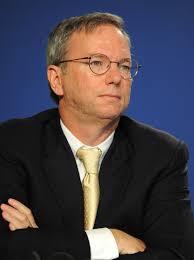
About Eric Schmidt
Eric Schmidt, the former CEO of Google and co-founder of Schmidt Futures, delivered the commencement address at the University of Arizona in May 2026. During the speech, he discussed the potential of artificial intelligence, stating that AI is "already accelerating research at a rate that we could not have imagined even 5 years ago" and that it is "designing new molecules, running simulations, identifying patterns in genomic data that no team of humans will uncover in a lifetime." He also acknowledged fears about technology, saying, "There is a fear in your generation... that the machines are coming, that the jobs are evaporating." Reports indicate that portions of his speech were met with boos from the graduating class. In other appearances, Schmidt discussed the global AI race, describing it as "really an energy race" and noting that the "current number one problem in the AI companies" is a "lack of data centers." He also commented on government concerns about AI, stating that governments "want to win, but they're also concerned about safety for their populations and can it be misused."
Source: AI-verified profile updated from Eric Schmidt's recent appearances.
Browse all interviews →
✨ AI-enhanced transcript with speaker attribution
E
Eric Schmidt0:00
I think the message of technology innovation is an overwhelmingly positive one, and it's easy to criticize some of the effects of this. But the fact of the matter is that in the last 20 or 30 years, the globalization that we're all part of has brought a couple billion people from pretty significant poverty to what we would think of as lower middle class or middle class lives. We'll go from a very small number of people having access to the world's information to virtually everyone in the world having access to all the world's information, and in their own language. If you add that, and then you take a look at the sort of data analytics that's going on around medicine, genetics, and unlocking the human genome and the other kinds of genetic sequencing people can do, I think we can look forward to a world, at least for people who have a certain amount of income, extraordinarily long lives that are very, very productive with an enormous amount of information. That pace, in my view, is accelerating. If you take a look at the folks who are not so fortunate, people in the developing world, for them the world gets better too. It doesn't get better as much as our world does, but they get access to the things that they've wanted for decades that they cannot have today.
P
Peter Thiel1:03
I think, Eric, you do a fantastic job as Google's minister of propaganda. The part that I would challenge you a little bit on is just how healthy the state of technology generally is. If you look at the US, say in the last 40 years, 1973 to today, median wages have been stagnant. The 40 years before that, 1932 to 1972, they went up by a factor of six, and it was matched by incredible technological progress. Cars got better, the aeronautics industry got started, you went from no planes to supersonic jets, computers were invented, you had all sorts of incredibly important dimensions in which progress took place. I agree we've had certain narrow areas where there's been significant progress, but it's very odd that it hasn't translated into economic well-being. This is not just a problem with capitalist countries like the US, you may say the US is too capitalist for your liking, Eric, but it's also true of socialist countries like France, it's true of all sorts of other countries like Japan, where things have been surprisingly stagnant. There's this weird question of what's going on. If I had to sort of simplify it, we've had incremental but relentless progress on the computer side, and on the other hand we've had basically no progress on energy. If you think about where oil prices were in 1973, it was $2 or so a barrel, it is now at north of $100 a barrel. You've had a catastrophic failure of energy innovation, and it's basically been offset by computer innovation. I think that's a simplified account of what's happened in the last 40 years.
E
Eric Schmidt2:44
I think it's because the government's outlawed technology. We're not allowed to develop new drugs with the FDA charging $1.3 billion per new drug. You're not allowed to fly supersonic jets because they're too noisy. You're not allowed to build nuclear power plants. We've basically outlawed everything having to do with the world of stuff, and the only thing you're allowed to do is in the world of bits. If you're a computer, that's good, but the question is how good is it for human beings and how does this translate into economic progress for humans.
P
Peter Thiel3:12
US issues have to do with entitlement spending, bad government, and demographic issues. Well, you two are in agreement on that then.
E
Eric Schmidt3:18
We actually are, and the problem is he states the argument completely wrongly. If you look at a technological basis, I think to argue that the technological impact is not strong or that the bits and so forth and so on is crazy. If you look at the improvements in power to weight ratio with new materials and cars, I think you'd be pretty impressed with that. There's a whole renaissance of materials science going on with new smart services, new much lighter, much stronger materials. All of this is being driven by American universities. There's a mini boom in America in advanced manufacturing using all these new technologies. The core problem we have going forward is that you have two forces that are going to govern much of what's going to happen in the future. The first is globalization, which we're not going to repeal, and the second one is automation, which we're not going to repeal. If you look, these problems are ultimately cast in political systems in the west, and I think eventually globally as jobs problems. The solution to jobs problems, in my view, is education, right? Education at many levels in many different ways, which we can discuss. I don't see another solution to this.
P
Peter Thiel4:22
So how then? You have $50 billion at Google. Why don't you spend it on doing more in tech, or are you out of ideas?
E
Eric Schmidt4:28
It's not. And I think Google does more than most companies. You know, you're trying to do things with self-driving cars and supposedly with asteroid mining, although maybe that's just part of the propaganda ministry. And you know, you're doing more than Microsoft or Apple or a lot of these other companies. Amazon's the only one, in my mind, of the big tech companies that's actually reinvesting all its money, that has enough of a vision of the future that they're actually able to reinvest all their profit. If we're living in an accelerating technological world and you have 0% interest rates in the background, you should be able to invest all of your money in things that will return it many times over. The fact that you're out of ideas, maybe it's a political problem, the government's outlawed things, but still it's a problem. What you discover in running these companies is that there are limits that are not cash. There are limits of recruiting, limits of real estate, regulatory limits. As Peter points out, there are many, many such limits. Anything that we can do to reduce those limits is a good idea.
P
Peter Thiel5:23
But then the intellectually honest thing to do would be to say that Google is no longer a technology company, it's a search engine. The search technology was developed a decade ago. It's a bet that there will be no one else who will come up with a better search technology, so you invest in Google because you're betting against technological innovation in search. It's like a bank that generates enormous cash flows every year, but you can't issue a dividend because the day you take that 30 billion and send it back to people, you're admitting that you're no longer a technology company. That's why all these companies are building up hoards of cash, because they don't know what to do with it, but they don't want to admit they're no longer tech companies.
E
Eric Schmidt5:58
The brief rebuttal is you know, Chrome is now the number one browser in the world. The platform for enterprise innovation on top of Google is, I think, phenomenal. There are many, many examples of business innovation that Peter's not choosing.