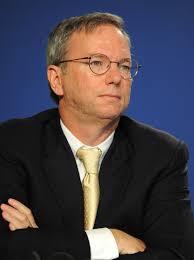
About Eric Schmidt
Eric Schmidt, the former CEO of Google and co-founder of Schmidt Futures, delivered the commencement address at the University of Arizona in May 2026. During the speech, he discussed the potential of artificial intelligence, stating that AI is "already accelerating research at a rate that we could not have imagined even 5 years ago" and that it is "designing new molecules, running simulations, identifying patterns in genomic data that no team of humans will uncover in a lifetime." He also acknowledged fears about technology, saying, "There is a fear in your generation... that the machines are coming, that the jobs are evaporating." Reports indicate that portions of his speech were met with boos from the graduating class. In other appearances, Schmidt discussed the global AI race, describing it as "really an energy race" and noting that the "current number one problem in the AI companies" is a "lack of data centers." He also commented on government concerns about AI, stating that governments "want to win, but they're also concerned about safety for their populations and can it be misused."
Source: AI-verified profile updated from Eric Schmidt's recent appearances.
Browse all interviews →
✨ AI-enhanced transcript with speaker attribution
N
Narrator0:00
Outside the theater, the inscription read "Children" to try to dissuade Russia from striking the building. More than 600 people died in that attack. A new piece details one reason Ukraine has been able to hold out and why technology will define the future of geopolitics. It says outgunned and outmanned, Ukraine turned to one area where it held an advantage over the enemy: technology. The Ukrainian government uploaded all of its critical data to the cloud, so it could safeguard information and keep functioning even if Russian missiles turned its ministerial offices into rubble. When Russia sent drones, Ukraine sent its own drones to intercept its attack, while its military learned to use unfamiliar Western supplies from Western allies. Ukraine simply proved nimbler. What Russia imagined would be a quick and easy invasion has turned out to be anything but.
I
Interviewer1:22
With us is the author of that piece, Eric Schmidt. Thanks so much for being with us. We're coming up on the 20-year mark of the beginning of the Iraq War. How much has warfare changed over the past 20 years because of technology?
E
Eric Schmidt1:35
It's going to change a great deal more. The biggest change is going to be the arrival of autonomy, that essentially translates into drones. If I were a soldier, I'd want 50 drones ahead of me, looking out, defending me, attacking. Most of the military techniques on the Ukrainian side seem to be clever. They're in and out, use Himars and shoot something, or send a drone over and go behind enemy lines to take them out from the rear. These were technologies not available in the past and certainly not available to the Russians.
I
Interviewer2:12
Talk to us more about some of the stuff Ukraine's been using. They've used the Starlink satellites to stay connected. They've also done a remarkably good job warding off Russian cyber attacks, which many thought would be at the forefront of their invasion.
E
Eric Schmidt2:33
Everybody assumed Russia would destroy their cyber infrastructure. Russia tried, but the Ukrainians managed to hold it off. The arrival of Starlink made a huge difference. This is the first broadband war. This is the first war where citizens can take a picture of a tank and have it AI-targeted and take the tank out. That's how the first wave of the war was won in Kyiv.
I
Interviewer3:02
Will the technology also help Ukraine move on, rebuild when this war comes to an end?
E
Eric Schmidt3:14
They're going to have a heck of a lot of technology companies by the time they're done. The entrepreneurs, who are not allowed to leave the country anyway, are busy building the companies that will power the new generation of technology, drones, both land and sea.
I
Interviewer3:35
Shifting into what some think might be a future cold war, explain how technology is taking place between US and China and a potential standoff down the road.
E
Eric Schmidt3:47
I wish I could tell you otherwise, but at the moment I think the leader is China, not the United States. China produces four to five times more STEM graduates and is very capitalist in the way it approaches these things. They dominate in new energy, all the batteries that you use. They're probably going to dominate in cars. They already dominate in financial services. They're trying to compete with us in AI, quantum, and synthetic biology. The Chips Act helped us with a lot of science lending and so forth. The American model is the universities invent stuff, capital at risk funds it, and the government helps make the market happen and regulate it. That triad when it works is exceptional. Look at Operation Warp Speed and how well it worked. We've got to get back to building these things at scale or the Chinese will basically beat us.
I
Interviewer4:44
Let's talk about it. We've heard stories of generals being killed because they took out a cell phone, just a crude cell phone to call back home. Other Russians have done the same thing where they're not equipped with advanced technology and they give up their locations time and time again. With the brain drain that is happening in Russia and has happened since the start of the war, doesn't this technology gap only increase?
E
Eric Schmidt5:24
It does, so long as Russia does not become reliant on the Chinese technologists, who are very, very good. We've got to make sure these smart people come and we give them visas and keep them in the United States. There's no place to hide anymore. There's too many satellites, too many people watching. You can't hide your aircraft carriers and so forth. New combat techniques will be hidden, surprise and so forth. Imagine a war between North Korea and the United States. North Korea attacks, the United States defends. China decides it's a bad idea. The whole war occurs in about 5 milliseconds because it's a cyber war. They're going to have to figure out what to do because the war happens faster than humans can decide.
I
Interviewer6:22
I want to circle back to something you referenced in your last answer. Can you talk about how critically important it is that Congress gets its act together and figures out a way to make sure the best and brightest that come to America to get advanced degrees don't have to go back to China or India, but we actually have immigration reform that keeps them here?
E
Eric Schmidt6:53
This is such an easy argument. The top, top papers in AI, which I work on a lot, often have a Chinese author, one of five or one of ten. Those that are in America, we should give each and every one of them a great place in the United States and a visa and the ability to stay here. We do not want them going back to China with their knowledge.