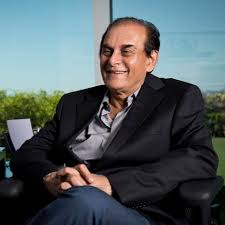
Good morning to all of you. So, I think last week I met Dr. Solanki in my office and at that time he mentioned to me that this is a confluence of chief executive, HR heads, and academics. And if I look back at my own history, I think it resonates very well because when you are a small entrepreneur, it's very difficult to attract talent. In the early '70s, our turnover was very small, we were located in the heart of commodity markets in Mazgaon, and it was impossible for us to recruit good talent. At that time, I relied a lot on academics in terms of consultants. So I used to work with consultants out of IIM-A, some other HR professionals who were also HR heads. And then as a business group, I think it made sense to leverage all three, and I see that there is a very good synergy between these three. Unfortunately, in a country like India, the academics part is not as well respected by the corporate world in terms of consulting as compared to international academics. So I think there is a lot of potential in that area for academics to actually play a very important role in the corporate world. And when I interact with young entrepreneurs, one of the biggest challenges they face is HR: how do I attract talent, how do I retain talent? They are completely clueless because that's the biggest problem they have. Somewhere, I think that link has to be formed between what are the needs, and they are not able to recruit good talent, and there is a genuine shortage of good talent, especially in HR. So in that case, can the academics play a role of consulting? I always told them that there's no point trying to recruit a good HR person; you may not get one for your scale, but if you're able to identify a good consultant, I think that will help you at least for some time. And at some stage when you become much larger, at that time you can afford to have and you can actually attract good HR talent.
So I look back at my own history. Earlier, it was a part of Bombay Oil Industries when I started working. At some stage, we realized that being part of an organization which had other businesses and where there were many other family members, it was very difficult to attract talent because of the fact that there were four of my cousins, three of my uncles, my father, me in one company, three or four different businesses. When it comes to attracting talent, there is always a fear that this is a heavily family-dominated, family-managed company, and there could be issues of dual reporting relationships between the family members. So I had to arrive at a structural solution. If I had to give thrust to my business, and especially in our kind of business, good talent plays the most important role. So with that, I was able to convince the family that let me take this business away from Bombay Oil Industries into a new company where only me, only one family member, will be present. It was not a financial separation; financially, it was the equal stake earlier, and the new one in Marico. But that gave me a tremendous opportunity to attract talent. If I look back at my own history, I think that was the most important decision I took in my life. If I had not moved away from Bombay Oil Industries, the location Mazgaon, so many family members, it was impossible to attract good talent. That gave me a very good opportunity to improve my talent base, and that has had its own impact in terms of our overall growth. In the year 1990, Marico took over Bombay Oil Industries' consumer products business, which had built up from 50 lakhs. Since then, we have grown on average at 17-18% per annum, and I think the key reason was the formation of Marico. If I really look back at my own learnings, I would say talent and innovation have played the most important role.
So what did I do after Marico was formed? We had to recruit a new team, and I was very clear that we started with a good HR head. So my first recruitment was an HR head. The perception that it's a family-owned organization, I couldn't escape that. But the fact that I was able to recruit a senior HR head from an XLRI background who had worked in Asian Paints and other companies, I think that really helped me in attracting talent because he was then batting for me in terms of talking to candidates and attracting talent. That synergy in working together was one of the most important things in attracting talent at that stage. So within a very short period of time, almost 6 months, we recruited something like 20-30 good talents from different backgrounds: MBAs, chartered accountants. There was a huge upgrade in terms of what we were earlier to what we had recruited, a lot of excitement. But very soon I realized that this had become very chaotic because all of a sudden, when you recruit 30 people from different backgrounds with different beliefs and different ways of working, it led to a lot of confusion. How do we treat people? Do we reward loyalty? Do we reward performance? What should be the HR practices? What do we do with profits? What kind of products do we get into? Very quickly, I realized that if we had to work as an organization, I had to unify all their beliefs into a system. So at that time, I personally wrote down a lot of my own thoughts which had built up over 15-20 years in terms of how to deal with people, products, profits, something like 20-30-40 random pages. I shared that with my team who was reporting to me at that time, and I'm talking of the year 1991. It evoked a phenomenal response from my team. Everybody thought that at that time, 25-27 years back, very few Indian organizations had thought about writing out values. There were gaps in my own thoughts, and we discussed those notes for almost a year or so. At the end of those deliberations, we had a very well-structured values document dividing into people, products, and profits. More importantly, it had inputs from my team members, so it became from my document to our document, which was very important. So what do we do? It's very easy to finalize values, I would say relatively. But how do you convert those values into a culture is a bigger challenge, and I think many organizations are failing in that. In organizations, values are pasted in the reception, but when you talk to people inside the organization, you find that it becomes a laughing point, that this is just for the sake of feeling good. But I think the bigger challenge is how do you create values into a strong culture and how do you retain that culture over a long period of time.
So what did we do? How did we go about doing it? Post finalization of those notes, we called something like 30-40 managers in a similar kind of setting and we said that this is something which was started by me, but value addition happened by my team, and we want to use this opportunity to identify if we could still have blind spots. We may not have identified the right values. We may have made some errors. So we want inputs from you. So we divided the group of 30 or so into four or five small groups and asked them to critique that value document and come back with a presentation about what they think is right, what is not right, and more importantly, if you decide to go ahead with it, compared to what we are doing today, where are the gaps? That was a two-day deliberation, and a lot of issues came up through them. They also identified many gaps which the organization was not practicing compared to what was written in the value document. So that became a lot of database for us to work upon. But I think the most important learning for me in this was that when you involve people, you get commitment. It could have been my values; I could have finalized with some consultant and given to my team or one or two layers down, and it would never have got that commitment. In any culture-building journey, the top and the senior management play the most important role. If I give one wrong signal that I don't value this, I don't practice this value, then it will just go down the line. So it is very important that the senior management practices, owns values, and reinforces values on a perpetual basis.
So what next? We had these 30-40 people owning the values, saying that these are our values. Then I personally went to all the corporate locations, which included all our regions, all our factories, and international locations, and talked about the fact that we are embarking on this journey. We called everybody, including workmen, and in locations where English was not known, in Kerala and in Maharashtra, it got translated into the local language. We shared with them why we are doing this, and again followed up with group discussions identifying what are the gaps we have in these values. So again we involved a lot of people at that time, maybe 400-500 people or a little more than that, and we got their inputs. This itself became so much work to do in the next two to three years. In the first two to three years, I must say that we gave a lot of attention to values and culture. Sometimes people reporting to me would say, 'Are you neglecting strategy by going too much into the culture building part?' But I think it was needed to get that momentum.
So how did we create that culture? I'll just give you a few examples of what our values are. We believe a lot in openness, trust, empowerment, which were very important as a way to attract talent. Because we compete with multinationals in attracting talent at campuses like Levers or Procter & Gamble, we had to create an employee value proposition which was different from what they were doing. So we said that we are empowering our people much more than any other multinational. What happens at their end is that a lot of decisions get taken at their headquarters, but in our case, everything gets decided here. So we have a lot of agility, speed, and empowerment. We also provide a lot of opportunities to our people to grow. We have learning as a value. Learning in my opinion, I have a lot of emphasis on on-the-job learning and job rotation. I'm not saying no to classroom programs, but I think a lot more learning happens when you're on the job and when you're rotated. So we have a very active job rotation program. How did we reinforce something like trust? We said, can we give some strong signals to our people? We call them not employees but our members. Through some ideation, we concluded that there is nothing like sick leave. If you're sick, you're sick; you're not entitled to sick leave. You are not entitled to casual leave. So we did away with sick leave and casual leave. If you are sick, you take sick leave; it may be 30 days in a year, it could be 2 days a year, but we trust you. There's nothing like casual leave, nothing like sick leave; there's one privilege leave, no carry forward and all that. Leave has to be taken, and it's not that you're entitled to sick leave. We said that we will do away with muster rolls wherever they were not statutorily required. So in our office, no muster since then, and we trust you to come on time. We also added flexibility in terms of coming to work. If somebody wants to not work, it's very difficult to catch a person; he may be doing something on the computer, he may be doing something else. So too much control doesn't help. You have to give signals in terms of trust. So we did away with that. In terms of expense statements, every time if anybody incurred an expense, you would have to write it down, go to the boss whether it is telephone expense, travel expense, or whatever else. We said, can we do away with that? So we have gone into a self-authorization scheme. We trust you, and you can self-authorize your expenses. We have limits, we have policies, but we believe that if anybody misuses anything on leave or on authorization or expenses, then that person will be asked to go. We do some random audits. There have been some cases where some people have misused, and that person was asked to go because he betrayed that trust which you had placed in that person.
In terms of openness, we were moving into a new office. So the interior designer was given a brief that people should see openness, so they could see even what I was doing. It was not open in terms of there were partitions, but you could see through partitions. We have an open house every year at all our locations wherein anybody can ask any questions to management. It could be related to their hygiene factor, salary, or it could be related to strategy of the organization. So they get a chance to air their grievances through the open house mechanism. We share a lot of information with our members. We talk about our strategy even to workmen. We share our strategy: what are we going to do next year? Every year in the month of April and May, once we declare results, we have these gatherings, what we call organization communication exercises, which basically talk about strategy, and then there's open house, and then there are awards which reinforce values. So somebody has done something in the area of openness, trust, whatever else, we call for applications or innovation, and then we award those people. Basically, what I'm trying to say is values need to be reinforced on a perpetual basis. It is just not at that time. Today, if you look at that team which was there, nobody is there in that team; it has been replaced by maybe one or two sets of new teams over the last 25 years. So what is the challenge? When you have new people coming in, again you have to treat that subject of values and culture in a serious manner. There is an induction program where everybody goes through one day induction on values and culture, what was the history behind it, and why are we like this. When it comes to acquisition, same thing. We acquired companies in South Africa, Egypt, and it's very different because you're acquiring something which has a different culture, but over a period of time, the challenge is to integrate that into a culture. I've talked a lot about culture because I believe that culture is a source of competitive advantage. Peter Drucker has said that culture eats strategy for breakfast, and I think it is the role of HR to play a very important role in culture building. But at the end of it, the CEO has to be passionate about HR. If CEO does not take HR seriously, nothing will happen in the organization. HR has to be a very integral part of strategy. HR head has to be a part of the top team without fear. It cannot be that I will invoke HR. We believe that the role of HR is a very catalytic role. HR has to make line perform better rather than do things which the line is supposed to do. So hiring, firing has to be done by line, not HR. Even union negotiations in our case has to be done by line, not HR, because HR plays a catalytic role. Of course, they will teach you, they may be present, but ultimately it is the line which has to own it. In today's environment where there is intense war for talent, it is just not HR's responsibility to attract good talent. We say that all the line managers are equally responsible in terms of spotting talent from external sources. You have to treat recruitment like a marketing function. You have to sell yourself, you have to create that image for the organization. Before anybody joins, most of the time people refer to what kind of an organization it is. If it is not known well, it's very important that you create that right image. HR has to play a very important role in creating image. We also realize that the ex-employees who have left you are your ambassadors. Many times, a person who has been given an offer may know somebody who had worked with the organization maybe a few years back, and normally there is a tendency to say, 'What kind of an organization is this?' So if we treat all our ex-employees as ambassadors, that really helps. When I say ambassadors, you have to be in touch with them, you have to inform them what's happening in the organization, and there are enough ways of doing that in today's world. Once in a while, you also have to create opportunities for them to get together. When we achieved 1,000 crore turnover, when we did 2,000 crore turnover, and when we reached 5,000 crore turnover, we called all our ex-employees above a certain level, our manager level, to a dinner. That was our way of saying that ex-employees are also treated well and they are perceived as ambassadors in your journey.
I'll just give one other example of how HR played a very strategic role for Marico in the year 1993-94. We had to set up a new factory to manufacture Parachute coconut oil. From all angles in terms of cost, Kerala seemed to be the best location. But when I talked to my family, talked to my friends, everybody was completely against the idea of setting up in Kerala because they felt that on paper this may be there, your cost savings, but the industrial relations in that state are very bad. You will battle with a lot of strikes and you will not be able to do production in that state. So then we discussed that internally with my HR head and my operations head, and they said, 'You give us a challenge, we are willing to accept that challenge. We will look at people from a different lens.' I said, 'Okay, I believe in innovation, so come back to me with what is the different lens you want to look at.' So they said that we will first of all select people by going to their houses. We'll not only meet the likely candidates but the parents also and tell them what kind of an organization we are. We'll do proper reference checking. The key insight which they got was that especially in small towns, even in big cities, after work most of the workmen don't have anything to occupy themselves in terms of hobbies, art, sports. So can we actually keep them occupied post work? So we divided the whole factory into four different houses like in schools and created a lot of internal competition on art, sports. We offered them sports facilities, music. I must say that that really helped because most of the negative energy which goes into trade unionism went into a positive way in terms of a better lifestyle, and they were happier. It's now more than 20 years we are there, and it's been an amazing experience in Kerala. We have not lost any production for a day. We won some HR awards for that. It was important to take that decision. So HR played a very strategic role in this, and I must say that we must have saved crores of rupees because of that decision to locate and not just get cowed down by the fact that others were suffering in Kerala.
So I think let me end by saying that HR is a source of competitive advantage, and I think line has to play a very important role. All managers are responsible and accountable for strengthening the talent pool because people are every manager's responsibility. So these are my thoughts on the role of HR. I tried to condense it in maybe about 30 minutes or so. So if there are any questions...