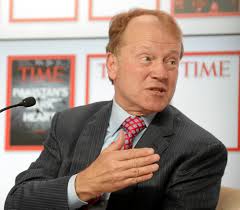
About John Chambers
John Chambers, founder and CEO of JC2 Ventures, has been speaking publicly about artificial intelligence, US-India economic ties, and energy infrastructure. In a March 2025 interview, Chambers described AI as "the biggest technology shift since the internet" and said the industry is only in the "second inning" of a "hundred inning baseball game." He predicted that the majority of AI startups will fail, adding that success will depend on execution and business models rather than technology alone. Chambers also stated that all 480 member companies of the US-India Strategic Partnership Forum are continuing to increase their investments in India, attributing this to "economic logic" and the country's scale and innovation ecosystem.
Chambers has also addressed challenges related to AI adoption, including energy constraints for data centers. He said the US energy grid cannot handle the demand and advocated for on-site power generation, citing Bloom Energy as an example. Chambers predicted 3 to 5 percent productivity growth in the US as a result of AI, and described Indian Prime Minister Narendra Modi as "one of the top three leaders of my lifetime." He expressed confidence that the US-India relationship will become "dramatically stronger" within three to five years, though he acknowledged the need for better public education about AI's impact on jobs and living standards.
Source: AI-verified profile updated from John Chambers's recent appearances.
Browse all interviews →
✨ AI-enhanced transcript with speaker attribution
I
Interviewer0:00
We're living in a world where we don't know who your friends are or the good thing is you don't probably have permanent enemies either and you certainly don't have permanent friends at this point in time. What does that mean as a CEO who's weighing decisions on where you should invest, how you should invest, how much you should invest? I mean at the end of the day capital goes where it feels safe. How much is geopolitics going to weigh on investment decisions specifically related to AI?
J
John Chambers0:27
So anytime you invest, the more predictable the environments you're in, the more comfortable your investment opportunities are. But of even more importance is the larger the opportunity, the more likely you are to invest. Now here's where I transition from the emotional question back to the factual question. There are 480 companies in the US-India Strategic Partnership Forum. You know many of them, you've interviewed us. The majority of them are large companies. Out of the 480 companies, how many are not continuing to increase and actually accelerate their investment in India? All of them. Are they saying that out loud? Is that the right time to probably be a little bit low profile? Yes. But in the end logic always wins. Economic logic, the businesses have already voted. The businesses want this on India, startups, big companies back and forth. Citizens want a higher standard of living, but they don't want it at the expense of losing their jobs. And so as you begin to show the generation of jobs for each company that works together in India, the jobs generated in the US and vice versa, then they begin to get it and see the outcomes that go with it. And then if you look at what you really need is innovation at scale, i.e. 1.4 billion people, 360 billion people with capital. Nobody's richer in the US by far on it. With democracies that really believe in countries that believe in technology. With the internet, 92% of Americans believed that was in their best interest and the country's best interest. We've done a terrible job of not just positioning because it can't be marketing, but actually saying here's how we're going to address AI and why is it important to people that are in the central part of the nation where I lived the majority of my life.
I
Interviewer2:21
But, you know, just going back to the US-India question and as you rightly pointed out, companies continue to invest, companies continue to be invested in the India story. But to your point about if you don't make the investments in AI today, you're going to be left behind. Now, India is making its play, whether it's data centers, it's a semiconductor mission, and so on and so forth. But the fear is that you're not really creating IP at this point in time. Yes, you're the largest consumer base, enterprise adoption is still lagging behind. What are your concerns, if any, on AI specifically and the role that India is likely to play?
J
John Chambers2:58
So, on the positive concerns and then the issues that we have to address in India, and I love the Prime Minister, you know that. I think he's one of the top three leaders of my lifetime, and he understood when he first came in about a digital India and the 11 planks that he would drive through it. And then he understood when AI came on, India had to be an AI country in terms of direction and implementation. In terms of where we can work together, there's no bigger data than 1.4 billion people. And there's no bigger source of capital and how do you grow and scale companies than here. And so, you just have to say how do we work through these issues together, and there are going to be setbacks. It's like a relationship. I don't know how many of you are married? Is your relationship always straight up into the right, no bumps? Anybody want to raise their hand that they're going well on that? It sets back. And by the way, what people miss, the setbacks, if you survive them, make you stronger. My best relationships with customers weren't the ones that took them straight up into the right. It was when we had setbacks, sometimes our fault, sometimes my customer's fault, we worked through together, and the relationship was stronger. This relationship with India, and I'll do another bet, will take three or five years and maybe give me a in that window, will be dramatically stronger than it's ever been three to five years from now. It is in both countries' government leaders, business leaders, citizens to do it. But we've got to do a much better job of educating people for why it is. We aren't going to take jobs from one country to another. We're going to increase the standard of living together, and we can do it dramatically. We're probably at two percentage points to India's GDP, one to the US. So, we'll navigate through it, whether bumps along the way. Oh, yeah. But I love disruption. I apologize. I wish I could tell you this makes me uncomfortable. This is my world.
N
Narrator4:59
For more news and updates, all you need to do is follow CNBC-TV18 on all of our digital platforms.