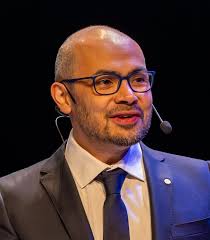
Demis Hassabis0:00
Well, proteins are like the building blocks of life. Every function in biology depends on proteins. Proteins are specified by what's called their amino acid sequence. You can think of that a little bit like their genetic sequence. You think of it as a one-dimensional string of beads, and in nature that scrunches up into a ball. The shape of that ball is very important for telling you what the function of the protein does. So what you really want to know is, can you tell from the amino acid sequence, the one-dimensional sequence, can you directly predict the exquisite 3D structure that the protein will take? It's been a long-standing grand challenge in biology for 50 years. There are ways to do this experimentally, but it takes a very long time, very painstaking work on very expensive equipment to discover the structure of just one protein. There are 20,000 proteins in the human body and 200 million in nature. Computational methods like AlphaFold really allow you to accelerate that to know the structures of actually every protein in nature.
With AlphaFold 2, we essentially solved the static picture of a protein, the 3D structure of a single protein. That's really important for things like drug discovery or disease understanding, which is why it's such an important breakthrough. But biology is a dynamic system. All the interesting things in biology happen when things interact in nature. So you don't just want the static picture of a protein; you need to understand how it interacts with other proteins, or with DNA or RNA, or chemical compounds like drug compounds. That's what AlphaFold 3 is: the first step in that direction of understanding and predicting how pairwise interactions will happen between different biomolecules.
The whole point of AlphaFold and why the protein folding problem was so important is that it should accelerate drug discovery a lot and understanding of diseases. The reason it accelerates drug discovery is that if you know the 3D structure of a protein and you know what its function is, you can design a chemical compound, a drug, to bind to the right part of the protein, the surface of the protein, to block its function or accelerate function, whatever it is you need to do. Knowing the 3D structure should accelerate drug discovery, but it's only one part of the drug discovery process. We also need other systems to help with drug discovery, to design the chemical compounds and things like that. We're working on those topics now. We spun out our new company, Isomorphic Labs, to do the chemistry space of that. If that all works, I think in the next 5 to 10 years, what I hope will happen is that instead of taking an average of 10 years to discover a new drug, which is an enormous amount of time and cost, it can maybe be reduced down to months instead of years, or maybe even weeks. That would be revolutionary if you think about getting a solution to a disease, a cure to a disease, in a matter of weeks. That would revolutionize human healthcare. I think that's a really beautiful story too.
I wanted to be inspired not just by the computer science and the engineering ideas, but also the neuroscience and biology ideas of how the brain works. That was the beginning of DeepMind: combining the knowledge from those two fields.
That's a really hard question that I'm not sure I can answer. Obviously, building a scientific advance worthy of something like the Nobel was one of my dreams for sure, and that's been achieved now. But my overarching dream has always been to build artificial general intelligence, to use it to accelerate human knowledge so that we better understand the deepest mysteries of the universe around us. I've always been obsessed and intrigued by that from as far back as I can remember: all the biggest questions, the nature of consciousness, nature of time, fabric of reality. I think having a tool like AI will help us as humanity understand ourselves better and our place in the universe.