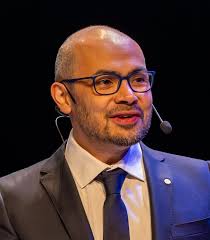
About Demis Hassabis
Demis Hassabis, co-founder and CEO of Google DeepMind and 2024 Nobel laureate in Chemistry for AlphaFold, has continued to discuss the timeline for artificial general intelligence (AGI) and its potential applications. In multiple recent appearances, Hassabis stated that he believes AGI could arrive around 2030, describing the current period as the "foothills of the singularity." He has emphasized that key capabilities such as continual learning, long-term reasoning, and aspects of memory remain unsolved challenges. Hassabis has also discussed the importance of the "agentic era," where AI systems actively solve problems, as a path toward AGI.
Hassabis has frequently highlighted the potential of AI to revolutionize drug discovery and medicine, stating that he believes AI could help cure every disease on Earth within a decade. He described a goal of reducing drug discovery times from an average of 10 years to months, weeks, or even days. Hassabis noted that Isomorphic Labs has test compounds in pre-clinical stage and that he views the first AI-designed drug reaching patients as a potential watershed moment. He has also expressed concern about public perception of AI, stating that the public is "right to be concerned" and that the technology is "dual purpose." Hassabis has called for international standards and cooperation on AI safety, and has advocated for the industry to demonstrate more unequivocal benefits of the technology, particularly in health and science.
Source: AI-verified profile updated from Demis Hassabis's recent appearances.
Browse all interviews →
✨ AI-enhanced transcript with speaker attribution
I
Interviewer0:02
I have to ask you about the book The Maniac. There's this hand of God moment, Lisa Doll's move 78, that perhaps the last time a human did a move of pure human genius and beat AlphaGo, or like broke its brain, if I'm sorry to anthropomorphize, but it's an interesting moment because I think in so many domains it will keep happening.
D
Demis Hassabis0:26
Yeah, it's a special moment. It was great for Lisa Doll, and I think in a way they were kind of inspiring each other. We as a team were inspired by Lisa Doll's brilliance and nobleness, and then maybe he got inspired by what AlphaGo was doing to conjure this incredible inspirational moment. It's all captured very well in the documentary about it. I think that will continue in many domains where, at least for the foreseeable future, the humans bring in their ingenuity and ask the right question, and then utilize these tools in a way that cracks a problem.
I
Interviewer1:10
Yeah. As the AI becomes smarter and smarter, one of the interesting questions we can ask ourselves is what makes humans special? It does feel, I'm perhaps biased, that we humans are deeply special. I don't know if it's our intelligence.
D
Demis Hassabis1:27
It could be something else, that other thing that's outside the mad dreams of reason. I think that's what I've always imagined. When I was a kid starting on this journey, I was fascinated by things like consciousness. I did a neuroscience PhD to look at how the brain works, especially imagination and memory. I focused on the hippocampus. It's going to be interesting. I always thought the best way, one can philosophize about it and have thought experiments, or even do actual experiments like you do in neuroscience on real brains, but in the end, I always imagined that building AI, a kind of intelligent artifact, and then comparing that to the human mind and seeing what the differences were would be the best way to uncover what's special about the human mind, if indeed there is anything special. I suspect there probably is, but it's going to be hard to define. I think this journey we're on will help us understand that and define that. There may be a difference between carbon-based substrates that we are and silicon ones when they process information. One of the best definitions I like of consciousness is that it's the information that feels when we process it, right? It's not a very helpful scientific explanation, but I think it's an interesting intuitive one. So this scientific journey we're on will help uncover that mystery.
I
Interviewer2:48
Yeah. "What I cannot create I do not understand." That's somebody you deeply admire, Richard Feynman, like you mentioned. You also reach for the Wigner's dreams of universality that he saw in constrained domains, but also broadly in mathematics and so on. So many aspects on which you're pushing towards.