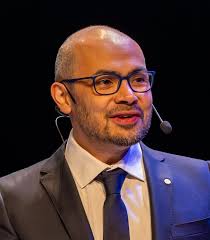
About Demis Hassabis
Demis Hassabis, co-founder and CEO of Google DeepMind and 2024 Nobel laureate in Chemistry for AlphaFold, has continued to discuss the timeline for artificial general intelligence (AGI) and its potential applications. In multiple recent appearances, Hassabis stated that he believes AGI could arrive around 2030, describing the current period as the "foothills of the singularity." He has emphasized that key capabilities such as continual learning, long-term reasoning, and aspects of memory remain unsolved challenges. Hassabis has also discussed the importance of the "agentic era," where AI systems actively solve problems, as a path toward AGI.
Hassabis has frequently highlighted the potential of AI to revolutionize drug discovery and medicine, stating that he believes AI could help cure every disease on Earth within a decade. He described a goal of reducing drug discovery times from an average of 10 years to months, weeks, or even days. Hassabis noted that Isomorphic Labs has test compounds in pre-clinical stage and that he views the first AI-designed drug reaching patients as a potential watershed moment. He has also expressed concern about public perception of AI, stating that the public is "right to be concerned" and that the technology is "dual purpose." Hassabis has called for international standards and cooperation on AI safety, and has advocated for the industry to demonstrate more unequivocal benefits of the technology, particularly in health and science.
Source: AI-verified profile updated from Demis Hassabis's recent appearances.
Browse all interviews →
✨ AI-enhanced transcript with speaker attribution
I
Interviewer0:00
Demis, thank you so much. Glad to be here. Thank you all for coming. It is a great honor for us to host you at our chocolate factory. Yes, I was just told about that. I look forward to trying the chocolate. Demis, let's get straight to business. We have with us a person who can be called a pioneer in every sense. An original thinker, scientist, founder, visionary, and expert in everything related to AI, a true advocate and a real scientist in the person of Demis. At the beginning of our conversation, we will talk about the early days, then about the birth of DeepMind, after which we will move on to science and answer questions from the audience. So, Demis, you were a chess prodigy.
D
Demis Hassabis0:39
You also founded a game company. You are a neuroscientist and founder of DeepMind, and now you lead a very large and influential company. It seems that all this is not connected, but you once mentioned that there is a common thread. Tell us about it. There is indeed a common thread. Although, perhaps, I connected it all into one thread in hindsight. You know, I just built such a structure. But I wanted to work on AI for a very long time, and as a teenager, I decided that this was the most important and most interesting thing I could do. And then I chose areas of study or work that, as it seemed to me, would ultimately help me create a company like DeepMind. So this plan appeared when I was about 15-16 years old, and I went into games for a while because in the nineties, that's where the most advanced technologies were developing. Obviously, not only in the field of AI, but also in graphics, especially at the hardware level. The same graphics processors that we all use today were originally created for graphics engines. And I worked with the first video cards back then, in the late nineties, so there were a lot of truly advanced technologies there. Moreover, all the games I created, including projects for Bullfrog and for my own company Elixir Studios, used AI as the main element of gameplay. Perhaps my most famous game was Theme Park, which I made when I was about 17. It was an amusement park simulator. Thousands of little people came to your park, rode the rides, and decided what to buy in the store. That is, under the hood, there was a whole economic model based on AI. It was one of the first games of its kind along with SimCity. And when I saw that it sold over 10 million copies, and when I noticed how delighted people were interacting with AI, it became one of the reasons why I decided to dedicate my entire career to this. Well, neuroscience was needed to draw inspiration from the brain's work and take various algorithmic ideas from there. And then I simply combined all these different directions when creating DeepMind, when we felt the time was right. And, of course, in the early stages, we used games as a testing ground.
I
Interviewer2:53
We have a full room of founders here, and they will understand you, because you yourself founded companies not once, but twice. Take us back to the early days, to the time of Elixir Studios. What was it like? It's not the startup you're most famous for, but you achieved incredible success with it. How did you manage it and what did it teach you about building a business?
D
Demis Hassabis3:10
Well, I founded Elixir Studios right after college, and before that I was lucky to work at Bullfrog Productions. Those who know games know that it was a legendary studio at the dawn of the gaming industry. Perhaps the best in the UK and all of Europe. And I wanted to do something that would combine and develop AI and, in fact, in those days I financed it indirectly through game development, striving to push these boundaries and combine technology with advanced creativity. I think this is relevant today, given how we conduct our fundamental research. But perhaps the main lesson I learned is that you need to be ahead of your time by 5 years, not 50. At Elixir Studios, we tried to make a game called Republic, which simulated the life of an entire country. The idea was that the player could overthrow the ruling dictator in various ways. We literally simulated living, breathing cities. And this, mind you, in the late nineties on a Pentium processor. We needed to make all the graphics and AI for a million people work on an ordinary home PC of that time. So we had no shortage of ambition. And perhaps the project was too ambitious, which caused certain difficulties. But I learned that lesson. You need to be ahead of your time. Of course, when the idea is obvious to everyone, it's already too late. But if you are 50 years ahead of your time, you most likely have no chance of making the project successful.
I
Interviewer4:39
Great. And speaking of not being too far ahead of your time. It was 2009, and you decided that the time had come for AI.
D
Demis Hassabis4:46
Yes, perhaps that time we were only about 10 years ahead, which is better than 50. Tell us, again, considering there is a full room of founders here, tell us about 2009. How did you manage to convince the first brilliant specialists? After all, you attracted top-class employees, the first team members. How did you make them believe in what at that time seemed like pure science fiction? But we found several interesting directions. It seemed to us that we were about five years ahead of our time, but perhaps it turned out to be closer to ten. We are talking about deep learning. It had just been invented by Geoff Hinton and colleagues in academia, but almost no one yet understood how groundbreaking it was. We also knew a lot about reinforcement learning and felt that we could make tremendous progress by combining these two methods. And at that time, almost no one was combining them. At least, it didn't go beyond the simplest educational tasks in academia. These were two fairly isolated areas. And besides, it was already clear that graphics processors would be extremely useful. Of course, now we use tensor processors, but the industry of accelerated computing promised to help a lot. Moreover, by the end of my graduate and postdoctoral studies, I and several other people I had gathered together were computational neuroscientists. We had enough ideas and principles borrowed from the brain that could be useful, including the idea that reinforcement learning could ultimately scale to the level of AI. We felt that we had all these elements in our hands, and we felt almost like keepers of a secret, because no one in science or business really believed in the possibility of major progress. In fact, many scientists in academia literally rolled their eyes when we hinted that we were going to work on AI or strong AI, as it was sometimes called then. They treated us with an attitude like, "Well, we know it doesn't work." Everyone tried it in the nineties. I did my postdoc at MIT, which was then a kind of center for expert systems and logical language systems. It's even surprising to think about it now, but I already considered it a thing of the past. However, that's how work was still being done at Cambridge, in the UK, and at MIT, these largest centers of traditional AI. And this feeling only convinced me even more that we were on the right track. At least, if we were destined to fail, our failure would be different from how people failed on the path to AI in the nineties. So it was worth doing anyway, even considering that it was pure research. We didn't know for sure if we would succeed, but at least in case of failure, our failure would be original.
I
Interviewer7:22
Was there any common controversial point at the stage of the birth of this faith? Something that you had to prove either to yourself or to your first followers in order to inspire them?
D
Demis Hassabis7:32
Well, let's say I would have dedicated my life to artificial intelligence anyway, regardless of the outcome. In the end, everything turned out according to an absolutely amazing, most optimistic scenario of all that we assumed. Although it still fits within our 2010 forecasts. At that time, we expected this to be a 20-year mission. And I think the entire industry is now exactly on schedule. Of course, we played our part in this. But even if everything had turned out differently and it had remained a niche topic, I would still be doing exactly this, because it was obvious to me that this is the most important technology in history. Our original mission at DeepMind was: step one – solve the mystery of intelligence, that is, create AGI. Step two – use it to solve all other problems. So I always considered it not only the most important technology ever invented, but also the most interesting, both as a tool for science and as an amazing phenomenon in itself. And generally as one of the best ways to understand our own mind, the nature of consciousness, dreams, creativity, and all such questions. As a neuroscientist, it always seemed to me that we lack a tool for analysis like AI, as well as the opportunity for comparison, when you can conduct a controlled experiment and compare two different systems with each other.
I
Interviewer8:51
Let's talk about AI for science. You were one of the first to enter this field. You believed in it and approached this issue as uncompromisingly as possible. This is your main mission. What exactly in how you created DeepMind and built its culture allowed the company to constantly remain at the forefront of applying AI in science?
D
Demis Hassabis9:08
Well, for me, this has always been the ultimate goal. My personal passion, my internal motivation for creating AI, was to advance science, medicine, and our understanding of the world. My vision of this mission was to approach it, let's say, at a meta-level. That is, first create the perfect tool, and then, when it is ready, come back and use it to make scientific breakthroughs. An example of this is the AlphaFold project, which we implemented. And I think there is still a lot ahead of us. So this idea has always been at the core of everything we tried to do at DeepMind. In fact, we have had a whole division for AI for science for almost 10 years, led by Pushmeet Kohli. We officially launched this direction almost the day after returning from Seoul with the AlphaGo match. And this event is exactly 10 years old this month. I was just waiting for the algorithms to become powerful enough and the ideas universal enough. And for me, winning the game of Go was that point, that moment when we thought: "Okay, now we are ready to apply these ideas to important real-world problems, starting with large-scale scientific challenges." We have always considered this the most useful application. And what could be better than using it to treat diseases, extend healthy life, and help medicine? This is obviously followed by other critical areas such as materials science, ecology, and energy. I am confident that in the next few years, AI will also play a huge role in these areas.
I
Interviewer10:34
And how exactly is AI making a breakthrough in biology? You are deeply involved in the work of Isomorphic Labs. And this topic is of great interest to you. You sincerely believed in the potential of AI for treating diseases from the very beginning. When will such a moment come, which we have already observed in the field of text and coding, but specifically in biology?
D
Demis Hassabis10:53
Yes. Well, I would say that with the advent of AlphaFold, we have already had one of those moments. Protein folding and determining their three-dimensional structure is a very complex problem that science has been struggling with for 50 years. And this is incredibly important knowledge if you want to create drugs or understand biological processes. Of course, this is just one of the stages of the drug development process. An important one, but just one of the stages. Therefore, Isomorphic Labs, our latest subsidiary, the management process of which I am also very passionate about now, was created to develop related technologies in biochemistry and chemistry. They allow us to automatically design compounds so that they precisely fit and attach to the desired part of the protein. Now we know the protein itself, its shape, we know what its surface looks like and what exactly we need to target. But now we need to create the right compound that, of course, will bind strongly to the desired target, but ideally will not affect anything else, otherwise toxic side effects will occur. And our dream is to transfer almost all of this research progress, which takes 99% of the work and time, into a virtual environment, leaving the laboratory only for the final verification stage. And if we succeed, and I believe we will achieve this in the next few years, then we will be able to reduce drug development timelines. Instead of an average of 10 years, this process will take months, possibly weeks, and someday maybe just days. And then, I think, any disease will be within our power. And personalized medicine will become possible, for example, creating individual drug variants based on basic medications. So the entire medical field and the area of drug development will completely change in the next few years. This is amazing.
N
Narrator12:40
You are watching this video because you understand that the future lies with artificial intelligence. But it's one thing to watch, and another to apply. That's why we created our platform called Neurofon. It is a single window that brings together the best neural networks in the world: ChatGPT, Claude, Nanoban, as well as our Gigachats from Yandex. Our philosophy is one chat. All models in Neurofon. You simply write a task, and our algorithms themselves choose the model that will solve it best at the current moment. Everything works in one window, without complex settings, payment in rubles. And for businesses, we have a separate powerful version. This is token payment for business, convenient management of the entire team, built-in neuroshield that strictly controls that confidential data does not end up in requests. The system can be installed within your organization's perimeter, launch your own RAG on your documents, and connect systems via the MCP protocol. QR code on the screen, link in the description, registration in one click. At the start, we give bonus tokens so you can try our system right away.
I
Interviewer13:48
You have talked a lot about AI for science. Do you think AI will create new scientific disciplines? By analogy with how the industrial revolution gave rise to thermodynamics, will something fundamentally new appear in our education system? And if so, what will it look like?
D
Demis Hassabis14:05
Well, in this direction, it seems to me, several things will happen at once. First, the very understanding and analysis of AI systems will over time turn into a full-fledged science, a kind of engineering discipline. After all, the objects we create are incredibly interesting, and they are also incredibly complex. Ultimately, they will become as complex as the human mind and brain. This means they will need to be studied so that we can fully, much more deeply than today, understand how these systems work. So a whole direction is forming here. Interpretability of neural networks is only part of this process. But I think we can do much more to analyze such systems. This will become a separate science, but I also believe that AI itself will open up new sciences, which is perhaps what you are getting at. The direction that particularly inspires me is AI for simulations. I love simulations. All the games I wrote not only contained AI, they themselves were simulators. And it seems to me that simulations are precisely the way to approach what we are used to considering social sciences, for example, economics and other humanities. Why haven't they become as exact sciences as physics? Because it is very difficult to conduct controlled research in them. These are emergent systems, actually like biology. And it is extremely difficult to set up repeatable and controlled experiments there. If you want to raise the interest rate by half a percent, you have to do it in the real world and see what happens. You may have theories, but you cannot tweak this scenario thousands of times. But if you could simulate processes with high accuracy, new scientific horizons would open up where you could collect rigorous data from a very accurate simulator. I think this would allow us to make much more informed decisions in those areas that today remain extremely unpredictable.
I
Interviewer15:57
And what would be required to create such ultra-precise simulations? World models. What scientific and engineering approaches should come together here?
D
Demis Hassabis16:06
Yes, I think a lot about this, and we are doing a tremendous amount of work in this area. Essentially, it's about learning the simulators themselves. This is applicable in areas where we either don't know the mathematics of the process well enough, or it is too complex for us to simply take and write the simulator algorithm for a specific case manually. It turns out to be insufficiently accurate and does not take into account all the variables. We are already doing this. We applied this approach to weather. We have the most accurate weather simulator in the world, Weather Next, and it works much faster than what meteorologists use. Have you already learned how to change the weather? No, we can't change it. I'm not sure that would be a good idea, but the first step is to learn to understand it better. And if we take biology, we are now working on what I call the virtual cell. And this is a colossal, dynamic, and emergent system. And it seems to me that biology is ideal. More precisely, machine learning is the ideal language for describing biology. Just as mathematics is for physics. Because in biology and many similar natural systems, there are many weak signals, weak correlations, and tons of data, much more than the human mind can analyze. But within this data array, connections, correlations, and interesting causal relationships are hidden. I have always been struck that machine learning is the perfect tool for describing such systems, whereas mathematics until today has not coped with this. Either because, no matter how strong we are in mathematics, we simply cannot handle such complexity, or because the expressive power of mathematics is simply insufficient to understand such highly emergent dynamic systems. This is also due to their chaotic and stochastic nature. Yes, of course. And, by the way, ultimately, when you study these simulators, from them it is possible, and this is perhaps another new branch of science, to derive formulas. That is, you have such an implicit or intuitive simulator, and then you can extract explicit equations from it, including because you can run data through it as many times as you like. Such fundamental ones as Maxwell's equations or something like that. I don't know if they exist for such emergent systems, but if they do, I see no reason why we couldn't discover them using these methods. That would be amazing.
I
Interviewer18:23
You mentioned the theory that the basic building block of everything in the universe could be information. This is already a more theoretical plane. What do you think about this? And what does this mean for the traditional classical Turing machine?
D
Demis Hassabis18:39
Well, we all know the famous E = mc². Everything that Einstein did showed that energy and matter are in some sense equivalent, but I believe that information has exactly the same equivalence. That is, you can consider the organization of matter, structures, and especially things like biology, which resists entropy, essentially as information processing systems at their core. I think you can convert all these three quantities into each other, but I have a feeling that information is primary. This is a bit contrary to the views of classical physicists of the 1920s and that period, when energy and matter were considered primary. In fact, the best way to understand the world and the universe is to think about them through the prism of information first. And if this is true, and there is considerable evidence in favor of this, then, of course, AI has an even deeper meaning in some sense than we think, although it already has enormous significance. After all, AI is also about organizing information, understanding it, and constructing information objects. So AI, in my opinion, is completely tied to information processing. It seems to me that there is a very deep connection between all these areas if you look at them through the prism of information processing as the main way of thinking about it.
I
Interviewer19:57
Do you think a classical Turing machine can compute absolutely everything?
D
Demis Hassabis20:04
I sometimes think about what we do, and I call us champions of Turing. Alan Turing is one of my all-time favorite scientific heroes. What he did obviously laid the foundations not only for computer science but also for AI. And I consider the concept of the Turing machine to be one of the deepest results in the history of science. Everything that is, in principle, computable can be computed using a relatively simple description of a machine. So our brains are most likely approximate Turing machines. Of course, it's interesting to think about the connection between Turing machines, quantum computers, and quantum systems. But, at least on the example of AlphaGo and especially AlphaFold, we proved that a classical Turing machine, obviously in the guise of a modern neural network, is capable of modeling what was considered, in the case of protein folding, a quantum system. After all, in a sense, it involves working with the smallest particles, and one might think that here you would have to take into account all the quantum effects of hydrogen bonds and things like that. But it turned out that on a classical system, you can quite well arrive at an approximate optimal solution. So in the end, it may turn out that many things that we think require a quantum system to model or run can be modeled on a classical system if approached from the right angle.
I
Interviewer21:36
You constantly compare AI to such tools of the past as the telescope, microscope, or astrolabe. But when we talk about a machine capable of modeling almost everything, and even, as you noted, quantum systems, at what point will it cease to be just a tool, and will that happen at all?
D
Demis Hassabis21:57
My firm belief is that on this path to creating AGI, for us, those who are walking this road, including many present in the hall, the best thing is to first create a tool. An incredibly smart, useful, and accurate tool. And then cross the next Rubicon, which in itself is already a fundamental step. Of course, this tool can become more and more autonomous and turn into an agent, which we are all observing now. We are right in the midst of the era of AI agents, but the next step follows. Does the system have its own will? Is it conscious? We will have to answer these questions over time as well, but I would recommend leaving this as the second stage. Possibly using the tool created in the first stage to help us figure out these most complex questions. And ideally, it will also help us better understand our own brain and mind, as well as give the definition of consciousness a much more precise formulation than we are capable of giving today.
I
Interviewer22:58
Do you have any assumptions about what this definition of consciousness might be?
D
Demis Hassabis23:02
No. I don't have much to add to what has already been said over thousands of years of philosophy. But for me, it is absolutely obvious that certain components will be required here. They are probably necessary but not sufficient. Things like self-awareness and understanding the concept of self and other, or some continuity over time. Obviously, some of these things are necessary for anything that might resemble consciousness. But, of course, the question of a complete definition remains open. And I have discussed this with many great philosophers. Daniel Dennett, unfortunately, recently passed away, but a few years ago we had a long conversation on this topic. And I think one of the problems is how the system behaves. Does it behave like a conscious system? And it can be argued that some AI systems will learn this over time as they approach AGI, but the question still remains: why, for example, do we consider each other conscious beings? First, because of our behavior – we behave like beings with consciousness, but second, we function on the same substrate. And it seems to me that if both of these factors coincide, then it is quite logical to assume that you are experiencing the same thing as I am. That's why we usually don't argue about whether we have consciousness. But with an artificial system, we obviously will never have substrate equivalence. Therefore, I think it will be difficult to completely bridge this gap. That is, we can evaluate the system by behavior, but what about its internal experience? Probably, after creating AGI, there will be ways to test this, but today it goes a little beyond even the discussion of AI for science.
I
Interviewer24:41
Well, in just a moment we will move on to questions from the audience, but you mentioned philosophers. You once called Kant and Spinoza your favorite philosophers. Kant is a representative of deontology, the philosophy of rigid duty. And Spinoza has an almost deterministic view of the universe. How do you connect these two beliefs, and what is your own understanding of how the world works?
D
Demis Hassabis25:04
The reason I like these two, why they stuck in my soul, is that, for example, Kant, when I was writing my PhD in neuroscience, his assertion that the mind creates reality – I think that is essentially the case. And this is another reason to study the mind and how the brain works. Ultimately, I am interested in the very nature of reality, and that means we must understand how the mind interprets it. This is perhaps the main thing I took from Kant. And as for Spinoza, here it is more about what can be called a spiritual dimension in the sense that if you are trying to understand the universe using science, in my case as a tool, you are, as it were, touching some deep secret of the structure of the universe at a very subtle level. And this, it seems to me, is what we are doing. And I myself do this when I engage in science, when we work on AI and create these tools. We are somehow reading the language of the universe.
I
Interviewer26:07
Wonderful. What a beautiful description of what you do every day. Demis, scientist, speaker, and philosopher. Before we finish, we will conduct a short blitz survey. Thank you for completing the thought. He hasn't seen these questions yet. Bet on the year of AGI creation, higher or lower. Or do you reject the very essence of the question?
D
Demis Hassabis26:29
No, 2030. I am quite consistent in this regard.
I
Interviewer26:34
What book, poem, or scientific paper must be read by the time we create AGI, by the time we create it, that is, when it already exists?
D
Demis Hassabis26:45
Well, my favorite book is The Fabric of Reality by David Deutsch, so it's still relevant. I would like to answer the questions from this book using AGI. That's my task for the period after creating strong AI.
I
Interviewer26:56
And your greatest source of pride during your entire time at DeepMind?
D
Demis Hassabis27:00
We are lucky. We have had many such moments, but perhaps it's AlphaFold.
I
Interviewer27:05
Now a couple of questions about games. If you were participating in a turn-based strategy with high stakes, like Civilization, Polytopia, or other serious games, and could choose one scientist from the past for your team. We mean on the scale of Einstein, Turing, Newton. Who would you take?
D
Demis Hassabis27:25
To my team? Yes, to the team. Probably von Neumann. After all, he was one of the creators of game theory. I consider him the best. Logical. I think he would be an excellent partner.
I
Interviewer27:44
Well, Demis, you manage absolutely everything. Thank you for coming. Thank you all.