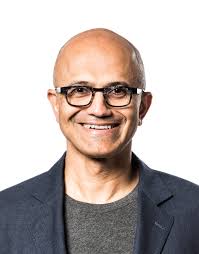
About Satya Nadella
Satya Nadella, chairman and chief executive officer of Microsoft, has been active in public appearances over the past two months, including a live event with The New York Times's Hard Fork podcast, the company's Build 2026 developer conference, and the fiscal third-quarter earnings call. At Build 2026, Nadella announced the Majorana 2 quantum processor, which he said provides a qubit mean lifetime of 20 seconds and operations at one microsecond, and introduced the Surface RTX Spark Dev Box, a device with one petaflop of AI compute. He also discussed a partnership with NVIDIA, including the RTX Spark system-on-chip and the Windows DGX Station, which he described as a "desktop data center." During the earnings call, Nadella said the company expects capital expenditures to increase to over $40 billion in the fourth quarter as it adds capacity for AI demand.
In his remarks, Nadella emphasized the concept of a "frontier intelligence ecosystem" where companies can participate by building on top of platforms rather than simply consuming models. He stated that "everyone is a stakeholder" in AI and argued that the technology must deliver tangible benefits to communities, citing data centers in Quincy, Washington, as an example of local economic gains. Nadella also addressed public skepticism about AI, saying that "the perception is terrible" and that companies must "do the hard work" to earn trust. On the podcast, he discussed the need for AI to be economically viable, noting that "the marginal cost of productivity improvement has to match the marginal cost of the token."
Source: AI-verified profile updated from Satya Nadella's recent appearances.
Browse all interviews →
✨ AI-enhanced transcript with speaker attribution
S
Satya Nadella0:00
Because the AI is doing the transcription and entering the records in the EMR system, entering the right billing code so that the healthcare industry is better served across the payer, the provider, and the patient ultimately. That's an outcome that I think all of us can benefit from. So I feel ultimately it's going to require real leadership in the private sector and the public sector to ensure that diffusion happens. And the one other thing I'll mention, Larry, is skilling. In some sense, the thing that diffusion is very strongly correlated to one thing alone, which is how broadly are people skilled in using this. Interestingly enough, I think if mobile has taught us one thing, it's actually distinct from what happened in the PC. I remember even growing up in the global south, there used to be a real relationship between learning Excel skills or Word skills and getting a job. Right now, what's the model in mobile? It's kind of created the same opportunity, but it's been a lot more consumption-led. It's the creator economy and what have you, but it has not been about how you get a healthcare job or a finance job or get ahead professionally. And that needs to come back. People need to say, I pick up this AI skill and now I'm a better provider of some product or service in the real economy. So it's very easy to see how mobile and the diffusion of mobile transformed economies, especially in the global south. How does this... To me, I just read a research report that said the applications for AI so far are heavily weighted towards those who are educated or educated economies. And so does that create more of a bifurcation, more polarization? How do we ensure that diffusion is spread evenly? How do we make sure that we're not leaving major portions of society or the world behind? Because I think that's going to be the big issue for us going forward.
L
Larry2:23
Yeah. So it's interesting, right? This is one of those times when by definition and because of the rails that have been established, as you said, what's happened with mobile as well as what's happened with essentially connectivity, you have the ability to deliver the tokens pretty evenly around the world, a lot more so than the PC era or even the beginning of the mobile era. Because it took a long time for even the smartphone to penetrate all of the world, whereas now it's not the case. These models and their outputs are pretty much available everywhere. And so the question to me is, what are the use cases that make sense? In fact, one of the demos I always go back to, I think this was even in the beginning of '23, was a rural Indian farmer was able to use a bot built on a very early GPT-3 or 2.5 even, essentially to reason over some farm subsidies that he had heard about in a local language and had it, even in those very early days, show some agentic behavior, like go complete a form for me. So in some sense, it brought back agency to someone who perhaps didn't have that because the technology was so much more accessible. So I do think it's in our hands, even in the global south, to use it to create more of that opportunity where there isn't one. But I think the necessary conditions still are: do you have the capital investment being put in? Do you even have an environment for capital? Because in an interesting way, we as hyperscalers are investing all over, including the global south. So as long as there's an environment which attracts the capital investment and you see the demand, then the demand is there. And so the question is, how do you have a set of policies that allow for both the capital to come in for it to find nexus? There are certain things that private capital can do, and certain things that only public capital can do, for example the grid. The grid in most countries is fundamentally driven by governments and public. So if you don't have a real approach to modernizing the grid, that will hold things back. There's a lot of talk about behind the meter and so on, and yes, there's some amount of that we can do ourselves.
S
Satya Nadella5:07
We can do that in the US. Many countries can't.
L
Larry5:09
Exactly. And it's not long-term scalable. To me, a long-term scalable solution is to have all of these token factories, part of the real economy, connected to the grid, connected to the telco network, delivering just like we delivered bits, you have to deliver tokens plus bits. And that's what's going to drive at scale, whether it's in the global south or in the developed world.
So many people talk about there may be an AI bubble. The most important thing that we see as an investor is the democratization of technology and the diffusion of that technology really does then transform the demand. The companies or the countries that diffuse it fastest are going to be the ultimate winners, not the technology creator.
S
Satya Nadella6:00
That's... for this not to be a bubble, by definition it requires that the benefits of this are much more evenly spread. I think a telltale sign of if it's a bubble would be if all we're talking about are the tech firms. If all we talk about is what's happening on the technology side, then that's purely supply side. Ultimately, if we are not talking about a drug that was brought into the market that's super successful because it was AI-accelerated in the clinical trial, it's not even the magical molecule, it's the rest of what is needed to make something much more relevant. And by the way, it's happening. So I'm not saying that. That's why I'm much more confident that this is a technology that will in fact build on the rails of cloud and mobile, diffuse faster, and bend the productivity curve and bring local surplus and economic growth all around the world. Not just economic growth driven by capital expenses, because that's a narrow point-in-time calculation.
L
Larry7:28
Right now that's what we're seeing more.
S
Satya Nadella7:29
That's what we're seeing in the developed world in particular. But remember, my capital... the one thing that we are definitely spending a lot of it in the United States, but 50% of it is also all over the world. And so interestingly, it depends on demand all over the world. And the demand all over the world will only be there if there is local surplus all over the world. So that's the way I see the equation.
L
Larry7:56
So let's drill down a little more. As AI diffuses, obviously organizations, companies, governments are going to have to evolve. Getting to the demand side, how do you think the structure of organizations is changing in an AI world across roles, across teams, management? I'm sure Microsoft has evolved itself. So it would be good to tell the audience how do you see this diffusion occur in the utilization at the corporate level or at a government level, which ultimately then creates that demand which eliminates any fears of bubbles.
S
Satya Nadella8:35
Yeah. I think it's probably one of the big challenges with all of these new technologies is when work artifact and work flow changes, the means we as firms have to change how we work. In fact, I remember meeting the CEO of General Electric a few years back, and he was describing how he had joined the firm pre-PC era, and he was describing how they worked with their agents in the field with faxes, interoffice memos, and suddenly the PC showed up and people would then put a spreadsheet in an email and send it around, and the entire workflow and work process changed. So similarly, with AI, you are going to start seeing actual change in how workflow happens. Even for me coming to Davos, with 50 bilateral meetings, preparing for those had a particular workflow. My field team would prepare notes, that would come to my HQ, and that would get further refined. Nothing had really changed since I joined in '92 to even a few years back. Whereas now I just go to Copilot and say, 'Hey, I'm meeting Larry. Please give me a brief.' And it comes back and gives me a 360 view. It knows what we're doing with you as a client, what we're doing as a client of yours, and everything in between as an investment. It captures information unlike anything else. In fact, I take that and immediately share it back with all my colleagues across all functions. Think about it. It's a complete inversion of how information is flowing in the organization. It's not like the classic organization with departments and specializations where information trickles up. No, it flattens the entire information flow. So once you start having that, you have to redesign structurally. The current structure may not make sense because you want people to be able to work in a way that allows this information flow freely. So what all this leads me to is a formula. It starts with the mindset. The mindset we as leaders should have is we need to think about changing the work and the workflow with the technology. Then that needs skill set. You can't talk about this in the abstract. You have to use it.
L
Larry11:26
You have to trust it.
S
Satya Nadella11:27
You have to trust it. You have to use it. You have to learn even how to put the guardrails to trust it. You can't just be afraid of it. It's going to be diffused. So the question is, as a firm, you have to use it to learn how to put the guardrails that allow you to trust it. So mindset, skills. The other big consideration is how do you make sure you have the data set that you're feeding? It's like you have a new intelligence layer, but the intelligence layer is only as good as the context you give it. People describe it as context engineering. That is what firms do. If you think about what firms do, it's all about the tacit knowledge we have by working as people in various departments and moving paper and information. So the question is, how do you have this AI also have that context? These are some of the new things that have to percolate throughout an organization to take advantage. That's why you're going to see the challenge of 'why am I not seeing immediate results in productivity?' because you have to do the hard work. That's why it's not going to be at some... there are going to be firm-wide differences, sector-wide differences, but it's fundamentally going to be because of the leadership will in an organization.
L
Larry12:59
Do you see the applications being used across large companies and medium and small companies, or is it still the domain of mostly the large companies at this moment? I think that what you're seeing is it's easier because if you start fresh, it's easier to adopt these tools and you construct your organization knowing that these tools exist.
S
Satya Nadella13:26
Is it a barbell then?
L
Larry13:27
It is a barbell. So small companies that are just starting use that platform.
S
Satya Nadella13:32
100%. And I think even for large organizations, there's a fundamental challenge. Unless your rate of change keeps up with what is possible, you're going to get schooled by someone small being able to achieve scale because of these tools. But large organizations have an inherent strength: relationships, data, know-how. But the bottom line is, if you don't translate that with a new production function, then you will be stuck. So the change management challenge for large organizations is going to be bigger. The structural challenge for small organizations of how to overcome scale issues is going to be harder. So it's two sides in an interesting way. It's going to be a very competitively intense world where neither side, whether you're a new entrant or an incumbent, can coast.
L
Larry14:31
What about country to country? Are you seeing big differences in how the applications are being used? Is AI still the domain of developed countries, or is it becoming rapidly a domain of all countries?
S
Satya Nadella14:43
I'm seeing two things, Larry. As I travel around the world, the quality of the know-how, the software developers, the startups, or even large organizations, it's not that different. It's fascinating. You can show up in Jakarta, Istanbul, Mexico City, it's not that different from showing up in Seattle or San Francisco. For the first time, just because access to what's happening is there. That said, at scale, the commitment to using this, the risk capital being there, the large companies pushing it hard... In the US, if I compare the financial sector's adoption of the cloud versus AI, it's night and day. It's much faster with AI than it was with the cloud, for a variety of reasons.
L
Larry15:55
Regulatory issues too, until the regulators allowed banks to bring their data off campus, that was a big issue.
S
Satya Nadella16:03
Yeah. So I would say wherever, in the West in particular in the US, there is clearly more energy around using it. But it's spreading around the world more uniformly than any technology I've seen.
L
Larry16:24
But you mentioned about the power, the grid. Is that going to be one of the determinants of accessibility? If you do not have cheap power, the demand is costly.
S
Satya Nadella16:38
100%. So if you look at the tokens per dollar per watt, I would claim that GDP growth in any place will be directly correlated. If you buy my entire argument that we've got a new commodity, its tokens, and the job of every economy and every firm is to translate these tokens into economic growth, then if you have a cheaper commodity, it's better. That's why there's tokens per dollar per watt. And by the way, there are many elements to this. It's not just the production side. That's why having the grid is important. Construction costs. If you think about the total TCO, how are you a cheap producer of energy? Can you build the data centers? What's the cost curve of the silicon and the systems? And look at token pricing. Token pricing drops by half every three months. So you can plot how you use the tokens to create surplus, knowing that you have a commodity whose prices are just going to monotonically come down on a pretty fast curve.
L
Larry18:03
We're sitting in Europe, and there is a real fear here because Europe does not have its own power and has to import most of its power. Do you have any messages for Europe related to this?
S
Satya Nadella18:20
Yeah. There are two sets of things. One is, here we are in Switzerland, and I look at the pharma or the financial sector. They do a big job in this country as in Europe, but they're also international brands with international operations. Whenever I think about Europe, the Europeans are producing products and services that are going everywhere in the world. So European competitiveness is about the competitiveness of their output globally, not just in Europe. I think sometimes when you come to Europe, there's a lot of conversation about just Europe. But the European economy thrives because they were able to produce things that the world needed. So that's number one. And in order to do that, you have to invest in producing the energy and the tokens here. We are investing, and others are investing in data centers here. The question is, what's the next generation of output that comes from here? I always think about the German Mittelstand. Whenever I go to a jeweler or a dentist in the United States, I'm surrounded by German Mittelstand. It's unbelievable engineering prowess of that country. They are producing industrial products which today are built with intelligence and data. Whenever we come to Europe, everyone talks about sovereignty and data. But Europe should be much more concerned about access to their industrial companies' and financial services companies' data from the US and the rest of the world, as opposed to just thinking that by protecting Europe you're going to be competitive. You are only going to be competitive if the products coming out of Europe are globally competitive. So that's what needs to change. Europe has led in privacy, that's fantastic, and has led in many aspects of safety around AI. That's a feature. But you also have to complement it by building locally and then also thinking globally about what contribution this continent will make to the rest of the world, which it has historically been a leader.
L
Larry21:06
A leader. So do you think the whole idea around sovereignty of data is being misunderstood?
S
Satya Nadella21:12
I think that when people talk about sovereignty, first of all, it's very important, clearly.
L
Larry21:21
And in a week like this, it's more important.
S
Satya Nadella21:24
But that said, you have to think about what sovereignty means. For example, in the AI era, the topic that's least talked about but I feel will be most talked about this calendar year will be the sovereignty of a firm. Just imagine if your firm is not able to embed the tacit knowledge of the firm in a set of weights in a model that you control. By definition, you have no sovereignty. That means you're leaking enterprise value through some model company somewhere. It's fascinating that nobody's talking about that. Everybody's talking about everything else outside of that, whereas the most important thing is... It really doesn't matter where the data center runs, that's the least important thing. Data centers are all over because the speed of light is a real constraint, so they will be spread. You will be able to encrypt everything, have the keys with you. All of these are technically solvable problems. But the one problem that will only be solved is by you having much more sovereignty over the tacit knowledge and control over the models. It's not a one-way enterprise value transfer. So sovereignty requires real thought on what it is. Control of destiny means that your ability to produce something unique is preserved. David Ricardo was not wrong. There is comparative advantage in countries. There is comparative advantage in firms that needs to be preserved even in the AI era. That's what'll give you real sovereignty.
L
Larry23:20
One last question. I know we're running out of time. In 5 years or 10 years, is there going to be one dominant model that we're all going to be using, or how is Microsoft preparing for this? Are we going to be using one model for enterprise, one model for other traits?
S
Satya Nadella23:39
Even in the last 3 or 4 years that we've been at it, the reality is it's a multimodel world. There are going to be multiple models, and the trick is how do you take advantage of these multiple models and in fact build your own model by distilling these? Think of these models that you orchestrate to build your own model. More importantly, you do what is described as orchestration or harness engineering. So the IP of any application or any firm is how do you use all these models with context engineering or your data.
L
Larry24:32
Right. So it's that three parts. So can I bring in all the models, which is closed source, open source, build my own model, orchestrate them, and feed it my data to change the trajectory of some outcome that I care about.
S
Satya Nadella24:49
That's it. That's the entire picture. So you can do it like, 'I produce a particular product or service. First, I need to do a better job in sales, or better job in R&D, or better job in finance.' You take that outcome and then you say, 'Can I use all the models, orchestrate them, and feed it my context?' And as a result, the reasoning traces lead to some capability and models that I control as my IP. As long as firms can answer that question, they're going to get ahead.
L
Larry25:23
Ladies and gentlemen, let's thank Satya, my friend. Thank you. And hopefully this is the beginning of many great dialogues and conversations here at the World Economic Forum. Thank you everyone.
S
Satya Nadella25:40
Thank you.