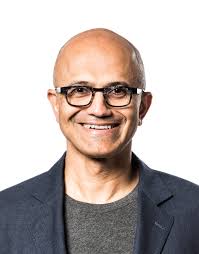
About Satya Nadella
Satya Nadella, chairman and chief executive officer of Microsoft, has been active in public appearances over the past two months, including a live event with The New York Times's Hard Fork podcast, the company's Build 2026 developer conference, and the fiscal third-quarter earnings call. At Build 2026, Nadella announced the Majorana 2 quantum processor, which he said provides a qubit mean lifetime of 20 seconds and operations at one microsecond, and introduced the Surface RTX Spark Dev Box, a device with one petaflop of AI compute. He also discussed a partnership with NVIDIA, including the RTX Spark system-on-chip and the Windows DGX Station, which he described as a "desktop data center." During the earnings call, Nadella said the company expects capital expenditures to increase to over $40 billion in the fourth quarter as it adds capacity for AI demand.
In his remarks, Nadella emphasized the concept of a "frontier intelligence ecosystem" where companies can participate by building on top of platforms rather than simply consuming models. He stated that "everyone is a stakeholder" in AI and argued that the technology must deliver tangible benefits to communities, citing data centers in Quincy, Washington, as an example of local economic gains. Nadella also addressed public skepticism about AI, saying that "the perception is terrible" and that companies must "do the hard work" to earn trust. On the podcast, he discussed the need for AI to be economically viable, noting that "the marginal cost of productivity improvement has to match the marginal cost of the token."
Source: AI-verified profile updated from Satya Nadella's recent appearances.
Browse all interviews →
✨ AI-enhanced transcript with speaker attribution
U
Unknown0:00
Or even during pilots, you know, you need to make decisions quickly, but you need to create the right operation model in your establishment for you to be able to create the value that we are seeing today. And this is what we are hoping through working with hyperscalers in the industry. Accenture is a good example. You know, we are trying to group our use cases and see which industry might be the best user of them and how we can scale this across.
M
Moderator0:30
We only have a couple or a few minutes left, and so I'm going to ask each of you to maybe answer the same question, and I'm going to start with you, Julie, which is: what lessons have you learned, especially over the past year or two, about scaling AI that you wish you had known earlier? And please do answer quickly because we just have a couple.
J
Julie0:49
I think it's about human in the lead, not human in the loop. We will inspire people and we will run companies with people and they will have a greater technology landscape, but we need to completely change the narrative to inspire people to paint the future. It is human in the lead, not human in the loop.
U
Unknown1:08
It should be a business pull, not AI or IT push. If the business is not involved, you can pilot it, you can scale, but you cannot have it across the whole establishment. So the business needs to be involved from day one for it to capture the whole value across the establishment and the group. I didn't realize it till 10 minutes ago, but I should have hired Accenture because what Julie said hit me like 10 minutes ago. What Julie said about leadership is so true at Visa. Like we went so fast by trying to democratize access to all of these LLMs across the company. I preached it from the top. The whole leadership team, we talked about it for about 18 months and we didn't really see the breakthrough until we got 300 of our top 300 people in the room for two days. And we forced them to go through hands-on keyboard training, build agents, be supervised, be evaluated, and to your earlier point, once those top 300 leaders had confidence to build, use agents, and then lead their teams, that was the unlock for us. And I wish I would have known it earlier.
M
Moderator2:25
There's still time, right?
U
Unknown2:26
I know, right?
M
Moderator2:27
Still time.
U
Unknown2:28
I'm learning. I'm always learning. And this panel was no exception.
S
Satya Nadella2:33
I would say spend at least as much time on the adoption as on the technology development. I think we're overexcited often by technology and we are technology companies so definitely speaking to myself. But actually if you want to have it really driving impact, think about how you get it being worked with, which means that from the first moment you start to develop the technology, think about how it lands in the practice. So adoption is ultimately where success is measured and actually you need to design that in from the get-go, and that is much less about technology, much more about understanding the practice that it will actually serve and how you then indeed rally the humans around it that run that business or run that practice. I think that's something that we have been learning in the last few years.
M
Moderator3:23
Well, thank you all so much. I think we kind of came back to the same place we started about thinking about outcomes and not just operations. And you said something that I wrote down because I thought it was so great, which is that it's hard to trust something until you understand it. I think we've all come away with a lot better understanding about scaling AI in large organizations. Thank you so much everyone. Appreciate it.
U
Unknown3:47
Thank you, Matt.