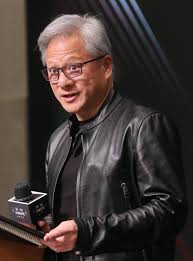
About Jensen Huang
Jensen Huang, CEO of Nvidia, has been active in public appearances and keynote speeches in mid-2026, focusing on the rollout of new hardware and his views on the societal and economic impact of artificial intelligence. At Computex 2026 in Taipei, Huang announced the Vera Rubin architecture for data centers, which he described as being in full production and designed to run AI agents, as well as the RTX Spark superchip for Windows PCs, developed in partnership with Microsoft. He characterized the RTX Spark as a reinvention of the personal computer for the era of local AI agents. Huang also discussed Nvidia's partnership with Marvell on MVLink Fusion technology and highlighted Taiwan's role as "the epicenter of the world's technology ecosystem" and a strategic partner for the United States in diversifying supply chains.
In interviews, Huang addressed the broader implications of AI. He stated that AI's impact will be "largely wonderful" but acknowledged areas requiring caution, comparing the need for new social norms to the advent of automobiles. He argued that AI is creating more software engineering jobs, citing a near-tripling of GitHub commits in early 2026, and described the notion of AI reducing jobs as "complete nonsense." Huang also called for the United States to become "pro-energy growth" again, asserting the country is "woefully behind in energy production" and that energy is foundational to AI infrastructure. He described the current period as the largest infrastructure buildout in history, with a trillion dollars being invested annually across energy, chips, data centers, and AI models.
Source: AI-verified profile updated from Jensen Huang's recent appearances.
Browse all interviews →
✨ AI-enhanced transcript with speaker attribution
J
Jensen Huang0:00
We're reinventing the computer for the first time in 63 years. This is just an extraordinary thing. Since the invention of the IBM System 360 in 1964, we're now reinventing the computer. You no longer have to code and no longer record information in advance, pre-recording information. It's able to now solve problems in real time. And so the way that the computer has to be built is radically different. We've now built about 60 years with the computer infrastructure, the internet, and all the computers that you know. We're now in the process of reinventing all of that, which is the reason why over the course of the next 10 years, we're going to be building tens of trillions of dollars of new computers to replace the old computers that we built over the last 60 years. The United States is woefully behind in energy production, which is one of the great things that President Trump has really advocated to regrow, I guess, the energy industry and to be a pro-energy growth industry again, because without energy, that entire infrastructure on top cannot be created and produced. And so the first thing is to make sure that we are a pro-energy growth country again. The technology is very powerful, so we have to build it with safety and security, and we have to build it with responsibility. We have to make sure that the regulations support it. But after that, once we do that, we need to make sure that the United States takes advantage of this new industrial revolution just as we took advantage of the last industrial revolution. We've been competing in China for a long time. We're doing just fine. Now, of course, whatever the decisions were that banned us from shipping to China, that decision was made and so be it. President Trump would like us to take our last generation products and continue to compete around the world. And the reason for that is this. It is a false choice. We could have national security. That is absolutely foremost. We want our technology industry to succeed around the world, and in order to do that, you have to compete. You could have national security, you have technology leadership, and you could have economic prosperity all at the same time. Our country has been doing that for a long time.
I
Interviewer2:26
What is the difference between the AI people are dealing with now versus the AI that's coming in the future that you're seeing that this factory is going to make possible?
J
Jensen Huang2:33
It'll be smarter, safer, better guardrail. It'll be grounded on more truth. It'll be able to do more things, be more helpful.
I
Interviewer2:48
When you say grounded in more truth, what's that mean?
J
Jensen Huang2:52
Less guessing and more research.
I
Interviewer2:56
Less guessing and more research.
J
Jensen Huang2:58
Even this year's AI has done a much better job being grounded in truth because it can even use the internet, do some search. It brings back some information, two or three different versions of the information. It might evaluate the information based on what you know, based on an evaluator to see which one is more likely to be truthful.
I
Interviewer3:18
Yeah. And do you see AI as really driving the manufacturing reliable in the US?
J
Jensen Huang3:24
No question about it. This is we're reinventing the computer for the first time in 63 years. This is just an extraordinary thing. Since the invention of the IBM System 360 in 1964, we're now reinventing the computer. You no longer have to code and no longer record information in advance, pre-recording information. It's able to now solve problems in real time. And so the way that the computer has to be built is radically different. We've now built about 60 years with the computer infrastructure, the internet, and all the computers that you know. We're now in the process of reinventing all of that, which is the reason why over the course of the next 10 years, we're going to be building tens of trillions of dollars of new computers to replace the old computers that we built over the last 60 years. And that's the cap access result. We can use this incredible new investment to re-industrialize the United States, which is the reason why we're building new chip plants. This is a new chip plant that produces lasers that allows us to take a chip that processes electricity, convert it to optics or light, send the light down optics, convert it back to electricity for another chip. So now we can connect chips that are literally separated by hundreds, thousands of feet and let those two chips be connected and work together. Incredible.
I
Interviewer4:49
All right. Energy, chips, infrastructure, models, applications.
I
Interviewer4:54
Five layers of AI.
I
Interviewer4:57
Where is the US strong and where is it not?
J
Jensen Huang4:59
Oh, excellent. I really appreciate that. First of all, people think that AI is this model and it is. That's one of the very important parts of AI. Just as the computer industry is not just Excel or Word, the application, it consists of all of the infrastructure that supports it. The five layer cake that you mentioned. The United States is woefully behind in energy production, which is one of the great things that President Trump has really advocated to regrow, I guess, the energy industry and to be a pro-energy growth industry again, because without energy, that entire infrastructure on top cannot be created and produced. And so the first thing is to make sure that we are a pro-energy growth country. Again, for chips, infrastructure, and AI models, we are absolutely world class. And then the layer above, the applications, this is applications used for radiology, for healthcare, applications for manufacturing, robotic systems, all of the different applications for the various industries. The top layer, the bottom layer, the top layer, I would argue that we are probably not world class. Now, the reason for that is because on the lowest layer, we just suffocated energy production for too long. At the highest level, we have to be careful because we're increasingly describing AI in a way that causes communities and populations to be somewhat concerned about it. I think that the technology is very powerful. We have to build it with safety and security and we have to build it with responsibility. We have to make sure that the regulations support it. But after that, once we do that, we need to make sure that the United States takes advantage of this new industrial revolution just as we took advantage of the last industrial revolution. You know, as you know, 300 years ago, the production of energy was invented in Europe, but somehow the United States took advantage of it. We industrialized it. We applied it. Companies like GE and all the appliances, and we celebrated the industrialization of our economy. With the internet, we did the same thing. With computers, we did the same thing. We have to be very careful that artificial intelligence, this new next generation of technology revolution, that we're also enthusiastic about adopting and make sure that we don't get left behind.
I
Interviewer7:32
Do you think the issue with AI is the technology itself that concerns people or the absence of social structures to adapt to something happening so fast?

J
Jensen Huang7:42
It's a combination of all that. When automobiles came, we needed to create new social norms. Back in the old days, people said that cars killed children. What is it about cars that would hunt down a child to kill them? Well, the reason for that was because in the older days, when kids were growing up, they used to play in the streets. When I was growing up, they used to play in the streets. When cars came along, you obviously can't play in the streets. We now no longer have kids playing in the streets. We don't tell kids not to go play in the streets. And we have sidewalks, we have crosswalks, jaywalking is discouraged. And so all of that combination of social norms, regulations, safer cars, seat belts, and all the technology that comes along with it, it's all of it at the same time. So I think you have to deal with regulation, technology, and you have to deal with social norms.
I
Interviewer8:39
What is the social norm that you think would make people feel the most comfortable?
J
Jensen Huang8:44
Well, the first thing is that I would advocate that everybody use AI. Just go engage it. There's the free tier of AI. AI has closed the technology divide more so than any technology in history. And the reason for that is because it's accessible. It's on the internet and it's also free to use. There's a free tier and it's easy to use. Unlike a microwave, you have to read the manual. Unlike a computer, you have to learn, you have to go to school to learn how to program it. With AI, if you don't know how to use AI, just walk up to AI and say, 'I don't know how to use AI. How do I use AI?' And the AI is going to say, 'What would you like to do?' And it could be that you would like to write a program, create a website for your shop. Maybe you'd like to create a small program to help you manage your books. Maybe you would like to do some research to learn something about a new topic, help you with a new school project that you're having a hard time with. So whatever it happens to be, if you have a hard time using it, just go up and ask it. If you're a carpenter, you want to become a designer, help somebody be a creator of kitchens before you go and help somebody build it, AI could help you generate a lot of interesting designs. And so I think it could elevate your capability. What I would advocate for everybody to do is just go try it before you judge it.
I
Interviewer10:07
So in the past few days, we've seen some major challenges to AI, right? We saw the government put export controls on MRO. What do you make of that? Are export controls a good tool to use to have models get pulled back?
J
Jensen Huang10:22
Well, the US government has to be concerned about national security, and national security is a foremost top issue. Export control is a powerful tool that, if used precisely and specifically, could be quite effective. Beyond that, just got to be careful not to overexercise export control, so that it doesn't create unintended consequences to a lot of other things that we don't intend to do. And so aside from that, I'm not exactly in their conversation, but you can understand that the United States is quite concerned about national security.
I
Interviewer11:02
And do you see national security as a major concern?
J
Jensen Huang11:05
National security should always be the top concern of all technologies. But having said that, you have to be very specific about the risk that you're concerned about before setting up policies for export controls.
I
Interviewer11:19
And what about this idea that's been floated about government's own stake in AI companies that they would own shares or something to that extent. Do you think that government ownership of the AI modeling companies is a good idea for the technology?
J
Jensen Huang11:34
I'm not exactly sure what they're trying to achieve. I haven't had a dialogue with them about that. But just remember that these are American companies. Their success benefits the stock price, of which many Americans are investors in. It generates taxes, which helps many Americans. It creates a lot of jobs. And the AI companies is just one of the five layers. And so if they're successful, imagine all of the five layers and the jobs that are created across the board. And so I think that America has a stake in all American companies. When we succeed, we create a whole bunch of jobs. We generate a whole bunch of tax revenues. When we export around the world, we obviously bring back an enormous amount of revenues, create a lot of jobs locally, and so on and so forth. So I think America has a stake. Americans have a stake in American companies already naturally in a whole lot of different ways. I'm not exactly sure what they're trying to shape beyond that.
I
Interviewer12:38
So, President Trump likes you, right? Let's just cut to the chase. He's called you amazing, smart, he's called you a friend, but he's also said before he first met you, he was thinking that Nvidia was so dominant that he should break you up. I'm curious, how did you prep for your first meeting with him in January 2025? And what did you say to him that made him go aha?
J
Jensen Huang13:03
Let's see what happened. I happened to be in Florida to receive the Edison award and he heard that I happened to be in Florida. He invited me over for dinner.
I
Interviewer13:19
In Mar-a-Lago.
J
Jensen Huang13:20
Yeah, that's literally how it happened. He just happened to hear that I was in town. He says, 'Drop by for dinner.' And so I did. Lori and I dropped by for dinner. He was incredibly engaging, incredibly charismatic, conversational, asked a lot of questions. From the moment that I met him, the only thing that he's ever talked to me about is creating more jobs, re-industrializing the United States, protecting national security, winning. He wants America to be wealthy. He knows that if America's wealthy, we have a lot of tax revenues, we can fund the military, we can fund our economy, we can fund our communities, create more jobs. Literally that entire conversation I just went through is just every single time some version of that. And as far as I could tell, all he does is work. He calls me in the middle of the night and wants to talk about one of these topics.
I
Interviewer14:21
China has boxed out a lot of foreign competitors. What gives you confidence that China would be willing to accept a US-made AI ecosystem?
J
Jensen Huang14:32
Well, we were in China for 30 years and before the export control ban and Nvidia out of China, we had about 95% market share, and so we were competing just fine. American companies, American technology companies are incredible. I travel the world and I can tell you that we as Americans would be very proud of the technology companies that I'm part of. The capabilities of this country are extraordinary and we have every reason to be proud. We have every reason to be confident. We've been competing in China for a long time and we're doing just fine. Now, of course, whatever the decisions were that banned us from shipping to China, that decision was made and so be it. However, President Trump would like us to take our last generation products and continue to compete around the world. And the reason for that is this. It is a false choice. We can have national security that is absolutely foremost. We want our technology industry to succeed around the world, and in order to do that, you have to compete. You could have national security, you have technology leadership, and you could have economic prosperity all at the same time. Our country has been doing that for a long time. And so it is important that we recognize that China is a very large market, and if we seed that market, the competitors there will just become giants, and ultimately that leadership, that capability, theirs will scale outside of China that we'll have to deal with later. And so I think that the recognition that we have to, number one, make sure that we have national security and that we protect our nation. But we also simultaneously should go and compete and grow our technology industry and maximize our exports. We're trying to maximize exports. We're trying to improve our trade imbalance. And so it makes sense that we continue to export, continue to compete around the world, and to protect our national security, protect our technology leadership, and grow our economic prosperity. We can do all of that at the same time.
I
Interviewer16:49
Now, one of the things we've also seen since the start of the year is the US is getting more goods imports from Taiwan than it is directly from China.
J
Jensen Huang16:58
That's a change that you've helped spark.
I
Interviewer17:02
What role does that mean Taiwan has in relations with the US going forward? Is that stitching even tighter now?
J
Jensen Huang17:10
Well, Taiwan is the epicenter of the world's technology ecosystem. They make the world's best chips. They make the most of it. The ecosystem around them, including all of the necessary parts of the supply chain, is all fully integrated on the island. It is the case that Taiwan also is an incredible strategic partner for the United States. If not for Taiwan's company and Taiwan support to stand up manufacturing here in the United States, we wouldn't have all the fabs in Arizona. We wouldn't have the factories from Foxconn. We wouldn't have the fabs or the factories from Wistron. All of those factories and plants are necessary. They're bringing their skills. They're bringing their labor. They bring their experts to help us stand up manufacturing here in the United States. So they are, on the one hand, an epicenter and a critical part of our supply chain. On the other hand, they're also a strategic partner to help us diversify and create more resilience in our supply chain. And so Taiwan plays both parts, a really important part.