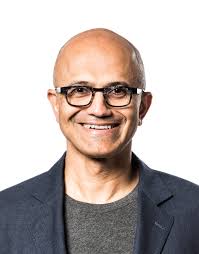
About Satya Nadella
Satya Nadella, chairman and chief executive officer of Microsoft, has been active in public appearances over the past two months, including a live event with The New York Times's Hard Fork podcast, the company's Build 2026 developer conference, and the fiscal third-quarter earnings call. At Build 2026, Nadella announced the Majorana 2 quantum processor, which he said provides a qubit mean lifetime of 20 seconds and operations at one microsecond, and introduced the Surface RTX Spark Dev Box, a device with one petaflop of AI compute. He also discussed a partnership with NVIDIA, including the RTX Spark system-on-chip and the Windows DGX Station, which he described as a "desktop data center." During the earnings call, Nadella said the company expects capital expenditures to increase to over $40 billion in the fourth quarter as it adds capacity for AI demand.
In his remarks, Nadella emphasized the concept of a "frontier intelligence ecosystem" where companies can participate by building on top of platforms rather than simply consuming models. He stated that "everyone is a stakeholder" in AI and argued that the technology must deliver tangible benefits to communities, citing data centers in Quincy, Washington, as an example of local economic gains. Nadella also addressed public skepticism about AI, saying that "the perception is terrible" and that companies must "do the hard work" to earn trust. On the podcast, he discussed the need for AI to be economically viable, noting that "the marginal cost of productivity improvement has to match the marginal cost of the token."
Source: AI-verified profile updated from Satya Nadella's recent appearances.
Browse all interviews →
✨ AI-enhanced transcript with speaker attribution
S
Satya Nadella0:00
Has the new element on the page loaded yet? Why are we still waiting? One of the things that Bill Gates writes in the foreword, I think captures so well the logic behind Hit Refresh, which is you've got to be smart so that the page load time is fast. That means you don't want to change everything; you want to change the things that matter the most to be able to really go after the new concepts. Culture change is in support of, in our case, innovation. And in tech, there is no such thing as a constant. So the idea that you have to come up with new concepts which need new capability is what culture enables. Culture on its own is not just an agenda, but culture coupled with new innovation is what really our business is all about.
C
CNBC Interviewer0:52
A lot of people are going to say, why write a book now? Some people write a book after they've retired or after they've hit some obvious success point. You said this is not a memoir; you're not trying to say that the game is over and you've won. Is this kind of a cultural touchstone moment where you're trying to do this for Microsoft's employees and prospective employees and customers, saying, hey look, here's what we're trying to do?
S
Satya Nadella1:16
You're right, because most business books are written looking back, either as grand successes or grand failures. One of the things I felt was, as we are going through this process of transformative change amongst transformative technology change, how do I reflect on that process? That's more this book. And the same time, the metaphor of hit refresh is we as individuals are dealing with change all the time and we are hitting refresh, we learn from it. This is the same for organizations and the same for our society. So while in the midst of it, so to speak, in the fog of war, what are the reflections? This is clearly not some destination that has been reached, but it's more a process of continuous renewal.
C
CNBC Interviewer2:05
One of the challenges you talk about in the book is privacy versus security. We've just had the CEO of Equifax resign in the wake of that huge data breach, 143 million accounts compromised. Maybe not on paper the worst privacy breach ever, but I would argue it is the worst in terms of the impact on consumers. Is Microsoft paying enough attention to technology's potential dark side, even as you look ahead to artificial intelligence and some of these other technologies, to prevent the equivalent of an Equifax happening 10 years down the line in the AI era?
S
Satya Nadella2:45
It's a very important question. There's no doubt that as every part of our life and every part of our economy increasingly is driven by software and it's becoming digital, cybersecurity is top of mind. In fact, if I look back, with any new technology there is always going to be the dark side. After all, with the telegraph there was wire fraud. We had to come up with both the laws as well as technology to deal with it. I think the same is going to be true with AI or cybersecurity. At Microsoft, one of the things we have to really step up to, and this is something we started 15 years ago, is the core security of our products has got to be a top priority. We are, after all, the first responders. So being on top of our game on a continuous basis, because the internet wasn't built for security. If it had been built inherently secure, that would be better.
C
CNBC Interviewer3:41
Machine learning and AI, the constructs that you're building, are they being built with security and the potential dark side in mind?
S
Satya Nadella3:48
That's a great point. One of the things we sometimes think is that security can be completely built in. Clearly there is a way for us to secure the protocols, the data, and so on. But one of the things that is so important for everyone to realize is the operational security posture that all of us have. It's kind of like someone said to me, you can get fit by looking at others go to the gym — you have to go to the gym yourself. So you have to really say, what's the digital estate, what are the intrusions, what are the attacks, am I able to detect them fast enough, am I able to remediate fast enough. So the operational security posture is as important as the locks you put on your front door. Are you watching? In some sense that's an intelligence game. I'll give you an example. At Microsoft, with Azure, we're using one of our cloud services. The fact that we see a billion plus endpoints and what's happening at them in real time, we use the intelligence from that to secure our cloud. That means anyone who's using Office 365 will not get malicious things that may be propagating in email, because of our ability to take data from one place and use it to secure everyone else.
C
CNBC Interviewer5:00
What about businesses like Equifax? If they had been on your cloud, would you have any kind of early warning system that would have alerted them that this vulnerability was being exploited, they were losing data?
S
Satya Nadella5:09
I can't speak to the specifics of Equifax and their state, but overall, I think the more we have the ability to take data that we see across our digital estates and all the good guys share that data, the better off we will be in keeping anyone who's trying to attack at bay. That is something I am a proponent of at the industry level.
C
CNBC Narrator5:40
Hey there, thanks for checking out CNBC on YouTube. Be sure to subscribe to stay up to date on all of the day's biggest stories. You can also click on any of the videos around me to watch the latest from CNBC. Thanks for watching.