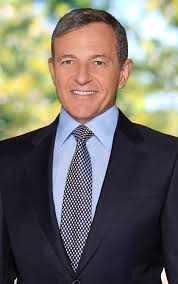
About Bob Iger
In a June 2026 interview with CNBC marking the 10th anniversary of Shanghai Disneyland, Bob Iger described the park as a career highlight and said he felt "filled with pride" about the project. Iger recalled that competitors in China had said the park "will never work," but he said he "could not wait to prove that they were wrong." He stated that Disney has "succeeded over the years in putting politics aside" and sticking to its mission of entertaining people globally, adding that "pretty much no matter what happens, Disney does just fine." Iger also said his own future involves "truly enjoying life after Disney" and that he felt "really good about handing the company over to Josh" (his successor, Josh D'Amaro).
In a 2020 interview on the Goop podcast, Iger discussed leadership and communication, saying he discovered that "being direct is far more efficient and effective." He noted that women are "held unfortunately to a different standard" regarding directness and may be "a little less direct for fear that it's going to affect people's perception of them." Iger also outlined his strategic priorities at Disney: spending capital on high-quality branded content, using technology to improve products and reach consumers directly, growing globally, and succeeding at diversity and inclusion, which he described as having "a great business case."
Source: AI-verified profile updated from Bob Iger's recent appearances.
Browse all interviews →
✨ AI-enhanced transcript with speaker attribution
B
Bob Iger0:00
I'm feeling filled with pride. Really, I've been involved in this project from its very beginning in the late 90s, and to be here today celebrating 10 years, knowing not only how successful it's been, but really how important it is in many respects, not just to the Walt Disney Company, but to the people of China.
I
Interviewer0:21
How do you want investors to think about this park, your role, the contribution to Disney?
B
Bob Iger0:28
Well, in many respects, this was a big risk because we had never operated or designed a park for the mainland, and we knew we needed to do so with great care and great respect.
H
Host0:38
Thank you. And good evening, everyone.
B
Bob Iger0:41
And I'd say we nailed it, meaning this is really pitch perfect in many different respects, including the fact that we set out to build something, as you know, that was authentically Disney but distinctly Chinese, and we did that for a reason, because we wanted the Chinese to have a sense of ownership that this was theirs. So I feel great about that from an investor perspective. Not only with over 100 million people visiting before the 10-year anniversary, but the success of this economically has been wonderful, and also the potential, as you look ahead, given the size of the property, for this to be able to grow.
I
Interviewer1:05
How has the Chinese consumer changed over the years in terms of the way they interact with the park, in terms of their spending habits?
B
Bob Iger1:25
When they first came, there was a sense of anticipation and excitement, but there was a lot that they didn't know. Most people who had visited had never been to a Disney theme park, and they didn't quite know what to expect or how to behave. And over time, what we've seen is they have adopted this as their own. They come dressed in costume, many of them. They come willing to be, in a way, part of the show, even though they're not hired to do so. That says a lot, actually. You know, I think, by the way, it increases their enjoyment.
I
Interviewer1:58
I remember 10 years ago we were talking about the competition from other theme parks, at that point you had said that the price would be reflected in the experience, and I was wondering what you're seeing today?
B
Bob Iger2:09
Well, I remember back when we were getting ready to open, there was a lot of speculation that it would be too expensive for the Chinese consumer, that it wasn't competitive from a price perspective, and I really never worried about that, because I knew the quality of what was going to be delivered to people would more than offset the cost of it. I think if you look at it now, the price-to-value relationship, which was good at the beginning, has never been better, because over time, Disney has managed to add so much to this park. I remember competitors in China saying, 'Well, this will never work, either they're too expensive or the Chinese people won't appreciate it.' I always felt they were wrong, and I could not wait to prove that they were wrong. And, in fact, now we've done that.
I
Interviewer2:59
Where are you right now in terms of your level of optimism for US-China relations?
B
Bob Iger3:04
Well, I try not to be an optimist or a pessimist when it comes to such things. I try to be a realist, and being a realist, I understand that there are going to be ups and downs, there are going to be highs and lows, there are going to be times of strain and times of great détente. And so I don't dismiss that, but I discount it a bit, because I didn't think about it in terms of where is Disney, and all of that. And Disney has, I think, succeeded over the years in putting politics aside and making sure that it sticks to its essence, which is to entertain people all over the world. And if you do that and you do it well, then pretty much no matter what happens, Disney does just fine.
I
Interviewer3:51
You mentioned the potential of this place, and given what you've been talking about in terms of the geopolitics, what is the investment outlook?
B
Bob Iger4:01
Right here, as we sit today, we're building Spider-Man Land, we're building two new hotels, we're expanding Soarin', which is one of the most popular attractions here. I mean, there's so much going on, and because of the available property and because of the intellectual property that Disney has, the opportunities to expand are limitless. And as long as the business is successful, which it has been, there's no reason why it won't continue to expand over time.
I
Interviewer4:28
Do you foresee another theme park here in China?
B
Bob Iger4:31
I just foresee continued expansion.
I
Interviewer4:33
What do you think right now are the risks of AI? How do you manage the risks? Where do you see the opportunities?
B
Bob Iger4:40
Disney has a long history dating back to Walt's day of using technology to improve the quality of its storytelling, and artists have always resorted to great technology to do just that. And that's how I believe Disney should look at AI: that in the hands of a creator, the ability to not only create more compelling entertainment, but to do so perhaps under more efficient circumstances, I think, is very positive.
I
Interviewer5:06
You still have to manage all those risks?
B
Bob Iger5:08
The world is full of risks, and I think if you approach the world in a risk-averse way, then you achieve very little. And I think anyone who is charged with running the Walt Disney Company should learn from its founder, Walt Disney, who was one of the ultimate great risk takers in a world that was really complicated. I mean, he founded the company in 1923. There was a Great Depression soon after that, then there was a World War, and you look all the way through the mid-60s and all the disruptive forces that Walt had to deal with, and yet he endured, and he continued to take big risks. And I think the only way Disney actually thrives in a changing world is to avoid being risk-averse, and to continue to step forward wisely, but with great courage and with great confidence.
I
Interviewer6:04
What's next for Bob Iger?
B
Bob Iger6:07
What's next for me is truly enjoying life after Disney.
I
Interviewer6:10
Bob Iger,
B
Bob Iger6:12
I had this extraordinary life experience to have the opportunity not just to work for Disney, but to be the CEO of Disney for almost two decades. It's something that I will forever be grateful for, and I'm now grateful to be able to look back on what was just a great life experience. But I'm also feeling really good about handing the company over to Josh tomorrow and to a group of people that I know will do extremely well and take the company to higher heights, well beyond where I took it.
I
Interviewer6:45
What advice would you share with people who are wondering what's going to happen next with Disney?
B
Bob Iger6:50
The biggest advice I would have is to create a balance between legacy and innovation. That's extremely important. The world is not a place that is standing still, it's forever changing, and Disney can't stand still. It must continue to change as long as it sticks to what I believe is its core and its core values and what its mission is, which is really to make the world happy. When you think about it, I think it'll do just fine.