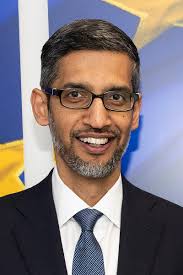
About Sundar Pichai
Sundar Pichai delivered the commencement address at Stanford University on June 14, 2026, during which approximately 200 students walked out in protest. The protesters, who waved Palestinian flags and chanted slogans, were demonstrating against Google's involvement in Project Nimbus, a cloud computing contract with the Israeli government. Pichai continued his speech, in which he acknowledged "global conflicts, economic anxiety, a rewiring of technology, information overload" and told graduates that "we don't get to choose the world we graduate into, but we do get to choose how we frame our circumstances."
Earlier in May, Pichai presented at Google I/O 2026, where he described the event as laying the foundation for an "agentic transformation" across Google's products. He introduced Gemini 3.5 Flash, a new AI model, and features including "Ask YouTube" and "Docs Live." In interviews following the conference, Pichai said that AI models three years from now would appear "primitive like a flip phone" by comparison, and stated that while Google's models are "at the frontier in some areas," the company is "a bit behind" in others such as agentic coding and long-horizon tasks. He also said that the timeline for achieving AGI "doesn't matter because the rate of progress means you're dealing with ever more intelligent systems in a profound way."
Source: AI-verified profile updated from Sundar Pichai's recent appearances.
Browse all interviews →
✨ AI-enhanced transcript with speaker attribution
S
Sundar Pichai0:00
Before I start, I know this hearing was delayed because of the ceremonies to honor the life of your colleague, Representative John Lewis. Because of his courage, this world is a better place, and he'll be deeply missed. At its heart, a discussion about competition is a discussion about opportunity. This has never been more important as the global pandemic poses dual challenges to our health and our economy. Expanding access to opportunity through technology is personal to me. I didn't have much access to a computer growing up in India, so you can imagine my amazement when I arrived in the U.S. for graduate school and saw an entire lab of computers to use whenever I wanted. Accessing the internet for the first time set me on a path to bring technology to as many people as possible. It inspired me to build Google's first browser, Chrome. I'm proud that 11 years later, so many people experience the web through Chrome for free. Google takes pride in the number of people who choose our products; we are even prouder of what they do with them—from the 140 million students and teachers using G Suite for Education to stay connected during the pandemic, to the 5 million Americans gaining digital skills to grow with Google, to all the people who turn to Google for help, from finding the fastest route home to learning how to cook a new dish on YouTube. Google's work would not be possible without the long tradition of American innovation, and we are proud to contribute to its future. We employ more than 75,000 people in the U.S. across 26 states. The Progressive Policy Institute estimated that in 2018, we invested more than $20 billion in the U.S., citing us as the largest capital investor in America that year and one of the top five for the last three years. One way we contribute is by building helpful products. Research found that free services like Search, Gmail, Maps, and Photos provide thousands of dollars a year in value to the average American. Many are small businesses using our digital tools to grow. Stone Dimensions, a family-owned stone company in Pewaukee, Wisconsin, uses Google My Business to draw more customers. Gil's Appliances, a family-owned appliance store in Bristol, Rhode Island, credits Google Analytics with helping them reach customers online during the pandemic. Nearly one-third of small business owners say that without digital tools, they would have had to close all or part of their business during COVID. Another way we contribute is by being among the world's biggest investors in research and development. At the end of 2019, our R&D spend had increased tenfold over 10 years, from $2.8 billion to $26 billion, and we have invested over $90 billion in the last five years. Our engineers are helping America remain a global leader in emerging technologies like artificial intelligence, self-driving cars, and quantum computing. Just as America's technology leadership is not inevitable, Google's continued success is not guaranteed. New competitors emerge every day, and today users have more access to information than ever before. Competition drives us to innovate, and it also leads to better products, lower prices, and more choices for everyone. For example, competition helped lower online advertising costs by 40% over the last decade, with savings passed down to consumers. Open platforms like Android also support the innovation of others. Using Android, thousands of mobile operators build and sell their own devices without paying any licensing fees to us. This has enabled billions of consumers to access cutting-edge smartphones, some for less than $50. Whether building tools for small businesses or platforms like Android, Google succeeds when others succeed. Competition also sets higher standards for privacy and security. I've always believed that privacy is a universal right, and Google is committed to keeping your information safe, treating it responsibly, and putting you in control. We've long supported the creation of comprehensive federal privacy laws. I've never forgotten how access to technology and innovation changed the course of my life. Google aims to build products that increase access to opportunity for everyone, no matter where you live, what you believe, or how much money you earn. We are committed to doing this responsibly in partnership with lawmakers to ensure every American has access to the incredible opportunity technology creates. Thank you.