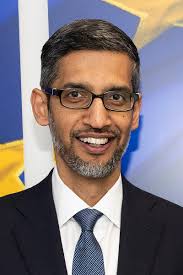
About Sundar Pichai
Sundar Pichai delivered the commencement address at Stanford University on June 14, 2026, during which approximately 200 students walked out in protest. The protesters, who waved Palestinian flags and chanted slogans, were demonstrating against Google's involvement in Project Nimbus, a cloud computing contract with the Israeli government. Pichai continued his speech, in which he acknowledged "global conflicts, economic anxiety, a rewiring of technology, information overload" and told graduates that "we don't get to choose the world we graduate into, but we do get to choose how we frame our circumstances."
Earlier in May, Pichai presented at Google I/O 2026, where he described the event as laying the foundation for an "agentic transformation" across Google's products. He introduced Gemini 3.5 Flash, a new AI model, and features including "Ask YouTube" and "Docs Live." In interviews following the conference, Pichai said that AI models three years from now would appear "primitive like a flip phone" by comparison, and stated that while Google's models are "at the frontier in some areas," the company is "a bit behind" in others such as agentic coding and long-horizon tasks. He also said that the timeline for achieving AGI "doesn't matter because the rate of progress means you're dealing with ever more intelligent systems in a profound way."
Source: AI-verified profile updated from Sundar Pichai's recent appearances.
Browse all interviews →
✨ AI-enhanced transcript with speaker attribution
S
Sundar Pichai0:00
While those moments add texture to your journey, they rarely determine the course of your life. But if you're able to filter the signal through the noise, you can nudge your life in these moments into having the impact you want. So today, I want to share three simple filters I've applied to my own life. Three filters that have helped me get more moments right than wrong and took some of the pressure off. First, choose optimism. The second filter is to gravitate towards working on hard things. And the third filter I use when all else is equal, do the thing that excites you.
N
Narrator0:42
A group of students walked out of the graduation ceremony while Google CEO Sundar Pichai was delivering the commencement address at Stanford University. The planned weeks-long protest targeted Google's involvement in Project Nimbus, a cloud computing and artificial intelligence deal between Google, Amazon, and the Israeli government. More than 100 students took part in the demonstration, reports said, leaving their seats at Stanford Stadium while chanting, 'Free, free Palestine.' The students said the protest was intended to raise awareness of concerns surrounding the project and its links to the ongoing conflict in Gaza. The walkout came moments after Pichai began his speech, turning what was meant to be a celebration of academic achievement into a wider discussion about technology, politics, and student activism. Students involved in the protest had expressed concerns about Project Nimbus and wanted the university community to consider what they said was the wider impact of the deal. The protest was a big moment in the ceremony, but Pichai did not touch on it directly in his comments.
S
Sundar Pichai2:03
Sundar Pichai begins by warning that this is only his second commencement speech, the first being in 2020 during COVID lockdowns. He contrasts that time of anxiety with the current celebration, thanking his family and the graduates' supporters. He mentions receiving advice on what not to say, but states the topic is immaterial to the timeless advice he wants to share: it's about the life you want to build and the choices you make. He recalls feeling uncertain on graduation day, the pressure to get every moment right, and shares a story of skipping class with a friend to drive to Vegas, realizing that the world doesn't end if you relax a little. He emphasizes that only a few moments in life are truly critical, like choosing a partner or career pivot, while many others only seem big but are not make-or-break. This leads him to share his three filters: first, choose optimism, despite global challenges; second, gravitate towards working on hard things, illustrated by his journey at Google, including working on Chrome with a small team against consensus; and third, do the thing that excites you, as seen in his passion for technology access through projects like Android. He concludes by encouraging the class of 2026 to keep moving forward and to follow what excites them, ending with congratulations and applause.