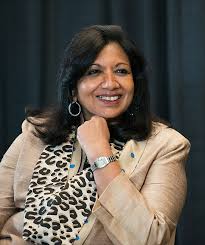
About Kiran Mazumdar-shaw
Kiran Mazumdar-Shaw, Executive Chairperson of Biocon, announced in May 2026 that her niece, Claire Mazumdar, will succeed her as the company's leader. Mazumdar-Shaw stated that she had long planned to groom Claire for the role and decided the time had come to announce it because Claire had "earned her stripes." She cited Claire's work building Biocara Therapeutics, including raising capital, obtaining a breakthrough designation for a bispecific antibody, and listing the company on Nasdaq in 2024 as a billion-dollar company. Mazumdar-Shaw said the transition will be gradual, with Claire expected to take over in five years, and that she herself plans to step back into a guiding role rather than an active one. She also stated that family will remain at the board level while professional management drives day-to-day operations.
On the company's financial performance, Mazumdar-Shaw reported that Biocon closed FY26 on a strong note, with Q4 operating revenue at Rs. 4,517 crore, up 10% year-on-year after adjustments. She said the company is now operating as "one unified biopharma entity" with a stronger balance sheet and that the heavy capital investment phase is behind them, with the focus now on improving utilization, expanding margins, and driving return on capital employed. Mazumdar-Shaw described the outlook as "very bullish," citing new product launches, a growing pipeline, and opportunities in biosimilars and GLP-1 therapies. She also noted that the FDA's decision to waive phase three clinical trials for certain biosimilars has reduced development costs by 50% and accelerated product timelines by three to four years. Separately, Mazumdar-Shaw hosted the 25th annual St. Patrick's Day celebration in Bengaluru in her capacity as Honorary Consul General of Ireland, alongside Ireland's Ambassador to India, Kevin Kelly.
Source: AI-verified profile updated from Kiran Mazumdar-shaw's recent appearances.
Browse all interviews →
✨ AI-enhanced transcript with speaker attribution
K
Kiran Mazumdar-Shaw0:19
India is a country on the crossroads. On the one hand, it's poised for great growth, and on the other, it has to grapple with the most basic of problems. And nowhere are the first world aspirations and the third world problems more apparent than in the healthcare space, where we have the best facilities co-existing with the worst. So what needs to be done to get the best in healthcare to all? That's the question that one of India's best-known entrepreneurs asks in this special series. Hello and welcome to India's Healthcare Challenge with me, Kiran Mazumdar-Shaw. My first guest is Dr. Montek Singh Aluwalia, who has a very special responsibility of planning India's future. Over the next 30 minutes, I will be speaking with Dr. Aluwalia to see what he has in mind in making sure that healthcare is a part of our development agenda.
Montek, thanks so much for coming on the show.
M
Montek Singh Aluwalia1:34
Well, pleasure.
K
Kiran Mazumdar-Shaw1:36
You know, I want to basically brainstorm with you on how we go about really seriously building a healthcare system for this country, because we have nothing at the moment.
M
Montek Singh Aluwalia1:50
Well, I wouldn't say that we have nothing, but the total expenditure on health in India as a percentage of GDP is roughly comparable to that in other developing countries. The difference is that government expenditure is very small, just over one percent, and most costs are borne by individuals out of pocket, about 80 percent.
K
Kiran Mazumdar-Shaw2:14
Yes, yes, and I think that is wrong. That's why the target we've set for ourselves is to take public expenditure on health somewhere between two and three percent of GDP.
M
Montek Singh Aluwalia2:27
I think in addition to that, you have to decide what kind of system you want. One approach is to expand the public sector health delivery system, but that's not ideal. Currently, 60 percent of hospitals and 50 percent of beds are in the private sector, while the public sector is sub-optimal due to resource constraints.
K
Kiran Mazumdar-Shaw3:28
Well, let me say, a lot of what you're saying is right, but I don't think it's an issue of public or private sector; both need to improve. The real issue is how government spends more money—either on public facilities for free services or subsidizing general insurance for people to choose public or private sectors.
M
Montek Singh Aluwalia4:20
Actually, we do need a system that ensures everybody, especially the poor, has access to basic health with minimal costs. We also need good quality private and public healthcare, with management, accountability, and regulation. For example, the US has the best medical care but the worst health system, spending more for poorer outcomes than Scandinavians. We need to design something right for India.
K
Kiran Mazumdar-Shaw7:09
You know, we are trying to build a health system from scratch. Looking at the US, they have the best healthcare but the worst cost structure and inefficient system. They recognize the need for robust infrastructure, so e-health and IT are big issues, with 200 billion dollars for health IT. That's a fundamental building block for us as well.
M
Montek Singh Aluwalia8:02
Absolutely, that's something we should consider when budgeting for healthcare in the next plan. The UID and other initiatives make it possible to revolutionize delivery systems, but there are resistances. For example, in the central government health service, converting to an IT-based system could provide medical history via a card, but doctors may be reluctant to have prescriptions double-checked. We need a radical change in medical practice and willingness to accept changes.
K
Kiran Mazumdar-Shaw13:45
I'm really pleased to hear that in the 12th five-year plan, we are seriously looking at building a national health system where government raises spend from one to two or three percent, and private sector tops it up to close to ten percent. This would create a robust and sustainable model, with 80 percent of incremental spend from private sector and a strong pharmaceutical industry for affordable drugs.
M
Montek Singh Aluwalia14:36
No, I mean there are a lot of strengths, but in the 12th plan, we must at minimum double health spending as a percentage of GDP. It's not true that we lack resources; for example, one percent of GDP is spent on subsidizing kerosene and LPG, which has leakage. Redirecting those savings to health facilities for the poor could help. The 12th plan will have to address these issues.
K
Kiran Mazumdar-Shaw15:46
And Montek, finally, getting the Public Health Foundation of India involved in developing a good and innovative national healthcare system would be very good. All stakeholders are keen to see such a system, as the healthcare sector is forecast to reach 300 billion dollars by 2025, a huge opportunity. We must ensure an inclusive model with advantages like low-hanging fruit: better maternity care, early diagnosis, malnutrition treatment, which can improve maternal and infant mortality rates quickly.
M
Montek Singh Aluwalia16:43
Yes, for the next five years, tackling low-hanging fruit can yield huge outcomes. We should concentrate on that. Unfortunately, we face challenges of both developed and developing worlds with a young and aging population, making the numbers staggering. But through brainstorming and innovative ideas, we can create an interesting healthcare model for the world to emulate.
K
Kiran Mazumdar-Shaw19:01
Well, the world will be watching us closely after India and China. China dismantled their public health system initially but is now correcting with new policies. We should learn from what the Chinese are doing. Thanks, Montek, that was most interesting. Thank you.