Darren Rebelez on brand reputation
From Casey's General Stores CEO Darren Rebelez sits down with Jim Cramer · · CNBC Television
“Because we have such a legacy with our prepared food and our pizza, people automatically assume anything we put our name on is going to be high quality. We take that responsibility seriously.”

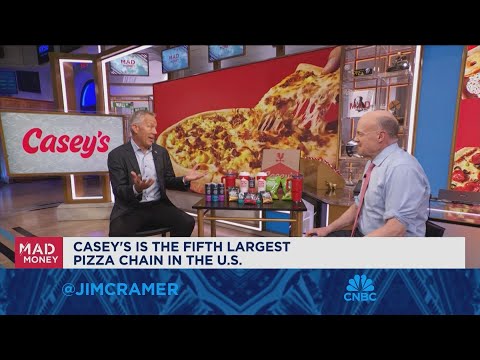
On , Darren Rebelez, President, Chief Executive Officer & Board Chair at CASEYS GENERAL STORES INC, spoke about brand reputation during Casey's General Stores CEO Darren Rebelez sits down with Jim Cramer on CNBC Television.
About Darren Rebelez
Darren Rebelez, President, CEO, and Board Chair of Casey's General Stores, has been discussing the company's financial performance and expansion strategy in media appearances. In June 2025, he told CNBC's Jim Cramer that the company's plan is to "focus on our food, focus on store growth, focus on running our business efficiently." He described the company's expansion into Texas, stating that "the population of Texas is 30 million people and we have 170 stores there. We have white space for days." In a separate CNBC appearance that same month, Rebelez said that post-COVID inflation and rising interest rates were "a shock to the system" that made consumers more value-conscious, and that Casey's has responded by "lean[ing] into quality" while maintaining its value proposition. In earlier appearances, Rebelez discussed consumer behavior and the company's prepared food business. In September 2024, he told CNBC's "Squawk on the Street" that the consumer is "hanging in there, pretty resilient" and that lower-income consumers are "not stopping spending, they're just being more discerning." He noted that the company launched a thin crust pizza platform and a hot sandwich that was "up 85% in the quarter." In November 2023, he stated that elevated consumer packaged good prices are not expected to subside, while on the prepared foods side the company tries to "price through the cycle" to maintain value. In September 2023, he said that about three-quarters of Casey's guest base makes over $50,000 a year and that the company benefits from the fragmentation of the convenience store industry, where two-thirds of operators run chains of ten stores or fewer.