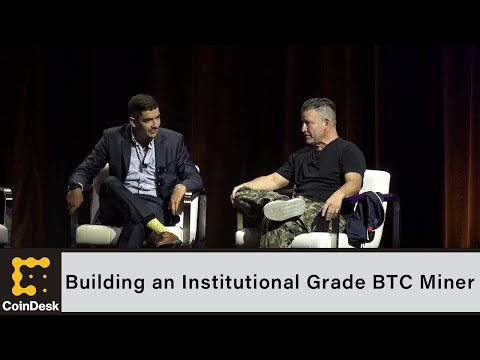
Darin Feinstein on site selection
From Building an Institutional Grade BTC Miner · · CoinDesk
“We picked North Carolina... there are regions with lots of excess hydroelectric power — that hydroelectric power was built by the United States government (Manhattan Project era) and became stranded renewable energies; many Appalachian communities were decimated by NAFTA and later Opportunity Zone laws were enacted to help those areas.”

On , Darin Feinstein, Cofounder at Core Scientific, spoke about site selection during Building an Institutional Grade BTC Miner on CoinDesk.
About Darin Feinstein
Darin Feinstein, co-founder and chief vision officer of Core Scientific, has continued to describe Bitcoin mining as an innovation in accounting and energy infrastructure. In interviews and public appearances throughout 2022 and 2023, Feinstein characterized Bitcoin as the first major advancement in accounting in 700 years, describing its proof-of-work ledger as a "triple-entry" system that makes transactions immutable and auditable. He argued that the technology provides private property rights and banking access to billions of people living under authoritarian regimes or high inflation. Feinstein also emphasized that Bitcoin miners operate data centers housing computer servers, and he stated that the industry's energy use represents roughly 16 basis points (0.016%) of global energy generation, calling claims that the network would consume all of the world's energy "insane" and "over 99% wrong." Feinstein has been active in the Bitcoin Mining Council, which he said was created to educate regulators and the public about the industry's energy footprint. He noted that the council publishes quarterly reports on energy usage and sustainability metrics. In discussing site selection for mining operations, Feinstein said the company consults local communities and elected officials before building, and he described Bitcoin miners as flexible, non-mission-critical loads that can curtail power during grid emergencies. He also stated that he is no longer involved in Core Scientific's day-to-day operations, serving instead on the board as chief vision officer.