Ryan Petersen: Building Flexport
Build the system behind the system. Flexport founder Ryan Petersen shows how to turn messy, multi‑party operations into a ...
Founder & Executive Chairman, Flexport
Search every verified Ryan Petersen interview, podcast appearance, and on-the-record quote — each transcript cross-checked by AI and human review to confirm speaker identity. Ryan Petersen, founder and executive chairman of Flexport, has been discussing global trade, tariffs, and remote work in recent appearances. On the Knowledge Project podcast, Petersen said that tariffs have had "the opposite impact that Trump would like," noting that while there is "some validity" to arguments about national security and employment, the result so far has not led to a reshoring of production. He argued that in logistics, "quality costs less" because mistakes such as incorrect customs classifications create costly delays. On the same podcast, Petersen described his goal for Flexport as an "asset light technology platform for freight forwarding" that could lower the cost of shipping by 5 to 10 percent. In a separate interview, Petersen described remote work as "white collar fraud," stating that he cannot work productively at home with young children. He also discussed the impact of high tariffs, saying that when tariffs reach 35 percent, there is a strong incentive for importers to lie about the value of goods, and that such fraud is "absolutely rampant right now." Petersen noted that the United States and the United Kingdom are the only countries that allow unrestricted imports by foreign companies with no domestic presence, creating an "honor system" that is difficult to enforce. He also commented on the Strait of Hormuz, saying that 20 percent of the world's oil flows through it and that the situation feels "economically" like a wakeup call.
“These tariffs have had the opposite impact that Trump would like. I think there's intention. There's some validity to it all like some of the things I said from national security and employment other things but the result has been thus far and it's pretty early in the cycle. We're only a couple months since the liberat...”
“I think most businesses like actually quality costs less it's very counterintuitive. Well, in logistics, like all the costs come from you making a mistake. Like like if you file a customs entry and you get the wrong classification code, you're going to spend weeks on doing that with the customs agencies and like you mi...”
“I say it's white collar fraud. I have a three-year-old and a 5-year-old. The idea that I could do any work at my house is like a total fantasy. Like, come on. You're kidding. And like, I have a bigger house than most employees do. Like, I actually do have a private office I can close the door on. It doesn't matter. Lik...”
“I think the negotiation that we're going to have with Salesforce going to be a lot different than the last one cuz we are I think selling SAS to tech companies is going to be a tough business because we can build stuff ourselves.”
“Incoterms are the standard terms by which you negotiate where the goods are handed over in a trade transaction. The most famous incoterm today is called DDP, delivery and duty paid, which means it's the supplier's job to deliver all the way to your warehouse. So it's obviously a big deal because it's who pays the tarif...”
“When tariffs have gone to 35% at peak, they were like 150% for a few weeks, but right now it's about 35% on most goods. That's a big incentive to lie about the value of the goods because it's 35% of whatever you tell the government the value of the goods is. And so people are just lying and they're saying, 'Hey, this t...”
“The United States is the only country in the world besides the UK that really allows anybody to import goods into their country almost unrestricted. You could just import stuff into the United States as a foreign company with no domestic presence whatsoever. And therefore we have no ability to enforce what these people...”
“The British East India Company was somewhat reluctant conquerors. They came to trade, but in some of what they did really kind of created a lot of breakdowns in India and society. India largely devolved into chaos during this time and I don't think they're unrelated. I think it was probably caused by the English East I...”
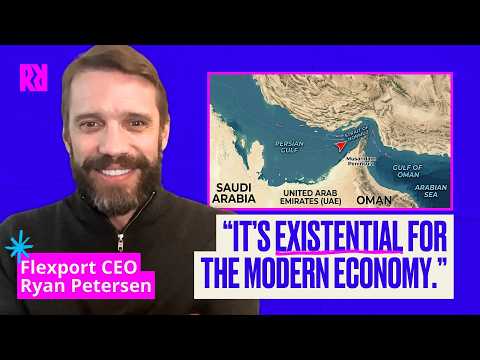
“20% of the world's oil flows through Hormuz. So we've had this violent wakeup call. I hate to be the guy always crying Chicken Little saying the sky is falling, but like it feels that way economically. I don't know. I saw a gas station here in California. It was $9 a gallon yesterday. Um, which I've been waiting for $1...”
“The US post World War II kind of established this order that said, 'everybody can trade with everybody ... and the US Navy will provide freedom of navigation.' Maybe the US Navy can't provide that guarantee anymore.”
“My strong view bordering on certainty is that the government will pay these tariff refunds.”
“The current topic is refunds on tariffs and we intend to be — we are like the thought leaders and intend to be the process leaders for how you get your money back from the government. I want to put on my tombstone someday: I got $50 billion from the government into the hands of the American citizen.”
“I think you could take out probably 20% of the cost of shipping things around the world because of AI, and that's just massive. If you're the people that do that, you have the biggest company in the industry and we're very well positioned to be that company.”
“The current topic to jour is refunds on tariffs and we intend to be — we are like the thought leaders and intend to be the process leaders for how you get your money back from the government. I want to put on my tombstone someday: I got $50 billion from the government into the hands of the American citizen.”
“I think you could take out probably 20% of the cost of shipping things around the world because of AI. And that's just massive.”
Build the system behind the system. Flexport founder Ryan Petersen shows how to turn messy, multi‑party operations into a ...
Ryan Peterson is the Founder & CEO @ Flexport, the logistics darling of the venture capital world that has raised $900M+ with the ...
Ryan Petersen is the Founder and CEO of Flexport. Flexport: https://flexport.com Ryan: https://x.com/typesfast Ti: https://x.com/ti_morse Timestamps: 0:03 Pablo Escobar was a logistics guy 2:29 The explosion in tariff fraud 8:58 The Dutch East India Company 11:20 History of global trade 14:39 1,000x spice markup 17:53 The British East India Company 24:02 How the British got 20% of China addicted to opium 27:44 The Forbes family & opium trade 30:40 Jewish trading networks 37:33 It’s illegal to criticize the King of Thailand 38:58 Strait of Hormuz 45:58 Maritime chokepoints
When global trade buckles, Ryan Petersen is the person executives call. The founder and CEO of Flexport returns to Rapid Response to offer a real-time account of the Strait of Hormuz crisis — what he's seeing on the ground, on the water, and across the supply chains straining under the pressure. Petersen also digs into the prospect of tariff refunds in the wake of the Supreme Court's ruling against the Trump Administration, and why businesses risk leaving $160 billion on the table by not acting. Plus, how AI is reshaping both logistics and software-based firms, and whether all the trade turbul…
Whenever global trade or shipping are in the news, the tech industry turns to Flexport CEO Ryan Petersen. But when Petersen returned to Flexport, the $8B-valued logistics unicorn he founded, in 2023, his company was in need of a turnaround. Customers were fleeing; morale had plunged. On this episode of The Upstarts Podcast, Petersen talks about his Upstart Moment: helping Flexport win again by focusing on customers. He also shares how AI agents have transformed how Flexport ships products, why "nobody cares" about startups by default, and how he hopes to return $50 billion in tariff refunds…
$50 billion. That’s how much in tariff refunds Ryan Petersen hopes to retrieve for U.S. citizens using AI agents recently built by his startup, Flexport. But logistics unicorn Flexport was struggling when co-founder Petersen returned as CEO in 2023. Customers were fleeing; morale had plunged. Ryan talks about his Upstart Moment in engineering a comeback – and why AI agents are increasingly the answer for solving the messiest challenges in global trade. Chapters: 00:00 Introduction 01:16 Tech’s ‘hurricane reporter’ 03:29 Scooter selling origins 06:49 ‘Schlep blindness’ 09:50 Flexport’s YC pit…
“It’s like black and white, they said it themselves. It’s going to go back to the court and they’re going to read and say, ‘you told us there would be refunds, so now you got to do refunds.’” Flexport CEO Ryan Petersen on his company's refund calculator tool.
Watch Ryan Petersen, Founder and CEO of Flexport, as he announces Flexport's 2026 Winter Technology Release featuring new AI agents to manage customs, cut hard costs, and remove friction from global trade.
In this exclusive interview, Ryan Petersen, Founder and Chief Executive Officer of Flexport, speaks with Reji John and Libin Chacko Kurian about the forces reshaping global trade and logistics, from tariffs and geopolitics to AI, data, and supply chain resilience. Petersen explains why AI will fundamentally change how supply chains are run, how tariffs are driving unprecedented volatility in freight markets, and why Flexport is now going harder on India with expanded operations and engineering investment. He also shares Flexport’s long-term vision, plans for a potential IPO in the next five y…
Ryan Petersen, founder of Flexport, breaks down a surprising truth about U.S. trade policy: when duty rates skyrocket, so does the ...
Sign in to search the full transcript archive, filter by topic, and access every quote from Ryan Petersen.
The summary and quote tags on this profile are produced with AI assistance from verified, first-person interview transcripts, then checked by our team to confirm the speaker's identity and the accuracy of every quote. See how we verify →