Customer-Centric Launch Vehicle: Terran R Program Update Q1 2025
Discover insights on the launch industry economics and Terran R's market-leading momentum. 0:00 – 0:35: LEO constellations ...
CEO & Co-Founder, Relativity Space
Search every verified Tim Ellis interview, podcast appearance, and on-the-record quote — each transcript cross-checked by AI and human review to confirm speaker identity. Tim Ellis, CEO and co-founder of Relativity Space, has been discussing the company's Terran R launch vehicle and its positioning in the growing market for low Earth orbit satellite constellations. In a Q1 2025 program update, Ellis stated that Terran R is designed to carry 20,000 kg to low Earth orbit, which he described as a "sweet spot" for serving mega-constellations. He said the company has a $2.9 billion backlog and emphasized that customers are seeking the best economics, high launch cadence, and a partner that will not compete with them. Ellis noted that reuse is critical both for cost and for achieving the ramp rate needed to launch dozens of times per year, and that demand is growing faster than any single supplier can serve. In other appearances, Ellis has discussed his long-term vision of making humanity multi-planetary, describing the goal as expanding the possibilities of human experience. He has said that 3D printing is the inevitable technology for building an industrial base on Mars, and that Relativity Space aims to be the first company to develop it. Ellis has also spoken about the importance of customer collaboration, stating that he has engaged with large commercial operators from the inception of Terran R to ensure the vehicle meets market needs. He has described the company's approach as building a full launch system with software-defined manufacturing, contrasting it with traditional aerospace methods.
“There's a augmentation of terrestrial telco in space and it's happening through low earth orbit constellations — these are very much like what Starlink is doing. There are folks like Amazon who have announced constellations in low earth orbit and our vehicle Terran R is geared to serving primarily constellations that a...”
“Terran R has been designed to carry 20,000 kg to low Earth orbit. That's really what we've identified as the sweet spot within the constellation market — large enough to provide great economics on a dollar per satellite basis, but small enough to ensure that we're able to fill it full with each launch.”
“Some other launch vehicles are much larger, but they run into the challenge of not being able to fill the launch vehicles — they're flying half empty or even more. Some vehicles are much smaller and end up with a much higher cost per satellite to space and require many more launches to deploy the same constellation.”
“I've always been a firm believer that you need to work with customers from day one to make sure that the product you're developing actually solves their needs. From the very inception of Terran R, we've been out engaging with the largest commercial operators around the globe — early, often, every quarter meeting with t...”
“Customers are looking for the company that can offer the best economics — the lowest dollar per satellite to space. They don't just need one launch; they need many launches and so they're looking for a company developing a full launch system with higher rate operations in mind and enough capacity to actually matter to...”
“The feedback that we've gotten from our customers over the last couple years is that we have built tremendous amounts of trust based on being very transparent about what we're building, why we're building it, and then delivering on our promises — which is again why we've created the $2.9 billion backlog that we've sign...”
“Reuse is absolutely critical to the economics, but reuse is also absolutely critical to ramp rate because in order to launch dozens of times a year, if you've got to build first stages dozens of times, you're just not going to physically be able to do it. Reuse enables the launch cadence required by these mega-constell...”
“What we're seeing today is demand that is growing faster than any one supplier can possibly serve, and customers have a very strong desire to ensure that they have multiple options to get to space.”
“The NFL is aggressively expanding its international presence, with games in London, Germany, and Spain, aiming to grow its fan base across diverse markets.”
“Flag football is a key part of our strategy to grow young, inclusive, and diverse audiences worldwide, helping us establish participation in new countries.”
“Getting lifelong fans involves participation; flag football is gender-neutral and a fantastic way to bring girls and women into the game, which is crucial for future growth.”
“Live sports, especially the NFL, continue to be the ultimate way to bring mass audiences together, with NFL games accounting for 93 of the top telecasts last year in the US.”
“Technology, especially AI, is beginning to meld with creativity, helping us enhance storytelling and bring art to life faster, more efficiently, and at scale for the NFL.”
“AI will help us create new forms of art and storytelling, but whether it will replace artists remains an open question; the idea and creativity are still paramount.”
“To build a loyal fan base, especially among young audiences, we focus on engaging girls, women, and Latinos, because these groups are key drivers of growth in the future.”

Discover insights on the launch industry economics and Terran R's market-leading momentum. 0:00 – 0:35: LEO constellations ...

VISIT us: http://www.digiday.com LIKE us on FACEBOOK: https://www.facebook.com/digiday FOLLOW us on TWITTER: ...


Chat with Tim Ellis, Co-Founder and CEO of Relativity Space about emerging technologies.


Relativity Space CEO Tim Ellis knows what went wrong during Terran 1’s first flight—and he shared with Payload why he is confident the same thing won’t happen to the startup’s Terran R rocket. What’s next: After the March flight, Relativity announced that it was scrapping Terran 1 development to focus solely on its larger Terran R vehicle. Ellis emphasized that this shift is not merely about scaling size, but also better aligning with market demands ($1.8B Terran R pipeline) and the broader vision of the company. Overall R&D costs should be in the ballpark of ~$1B, Ellis estimated, adding…

Envisioning Alternative Futures.
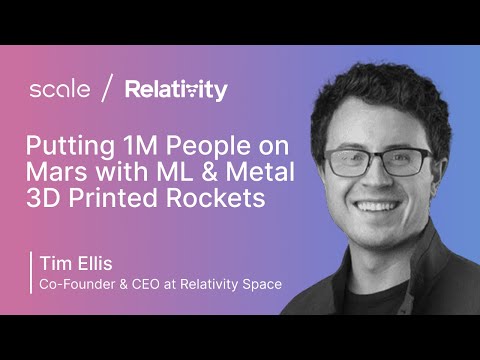
Tim Ellis is the Co-Founder and Chief Executive Officer of Relativity Space and wants to put one million people on Mars. He plans on accomplishing this goal by using the 3D printed rockets manufactured by his company, which boasts a one-million-square-foot factory and the largest metal 3D printers in the world. Ellis will describe his first in-person rocket test and how it drove him to build Relativity Space. He will also outline the concept of software-defined manufacturing, and how combining 3D printing and machine learning allows Relativity Space to experiment and iterate more quickly than…

NSF Live is NASA Spaceflight.com's weekly show covering the latest in spaceflight. It is broadcast live on Sundays at 3 pm ...
Sign in to search the full transcript archive, filter by topic, and access every quote from Tim Ellis.
The summary and quote tags on this profile are produced with AI assistance from verified, first-person interview transcripts, then checked by our team to confirm the speaker's identity and the accuracy of every quote. See how we verify →