CEOInterviews.AI
Start App
Try: AI strategy tariffs earnings guidance layoffs interest rates growth

Robert Nishihara

Former CEO & Co-Founder, Anyscale

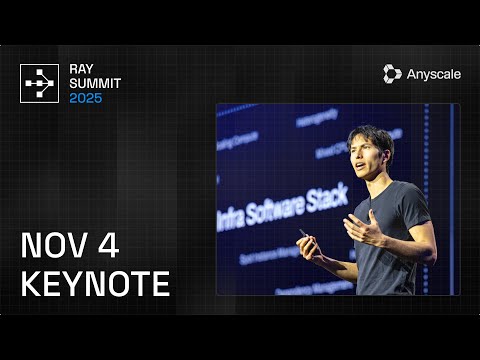
Search every verified Robert Nishihara interview, podcast appearance, and on-the-record quote — each transcript cross-checked by AI and human review to confirm speaker identity. Robert Nishihara, co-founder and former CEO of Anyscale and creator of Ray, delivered the Day 1 keynote at Ray Summit 2026 on September 17, 2026, titled "What Makes RL the Hardest Workload in AI." In the talk, he described reinforcement learning as one of the most difficult distributed systems problems in AI, explaining that it requires coordinating training, inference, and environments in a single, tightly coupled loop. He outlined two categories of challenges: workload challenges, such as scaling data processing, ensuring fault tolerance, and maximizing inference throughput for a single user and cluster, and platform challenges that arise when managing many users, workloads, and clusters. He detailed the software stack involved in an RL workload, noting that data generation involves an agent coordinating with an environment, a reward model, and an inference server in a tight loop, and that moving rollout data to training introduces complications like variable-length sequences and padding that can reduce efficiency. Nishihara also emphasized that each component of an RL workload—training, environments, reward models, and agents—has its own failure handling strategies, hardware requirements, and topology needs, such as training on reserved GB300s with rack topology considerations, environments running on hundreds of thousands of CPU cores, and agents being I/O-bound and multi-threaded. He stated that this complexity is why nearly every RL framework builds on Ray, arguing that the platform is essential for managing the coordination and infrastructure demands of running a single RL workload.

Recent appearances

Verified interview transcripts

Notable quotes

“Amazon migrated it runs an exabyte scale data processing workload on Ray. And when they started using Ray, they actually saved over a hundred million dollars a year and they and they have written publicly about this.”

“One blind spot I think people have is how much potential there is for breakthroughs around an existing model by using the input context or memory instead of just changing the model weights — I can see continual learning happening without continuously updating the weights.”

“I imagine data processing shifting from being a SQL-centric workload to an AI-centric workload — and if it's AI-centric it's going to be GPU-centric (or mixed CPU/GPU) — yet the tooling around very GPU- and AI-intensive, data-intensive workloads is practically non-existent.”

The summary and quote tags on this profile are produced with AI assistance from verified, first-person interview transcripts, then checked by our team to confirm the speaker's identity and the accuracy of every quote. See how we verify →