
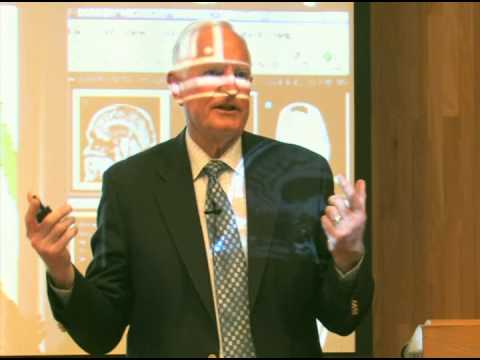
View from the Top: Craig Barrett, Intel
The Business of Innovation”
Former CEO of Intel, Intel Capital
Search every verified Craig Barrett interview, podcast appearance, and on-the-record quote — each transcript cross-checked by AI and human review to confirm speaker identity. Craig Barrett, former CEO and chairman of Intel, has continued to speak publicly about U.S. competitiveness, education reform, and the semiconductor industry. In a 2025 appearance at the Global Quantum Forum, Barrett discussed the trajectory of Moore’s Law and the development of the quantum computing ecosystem, noting that multiple qubit modalities have continued to progress over 25 years and that the trend of exponential growth in computing is “very convincing.” He also referenced the observation that human beings are “terrible at understanding the impact of exponential technologies.” Across numerous appearances from 2011 to 2021, Barrett has consistently argued that the U.S. K-12 education system is underperforming, citing international test scores and the percentage of students at grade level. He has said that the system lacks accountability and that “there is no silver bullet” to fix it, advocating for high expectations, well-trained teachers, and internationally benchmarked assessments. Barrett has also discussed the importance of STEM education for economic competitiveness, noting that companies like Intel hire the best talent globally and that a U.S. workforce that is not as well-trained as foreign workforces is a disadvantage. He has been involved with the BASIS charter school network in Arizona, which he said has produced four of the top 10 high schools in the country according to certain rankings.

Join art collector Craig Barrett as he interviews Art in Action artist Brooke Wetzel at Triple Creek Ranch.

CRAIG BARRETT: I spent 17 years at Stanford, seven as a student and roughly 10 on the faculty. And when I left at the advanced ...

It was destination India for President and CEO of Intel Corporation Dr. Craig Barrett as he addressed the Indian Business and Press in Delhi and Mumbai in his address Dr. Barrett revealed the Intel's plans for India which will focus mainly on the internet Dr. Craig Barrett, President and CEO Intel Corporation speaks about the Intel's plans for India. He says, "Our goal here is to make about 30 investments in this calendar year 30 total investments in the range of well over 100 million dollars invested in small companies and these companies come from different backgrounds they can be in serv…


Craig Barrett Talks with Mariette DiChristina on why our education system is broken and what we can do about it.

... and so we have the basis schools I'm working with Phoenix Union School District the superintendent there we're building what's ...


2007 Horatio Alger Award Recipient Craig R. Barrett recalls the loss of his father, his mother's emphasis on her children obtaining a high-quality education, and the importance of continuous learning, and not fearing new opportunities.

Brian MacCraith, Craig Barrett, Mary Moloney and Michael Murphy discuss new sources of innovation emerging from collaborative environments, such as Hackathons, Coderdojo, eLearning and digital learning structures. The role of education and research in the creation of startups, disruptive technology solutions and commercialisation of R&D are also. The panelists review the role of formal-informal methods to drive the education-innovation axis and how the transatlantic dimension can influence this.

2015 ITLG Tech Summit Craig Barrett Keynote Dublin May 26th.
Sign in to search the full transcript archive, filter by topic, and access every quote from Craig Barrett.
The summary and quote tags on this profile are produced with AI assistance from verified, first-person interview transcripts, then checked by our team to confirm the speaker's identity and the accuracy of every quote. See how we verify →
Pro unlocks every transcript in full, plus unlimited search across every executive and company we cover.
50% off appliedPulling data at scale? The Data API gives you 30,000 transcripts a month over REST, MCP and JSON.
Compare all plans