CEOInterviews.AI
Start App
Try: AI strategy tariffs earnings guidance layoffs interest rates growth

Andrew Bailey

Governor, Bank of England

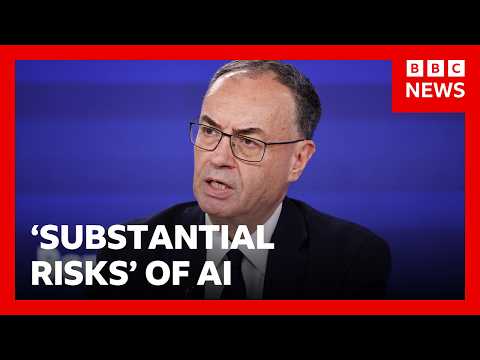
Search every verified Andrew Bailey interview, podcast appearance, and on-the-record quote — each transcript cross-checked by AI and human review to confirm speaker identity. Andrew Bailey, Governor of the Bank of England, has recently focused on the economic and financial stability implications of artificial intelligence, the ongoing conflict in the Middle East, and the UK's inflation outlook. Bailey described AI as a "double-edged sword," acknowledging its potential to strengthen economic growth and living standards while warning of significant risks, particularly to cyber security and financial stability. He argued that frontier AI has created a more powerful way of uncovering vulnerabilities and called it a "potentially very powerful weapon" in the wrong hands, while also cautioning that financial markets may be overestimating the value of AI companies and that "not everybody always wins." Bailey also discussed the importance of public trust in AI and the need for stronger model testing and standards. On the UK economy, Bailey noted that the conflict in the Middle East has created uncertainty around growth, inflation, and interest rates, with energy price increases raising the risk of second-round effects. He stated that inflation was just over 3% and that the Bank's framework for assessing pass-through into indirect effects had not changed. Bailey also addressed central bank independence, saying that while the Bank is independent of government, it is not independent of parliament or the people it serves. He appeared before the Treasury Committee, participated in G30 and IMF discussions in Bangkok, and gave a keynote speech at an economic forum in Istanbul, where he highlighted risks to sovereign debt markets, asset valuations, and credit markets.

Recent appearances

Verified interview transcripts

Notable quotes

“Well, I think first of all, I mean, I'm not elected. Um so, I think, you know, it's important we stay in our lane, as it were, in that sense. I mean, I you know, I'm not trying to compete with the Prime Minister and the Chancellor. They've got very big and important jobs. Um we have got an important job, but you know, we've got very well-defined responsibilities. But, you're right. We have a We do have a duty to expl”

“Well, that's a really interesting question because you're right. Um, you know, one of the things I have to sort of say is um I'm sorry we can't predict unpredictable events as it were. So, you know, sadly if you look at the conflicts in the in the Middle East that broke out in February, yeah, we can't predict it. We can't predict COVID breaking out. Um, you know, we have to respond to those things. So, our job is obv”

“We are independents in effect of government. We're not independent of parliament in the sense that parliament can legislate and we're not independent of the people of the country. Of course we're not. We should and nobody ever should ever think that we are nor should we be. We are we serve the people of the country. We serve their representatives and parliament. We're accountable to them. I take that very seriously. ”

“First of all, let me say quite straightforwardly. I very much welcome the TSC work that they're doing actually. I think it's an excellent thing. Such an important subject and it's actually you know very important part of our accountability. There are a number of challenges in the current environment which put this sort of question of independence into sort of quite sharp relief. The first one I'll start with is it is”

“I think there are four things that I would have in my mind. The first one is that obviously the demand effects in so far as they come through asset prices rest on markets forming a view on what the eventual productivity effects are going to be and what the effects on potential growth are going to be. Clearly markets could suffer a correction if they change their view on what those are. The second one comes back to my”

“I do think that the things over history that have actually raised potential growth rates over a sustained period are big changes particularly in general purpose technology and the effects that that can have in terms of spreading across the economy. And I think it is possible that one of the causes of us having lower potential growth rates in many of our economies for the last 15, 20 years is actually that we may have”

The summary and quote tags on this profile are produced with AI assistance from verified, first-person interview transcripts, then checked by our team to confirm the speaker's identity and the accuracy of every quote. See how we verify →