CEOInterviews.AI
Start App
Try: AI strategy tariffs earnings guidance layoffs interest rates growth

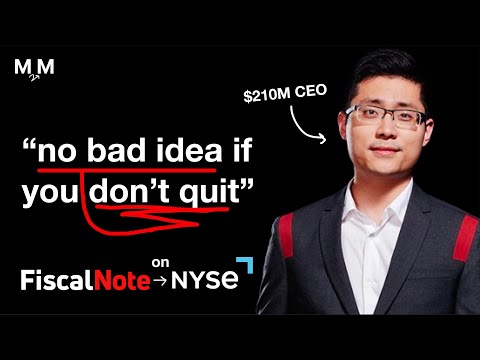
Tim Hwang

Cofounder, FiscalNote

Search every verified Tim Hwang interview, podcast appearance, and on-the-record quote — each transcript cross-checked by AI and human review to confirm speaker identity. Tim Hwang, cofounder of FiscalNote and CEO of Nitra, discussed his entrepreneurial trajectory and views on government and business in a September 2026 podcast appearance. He recounted founding FiscalNote, a regulatory and legislative intelligence platform, and described how his responsibilities shifted after the company went public, moving from involvement in product and hiring details to managing a broader set of stakeholders. He also offered advice to founders, emphasizing the importance of pursuing personally interesting work and delivering value to users, whether through deep impact for a small group or incremental improvements for many. In the same interview, Hwang argued that the U.S. government has become more interventionist in the economy since the mid-2000s, citing initiatives such as the Inflation Reduction Act, and noted that early FiscalNote planning was shaped by a period when regulators were actively scrutinizing companies like Uber and Airbnb. In a 2012 talk, Hwang examined the use of socialbots—automated identities that interact with real users on social platforms—and discussed experiments involving large-scale bot networks designed to connect separate groups of users without their knowledge. He described these bots as capable of influencing online communities and real-world coordination, and suggested that such tactics could become more common in politics due to the difficulty of attributing bot activity to creators. He also stated that as social activity moves online, scripts can increasingly act in place of humans, raising questions about the implications of that shift.

Recent appearances

Notable quotes

“My general thesis right now is that from call it 1970 to about 2010 or so, the US government has been very hands-off in the economy on a general basis, certainly relative to Korea or China or the European Union or the like. And then starting in the mid-2000s, the US government has really been very hands-on in the economy in terms of building up new industries and throwing trillions of dollars at specific problems. So”

“If you rewind the clock to 2012, 2013 when I was thinking about FiscalNote for the first time, you have to kind of open up the newspaper from 10 years ago. And if you open up the newspaper, the headlines were things like Uber executives were being jailed in Paris because they're illegally operating a ride sharing company, or the New York Attorney General was investigating this random company called Airbnb for illegal”

“We've basically identified a cognitive vulnerability in the network. We can sort of have the bots basically see this information into the network which gains credibility. And what's interesting about this kind of project is you could be the smartest person in the room. We don't need to get to you. We just need to get to your gullible friend who you trust.”

“I actually have a proposal out right now to the Dicastries that are running their commission on AI. And what I humbly submitted to them was that they should invest in compute and they should publish a technical research agenda and they should rally worldwide Catholics against that technical research agenda. If they want to have a future in shaping the technology, I think they have to be able to speak and argue in mac”

“I think it's a field which likes to kind of place before the world a sense of its objectivity and a sense of its science-ness, right? It talks in the language of evals, of code, of papers that are on archive, and at the end of the day, I see some of this as genuinely interesting technical work, but at the end of the day is also just an exercise in applied moral philosophy.”

“We service everyone from the Executive Office of the President, the Pentagon, the DoD, every member of the House and the Senate in the United States Congress, the Federal Reserve and hundreds of other civilian agencies.”

The summary and quote tags on this profile are produced with AI assistance from verified, first-person interview transcripts, then checked by our team to confirm the speaker's identity and the accuracy of every quote. See how we verify →