CEOInterviews.AI
Start App
Try: AI strategy tariffs earnings guidance layoffs interest rates growth

Thomas Peterffy

Founder & Chairman, Interactive Brokers

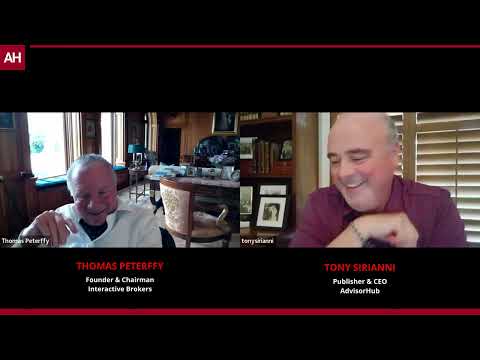
Search every verified Thomas Peterffy interview, podcast appearance, and on-the-record quote — each transcript cross-checked by AI and human review to confirm speaker identity. Thomas Peterffy, founder and chairman of Interactive Brokers, appeared on The Master Investor Podcast in September 2026, where he discussed the company's growth, his views on the economy, and investment strategy. He stated that Interactive Brokers has grown earnings and share price by roughly 40% per year over the past five years, attributing this to a focus on building products customers want. Peterffy said he remains calm about rising bond yields and predicted the Federal Reserve will raise rates, though he noted he would not be in favor of that decision. He expressed optimism about artificial intelligence, suggesting that high valuations are justified by earnings growth rates, and advised investors to learn about AI to use it to their benefit. He also recommended land as a logical asset for long-term investment, citing his family's experience in communist Hungary. During Interactive Brokers' Q2 2026 earnings call in July 2026, Peterffy addressed client margin risk, stating the company is "very cognizant" of it and comfortable with current levels. He reported excess capital of approximately $10.3 billion, up about $1 billion from the prior quarter, and noted an increase in acquisition proposals from investment banks, though none had stood out as worth pursuing. He also discussed the company's decision to offer cryptocurrency perpetual futures through Coinbase, explaining that these instruments allow shorting and margin trading, and noted that roughly one-third of crypto trading volume on the platform now comes from these perpetuals.

Recent appearances

Verified interview transcripts

Notable quotes

“I wouldn't worry about that either because even though valuations are very high from a historical perspective, if you look at the rates at which earnings are growing, they are not high as a matter of fact they may be even low too low. So if you look at a company like Nvidia at 27 times earnings and they stated expectations of increasing earnings by 70%, that is a relatively low valuation and similar situation to a le”

“I think if you think about how you want to invest your assets for your heirs to have something down the road, if these things happen that I'm worried about, then I think land is the logical asset. I grew up in communist Hungary and my family used to own a lot of land before communism came in and then of course they took it away from us. They took everything away. They took obviously all your real estate and your land”

“So I think that um well four five years is way too long to to look ahead right I mean even the next two years I think uh changes will be very very uh substantial and uh you will very it's very important that that you you look at the prediction markets and see what is coming and see to how see how to align the portfolio you manage to uh these different changes and uh especially AI and how that will impact uh the world”

“the first thing I would say is that advisors over the last three years have outperformed the S&P 500 index on our platform by 267%. So I think performance for advisor is very important because the better per per you perform the more clients you are likely to be able to get. So, uh much of that of course is is is uh uh due to the fact that uh we have uh uh we we we have extremely good executions in the sense that most”

“I think it is incredibly important there is so much uncertainty it is important incredibly important to have prediction markets where people can see what is the consensus opinion of very very crucial questions such as the rate of adoption of AI such as Will what will be the labor participation rate in the coming decades as as the we evolve? uh what will be uh the will will we constitute uh will we implement uh univer”

“The big regulatory problem is that there are many questions concerning specific companies that we would love to ask, but we do not know if the question would be a security or a commodity and do not know who should properly regulate it. This quagmire would have to be cleaned up, and then we would have a much better market.”

The summary and quote tags on this profile are produced with AI assistance from verified, first-person interview transcripts, then checked by our team to confirm the speaker's identity and the accuracy of every quote. See how we verify →