
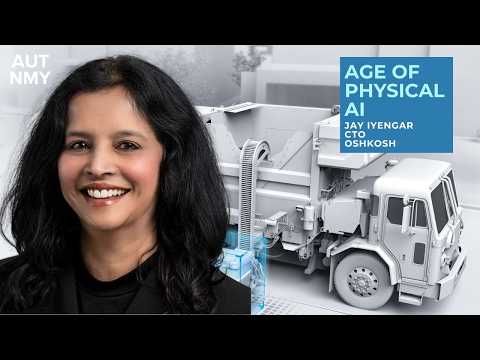
Autonomous Mail and Trash Trucks Do More Than Just Drive | Oshkosh CTO Jay Iyengar
Garbage trucks, mail trucks, and other vehicles are getting smarter with AI technology that goes beyond autonomous driving.
Executive Vice President and Chief Technology & Strategic Sourcing Officer, Oshkosh
Search every verified Jayanthi Iyengar interview, podcast appearance, and on-the-record quote โ each transcript cross-checked by AI and human review to confirm speaker identity. In a September 2025 interview, Jayanthi Iyengar discussed Oshkosh Corporation's use of artificial intelligence to make vehicles more intuitive and safer for operators. He described the company's approach as creating "intelligent teammates" that reduce driver fatigue and cognitive load by automating specific tasks, such as a refuse truck identifying a curbside bin and deploying its arm at the push of a button. Iyengar noted that this technology can shorten training times, which he said currently take up to six months for operators to master complex controls like joysticks. Iyengar also highlighted Oshkosh's work on predictive maintenance, which informs field operators about wearing parts and provides replacement components proactively to improve efficiency. He cited autonomous jet bridge technology as another example, which can align with various aircraft doors to reduce airport delays. Iyengar emphasized that the company focuses on making systems robust through extensive real-world testing before mass production, and he urged customers to evaluate technology from a total cost of ownership perspective rather than focusing on individual vehicles.
“We are trying to create that relationship between the person operating the vehicles and the vehicles themselves. Making it easier to use, making it intuitive and making it safer. We are cutting short on their driver fatigue, the time it takes to do a specific task and overall make the whole industry attractive and more...”
“We use the term moments of autonomy. People think of autonomous driving as fully driverless vehicles, but in our industries, the biggest value is automating parts of the task, like a mail truck stopping every 100 feet. This reduces driver fatigue and cognitive load by augmenting human control rather than taking it away...”
“We also look at predictive maintenance, particularly for our field operators, where we can tell them which parts are wearing out and proactively provide replacement parts ready to go, improving operational efficiency and reducing downtime.”
“Today's vehicles require operators to manage multiple controls like joysticks, which can take up to six months to master. Our AI technology simplifies this by making vehicle operation more intuitive, reducing training time and cognitive demand.”
Garbage trucks, mail trucks, and other vehicles are getting smarter with AI technology that goes beyond autonomous driving.
Sign in to search the full transcript archive, filter by topic, and access every quote from Jayanthi Iyengar.