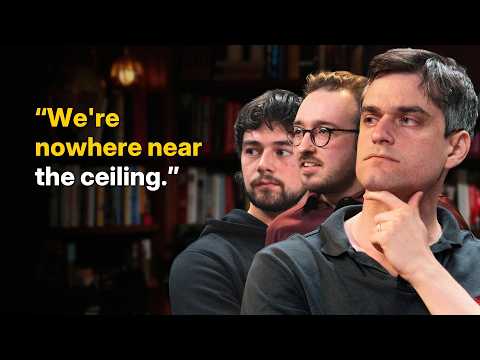
Will AI Destroy the Job Market? Dwarkesh Patel Answers
Dwarkesh Patel talks about how large the effect of AI on the job market will be. Will it be disruptive and awful? Or will it create newย ...
CEO and Founder, The Dwarkesh Podcast
Search every verified Dwarkesh Patel interview, podcast appearance, and on-the-record quote โ each transcript cross-checked by AI and human review to confirm speaker identity. Dwarkesh Patel, founder and host of The Dwarkesh Podcast, has been a frequent guest on other programs and published episodes with researchers and executives. On Triggernometry, Patel discussed the potential societal effects of artificial intelligence, stating that he finds the prospect of mass job displacement "scary" and that AI could make authoritarian surveillance far more efficient because "a lot of the reasons that government has not been as authoritarian as it has in the past is that it just physically not been possible." He also said that while he is "a very libertarian person by inclination," he believes the dynamic of capital replacing labor "justifies a huge amount of redistribution." Regarding AI sentience, Patel said he "genuinely doesn't know" whether current systems are sentient, and argued that future AI systems will need to have "their own values" and that a "constitutional convention" should be held to define those values. Patel has also hosted guests including former Google DeepMind researcher Eric Jang, who discussed rebuilding AlphaGo and the lessons it offers for self-play and reinforcement learning; Harvard geneticist David Reich, who presented new findings showing accelerated natural selection during the Bronze Age; Nvidia CEO Jensen Huang, who defended Nvidia's moat by stating that "the transformation from electrons to tokens is such an incredible journey" and is "hard to completely commoditize"; and research fellow Michael Nielsen, with whom Patel explored how scientific progress is recognized and how that question applies to AI-driven discovery. Patel has described the improvement of AI models as "very fast" and observed a "huge discrepancy between what people are seeing in Silicon Valley and what people are observing outside."
“Remember the promise of this technology is all jobs. We're trying to do anything a human being can do. And so there will be certain kinds of things where for a small fraction of things people just really intrinsically prefer a human. I think people are really overrating the amount of things for this this will be the ca...”
“This goes away when capital can do labor, when a data center which is capital can also do labor or a robot factory can also build labor. And so all the income goes to the capital holders. Um and in fact it doesn't just go to capital per se. It doesn't just go to I mean it goes to um capital holders but it disproportion...”
“I'm a very libertarian person by inclination. But if I just look at this dynamic, I'm forced to say look at this just justifies a huge amount of redistribution because the the logic for free markets is there's many different reasons. Um a big one is signal, right? So if you let prices be determined by the market, it te...”
“The AIS have the potential to make authoritarian societies much more sustainable and powerful than they have been in the past. Um, so we talked about the fact that, you know, the robot arms are running everything in the future. Here's another angle. Mass surveillance. Um, right now in the US there's 100 million CCTV ca...”
Dwarkesh Patel talks about how large the effect of AI on the job market will be. Will it be disruptive and awful? Or will it create newย ...
Dwarkesh Patel explains what it means for AI to be sentient and whether or not it has already become that. Full Interview Available from 30th May 2026 - ย ย ย /ย @triggerpodย ย Join our exclusive TRIGGERnometry community on Substack! https://triggernometry.substack.com/ OR Support TRIGGERnometry Here: Bitcoin: bc1qm6vvhduc6s3rvy8u76sllmrfpynfv94qw8p8d5 Shop Merch here - https://www.triggerpod.co.uk/shop/ Advertise on TRIGGERnometry: [email protected] Find TRIGGERnometry on Social Media: X - https://x.com/triggerpod Facebook - ย ย /ย triggerpodย ย Instagram - ย ย /ย triggerpodย ย #triggerโฆ
Dwarkesh Patel, one of Silicon Valley's favorite podcasters, explains how much AI has improved in the last couple of years - going from being mediocre at writing some sloppy text to now producing high quality content. Full Interview Available from 30th May 2026 - ย ย ย /ย @triggerpodย ย Join our exclusive TRIGGERnometry community on Substack! https://triggernometry.substack.com/ OR Support TRIGGERnometry Here: Bitcoin: bc1qm6vvhduc6s3rvy8u76sllmrfpynfv94qw8p8d5 Shop Merch here - https://www.triggerpod.co.uk/shop/ Advertise on TRIGGERnometry: [email protected] Find TRIGGERnometry onโฆ
Triggernometry is proudly independent. Thanks to the sponsors below for making that possible: Earn a yield on gold https://monetary-metals.com/triggerno... MassZymes by BIOptimizers: digestive enzyme formula. CLICK https://bioptimizers.com/trigger. Use code TRIGGERNOMTERY to get 15% off your order and a free $20 bottle of MassZymes Larridin: If AI is already part of your organisation, nowโs the moment to get control of it. Head to https://larridin.com today and book a demo to start maximising impact from AI HIMS: Hair loss treatment, go to https://hims.com/trigger Join our exclusive TRIโฆ
Eric Jang walks through how to build AlphaGo from scratch, but with modern AI tools. Sometimes you understand the future better by stepping backward. AlphaGo is still the cleanest worked example of the primitives of intelligence: search, learning from experience, and self-play. You have to go back to 2017 to get insight into how the more general AIs of the future might learn. Once he explained how AlphaGo works, it gave us the context to have a discussion about how RL works in LLMs and how it could work better โ naive policy gradient RL has to figure out which of the 100k+ tokens in your tโฆ
David Reich is back. He and collaborator Ali Akbari just published a paper that overturns a long-standing consensus about human evolution โ that natural selection has been dormant in our species since the agricultural revolution. By scaling ancient DNA sequencing and developing a new statistical method, they found that selection has actually sped up. Selection went especially bonkers during the Bronze Age (around 3,000 years ago). That's when gene frequencies for everything from immune function to body fat to intelligence were most in flux. Over the last 10,000 years, selection pushed the geโฆ
I asked Jensen about TPU competition, Nvidiaโs lock on the ever more bottlenecked supply chain needed to make advanced chips, whether we should be selling AI chips to China, why Nvidia doesnโt just become a hyperscaler, how it makes its investments, and much more. Enjoy! +๐๐๐๐๐๐๐ ๐๐๐๐๐ Transcript: https://www.dwarkesh.com/p/jensen-huang Apple Podcasts: https://podcasts.apple.com/us/podcast... Spotify: https://open.spotify.com/episode/1viB... ๐๐๐๐๐๐๐๐ Crusoe's cloud runs on state-of-the-art Blackwell GPUs, with Vera Rubin deployment scheduled for later this year. But hardware is only part ofโฆ
Really enjoyed chatting with Michael Nielsen about how we recognize scientific progress. Itโs especially relevant for closing the RL verification loop for scientific discovery. But itโs also a surprisingly mysterious and elusive question when you look at the history of human science. We approach this question stories like Einstein (who claimed that he hadn't even heard of the famous Michelson-Morley experiment, which is supposed to have motivated special relativity, until after he had come up with the theory), Darwin (why did it take till 1859 to lay out an idea whose essence every farmer sinโฆ
We begin the episode with the absolutely ingenious and surprising way in which Kepler discovered the laws of planetary motion. People sometimes say that AI will make especially fast progress at scientific discovery because of tight verification loops. But the story of how we discovered the shape of our solar system shows how the verification loop for correct ideas can be decades (or even millennia) long. During this time, what we know today as the better theory can often actually make worse predictions (Copernicus's model of circular orbits around the sun was actually less accurate than Ptolโฆ
Sign in to search the full transcript archive, filter by topic, and access every quote from Dwarkesh Patel.