
Ep113: Lewis Cantley & Siddhartha Mukherjee on Fighting Cancer with Food and Drugs
Lewis Cantley and Siddhartha Mukherjee, co-founders of Faeth Therapeutics, on fighting cancer with food and drug combinations.
Scientific Co-Founder, Faeth Therapeutics
Search every verified Lewis Cantley interview, podcast appearance, and on-the-record quote — each transcript cross-checked by AI and human review to confirm speaker identity. Lewis Cantley, scientific co-founder of Faeth Therapeutics, discussed the company's approach to combining dietary interventions with cancer treatments in a May 2022 podcast appearance. He described plans to deliver specially designed meals to patients in clinical trials, noting that providing meals directly helps ensure patients adhere to the diet. Cantley stated that the diets are intended to lower insulin levels, which he said can drive tumor growth, and that the approach is being tested alongside PI3 kinase inhibitors, chemotherapy, or diabetes medications. Cantley also discussed preclinical studies in mouse models of breast cancer, saying that a ketogenic, insulin-lowering diet combined with a drug could shrink tumors rather than only slow their growth. He acknowledged risks associated with the exploratory work but said the underlying science is based on known mechanisms, specifically keeping insulin levels down. He expressed hope that clinical data would be available within a few years to assess the intervention's broader potential.

Lewis Cantley and Siddhartha Mukherjee, co-founders of Faeth Therapeutics, on fighting cancer with food and drug combinations.

Lewis C. Cantley, PhD, is a Professor of Cell Biology at Harvard Medical School. Prior to this appointment, he was the Margaret and Herman Sokol Professor and Meyer Director of the Sandra and Edward Meyer Cancer Center at Weill Cornell Medical College/Ronald P. Stanton Clinical Cancer Program at New York Presbyterian Hospital (2012-22). Dr. Cantley is a graduate of West Virginia Wesleyan College, obtained a PhD in biophysical chemistry from Cornell University, completed postdoctoral training at Harvard University, and subsequently taught and conducted research in biochemistry, physiology and c…

Dr. Lewis Cantley has made significant advances in cancer research stemming from his discovery of the signalling pathway phosphoinositide 3-kinase (Pi3K) in 1984. It is an enzyme that mediates pretty much everything that insulin does, in the liver, in the fat cells, and it mediates the lowering of serum glucose levels because it drives glucose into the muscle, AND into tumours. Since tumours thrive on glucose, they thought to develop a Pi3 Kinase inhibitor in order to try to treat tumours but the inhibitor resulted in startling rises in blood glucose levels. In order to manage this they t…

Lewis Cantley gives his talk "PI 3-Kinase and Cancer Metabolism" as part of the JCB-JEM symposium on Tackling Cancer Plasticity and Heterogeneity at The Rockefeller University in New York, October 9th, 2018. https://rupress.org/pages/jcb-jem-sym... The Cantley lab at Weill Cornell Medicine College studies the regulation of metabolism in cancer. Methotrexate is a chemotherapy agent used to treat many diseases, including cancer. In this talk, Cantley describes how the cellular folate pool was radioactively labelled and analyzed by HPLC in order to quantify folate metabolites in triple-negativ…
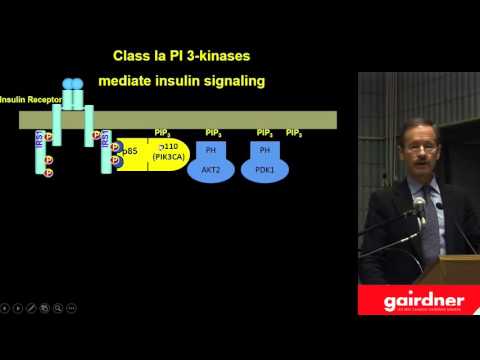
Dr. Cantley of Weill Cornell Medical College speaks at the 2015 Canada Gairdner Awardees Lecture about his work and discovery of PI3K.

George and Lily Boxer Memorial Lecture - April 15, 2015.

Lewis Cantley presents his Plenary Lecture: PI 3-Kinase: Connecting Diabetes, Obesity and Cancer.

At Beth Israel Deaconess Medical Center two world-renowned researchers are working on a completely novel approach to put an end to cancer. The job is far from over, but Lewis Cantley, Ph.D, and Pier Paolo Pandolfi, M.D., each recipients of the prestigious Pezcoller Foundation-AACR International Award for Cancer Research, are focused on identifying new cancer treatment strategies using genetically engineered mouse models to predict drug success in human patients.

Lewis Cantley, PhD's Lecture at STO Meeting 2010 Phosphoinositide 3-Kinase (PI3K) is a central enzyme in a signaling pathway that mediates cellular responses to growth factors and turning off PI 3-kinase with PI3K inhibitors that are in human clinical trials results in an acute decline in FDG-PET signal
Sign in to search the full transcript archive, filter by topic, and access every quote from Lewis Cantley.
The summary and quote tags on this profile are produced with AI assistance from verified, first-person interview transcripts, then checked by our team to confirm the speaker's identity and the accuracy of every quote. See how we verify →
Pro unlocks every transcript in full, plus unlimited search across every executive and company we cover.
50% off appliedPulling data at scale? The Data API gives you 30,000 transcripts a month over REST, MCP and JSON.
Compare all plans