CEOInterviews.AI
Start App
Try: AI strategy tariffs earnings guidance layoffs interest rates growth

Carolyn Bertozzi

Anne T. and Robert M. Bass Professor of Chemistry, Stanford University

Search every verified Carolyn Bertozzi interview, podcast appearance, and on-the-record quote — each transcript cross-checked by AI and human review to confirm speaker identity. Carolyn Bertozzi, the Anne T. and Robert M. Bass Professor of Chemistry at Stanford University and director of Sarafan ChEM-H, has continued to present on the development and clinical translation of bioorthogonal chemistry and its applications in cancer therapy. In 2025 and 2026 appearances, she discussed how her lab's work on bioorthogonal chemistry has enabled the creation of antibody-drug conjugates (ADCs) with site-specific drug attachment, noting that traditional ADC manufacturing can produce heterogeneous mixtures, which she said limits optimization. She also described her research on the cancer glycocalyx, including a therapeutic strategy that uses an antibody-enzyme conjugate to strip sialic acids from cancer cells, a "lawnmower" approach she said is being evaluated in clinical trials through the company Palleon Pharmaceuticals. At a 2026 Stanford lung cancer summit, she outlined how bioorthogonal chemistry is being used to develop new classes of cancer drugs, including ADCs being evaluated for lung cancer. Bertozzi has also spoken about her career and the broader scientific enterprise. In a 2024 interview, she reflected on how winning the Nobel Prize in Chemistry in 2022 changed her professional life, noting that her words now carry more weight and that she has had to manage a surge in invitations. She has emphasized the importance of diversity in science, stating that diverse groups are better equipped to solve complex problems and think creatively. In a 2023 interview, she said her lab places a high premium on diversity, equity, inclusion, and respect, and that this culture allows her group to pursue risky, out-of-the-box problems. She has also discussed the importance of basic science, saying in her Nobel lecture that bioorthogonal chemistry demonstrates how curiosity-driven research can lead to practical applications, and in a 2022 video that "without basic science, there is nothing to translate."

Recent appearances

  • Sugar on the brain | Carolyn Bertozzi

    Today on the show, we bring you a conversation with Carolyn Bertozzi, the Baker Family Director of Sarafan ChEM-H and the Anne T. and Robert M. Bass Professor in the School of Humanities and Sciences. Bertozzi is a Nobel Laureate, a MacArthur Fellow, and an all around cool person – although it didn't come up in the conversation, she used to play in a band with Rage Against the Machine's Tom Morello. Although Bertozzi wouldn’t call herself a neuroscientist — she’s a chemist at heart – her work is having a big impact on neuroscience. Today, she focuses on the sugar molecules that stud the oute…

    Read the verified transcript → Watch on YouTube ↗

  • 2025 Koch Institute Annual Symposium: Carolyn Bertozzi

    At the 2025 Koch Institute Annual Symposium on Antibody Drug Conjugates, Carolyn Bertozzi (Baker Family Director of Sarafan ChEM-H, Anne T. and Robert M. Bass Professor in the School of Humanities and Sciences, Stanford University) presented on "Bioorthogonal chemistry, from basic science to clinical translation." Save the date for the 2026 symposium on diet and metabolism in cancer on Thursday, June 18. Learn more about events and research at the MIT Koch Institute: Subscribe to event invitations and newsletters: https://ki.mit.edu/news/newsletter/su... LinkedIn:   / mit-koch-institute…

    Read the verified transcript → Watch on YouTube ↗

  • Bioorthogonal Chemistry, from Conception to Clinical Translation – Carolyn R. Bertozzi

    2026 Stanford International Lung Cancer Summit: Understanding Lung Cancer in People Who Have Never Smoked (Day 2) Day 2, Session 1 Presentation: Bioorthogonal Chemistry, from Conception to Clinical Translation Speaker: Carolyn R. Bertozzi, PhD Baker Family Director, Sarafan ChEM-H Anne T. and Robert M. Bass Professor of Chemistry and Professor (by courtesy) of Chemical & Systems Biology Department of Chemistry and Howard Hughes Medical Institute, Stanford University

    Read the verified transcript → Watch on YouTube ↗

  • Walk With Me: Carolyn Bertozzi, chemical biologist studying how sugars on cells shape disease

    Meet Carolyn Bertozzi, PhD, a chemist at Stanford Medicine and Nobel Prize–winning scientist whose work explores how chemical biology can help scientists better understand disease and develop new approaches to treating cancer and immune disorders. Hear about the moment she first fell in love with science — whether she’s an early bird or a night owl — and the superpower she wishes she had. Bertozzi is the Baker Family Director of Sarafan ChEM-H, the Anne T. and Robert M. Bass Professor in the School of Humanities and Sciences, and Professor of Chemistry. LEARN MORE: Newly minted Nobel laureate…

    Watch on YouTube ↗

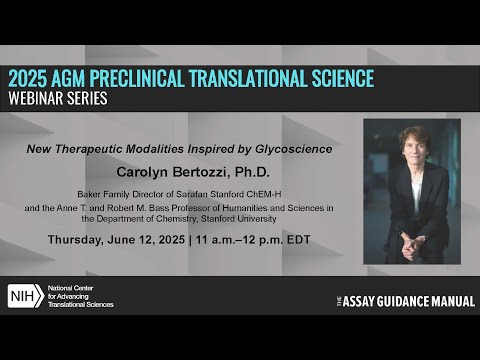
  • Carolyn Bertozzi: New Therapeutic Modalities Inspired by Glycoscience

    In this Assay Guidance Manual Webinar from June 12, 2025, Nobel Laureate Dr. Carolyn Bertozzi discusses why the glycocalyx changes in different disease states and a new therapeutic strategy that involves targeted degradation of mucins. Dr. Bertozzi is the Baker Family Director of Sarafan Stanford ChEM-H and the Anne T. and Robert M. Bass Professor of Humanities and Sciences in the Department of Chemistry at Stanford University. She is also an Investigator of the Howard Hughes Medical Institute. Her research focuses on profiling changes in cell surface glycosylation associated with cancer, infl…

    Read the verified transcript → Watch on YouTube ↗

  • Ep42: Carolyn Bertozzi

    Carolyn Bertozzi on becoming a chemical biologist/glycobiologist.

    Read the verified transcript → Watch on YouTube ↗

  • 2016 Biology-Chemistry Colloquium: Carolyn Berotzzi, Stanford University

    Successful tumors are able to evade the immune system, which is otherwise capable of killing transformed cells. Therapies that prevent this evasion have become revolutionary treatments for incurable cancers. This presentation will focus on our recent work targeting immune suppressive Siglec receptors and their sialylated glycan ligands, which are abundant within the cancer glycocalyx. We found that Siglec-ligand interactions can confer resistance to antibody-dependent cell cytotoxicity mediated by monoclonal antibody cancer drugs such as Herceptin. Based on this, we designed biotherapeutic mo…

    Read the verified transcript → Watch on YouTube ↗

  • Nobel Laureate Carolyn Bertozzi on Breaking Barriers and Making Discoveries in Scientific Research

    Dean Lloyd Minor welcomes Carolyn Bertozzi, PhD, 2022 Nobel laureate in chemistry, professor of chemistry and director of Sarafan ChEM-H at Stanford University, for a conversation about her journey breaking barriers in scientific research. They discuss how her early passion for organic chemistry laid the foundation for her prize-winning work, and how the new field that she founded, bioorthogonal chemistry, has led to the development of better diagnostic testing and targeting for medical treatments. They also explore obstacles historically faced by women and LGBTQ scientists, the importance of…

    Watch on YouTube ↗

  • Sweet Revenge on Cancer with Carolyn Bertozzi

    Carolyn Bertozzi, Baker Family Director of Stanford ChEM-H, Anne T. and Robert M. Bass Professor in the School of Humanities and Sciences, and professor, by courtesy, of chemical and systems biology and of radiology This talk was recorded at Stanford Reunion Homecoming 2023, an event presented by the Stanford Alumni Association.

    Watch on YouTube ↗

  • Bioorthogonal Chemistry, From Basic Science to Clinical Translation — Carolyn Bertozzi

    At the Hertz Foundation's 2023 Summer Workshop, Nobel Laureate Carolyn Bertozzi, professor at Stanford University and investigator of the Howard Hughes Medical Institute, presented "Bioorthogonal Chemistry, From Basic Science to Clinical Translation." For more information about the Hertz Foundation, visit https://hertzfoundation.org.

    Watch on YouTube ↗

  • Mesmerizing the Immune System: How Sugars on Cells Help Drive Cancer - Carolyn Bertozzi, PhD

    Nobel Laureate Carolyn Bertozzi, PhD, is widely lauded as the inventor of a new type of chemistry—one that allows researchers to study chemical reactions within live cells, rather than in test tubes, without disrupting the cell’s normal chemistry. Dr. Bertozzi uses this environment to study sugars on the surface of cells—sugars that not only whisper the presence of cancer, but actually control its development by mesmerizing the immune system into ignoring tumors. Learn how this landscape-altering discovery is fueling the development of new diagnostic and therapeutic approaches to help stop can…

    Watch on YouTube ↗

  • Carolyn Bertozzi, Nobel Prize in Chemistry 2022: Official interview

    Interview with 2022 Nobel Prize laureate in chemistry Carolyn Bertozzi, recorded in Stockholm on 6 December 2022. 0:00 - Official interview with Carolyn Bertozzi 0:07 - Where does your passion for science come from? 2:05 - Was there a particular person who influenced you? 3:02 - What do you enjoy about science? 4:26 - How do you cope with failure? 7:26 - As a woman in science and a member of the LGBTQ+ community, what barriers have you faced? 9:57 - Why is diversity of all kinds important in science? 11:58 - How can you create an open and accepting work environment? 13:49 - How can we encoura…

    Watch on YouTube ↗

Notable quotes

“Right now there are more than 150 biologic drugs approved to treat like immune diseases like autoimmune diseases. There's a similar number approved to treat cancer. There's only 15 biologic drugs that have been approved for central nervous system disorders, you know, and most of them are administered by intrathecal injection. So that's lumbar puncture, right? Which is horrible and invasive and takes all day in a clin”

“So if you put all that together, it kind of begs the question, the answer to which I think is sort of hiding in plain sight, which is: do siglecs function as checkpoint receptors in the context of tumor immune evasion, or is the reason so many cancers are hyper-sialylated due to the fact that that could be a survival adaptation that protects them from immune surveillance, just like having PD-L1 would protect against ”

Other executives at Stanford University

The summary and quote tags on this profile are produced with AI assistance from verified, first-person interview transcripts, then checked by our team to confirm the speaker's identity and the accuracy of every quote. See how we verify →